p.172
p.177
p.182
p.187
p.192
p.197
p.201
p.206
p.211
Experimental Research on Orthogonal Cutting and Oblique Cutting of Hardened Steel GCr15

Abstract:
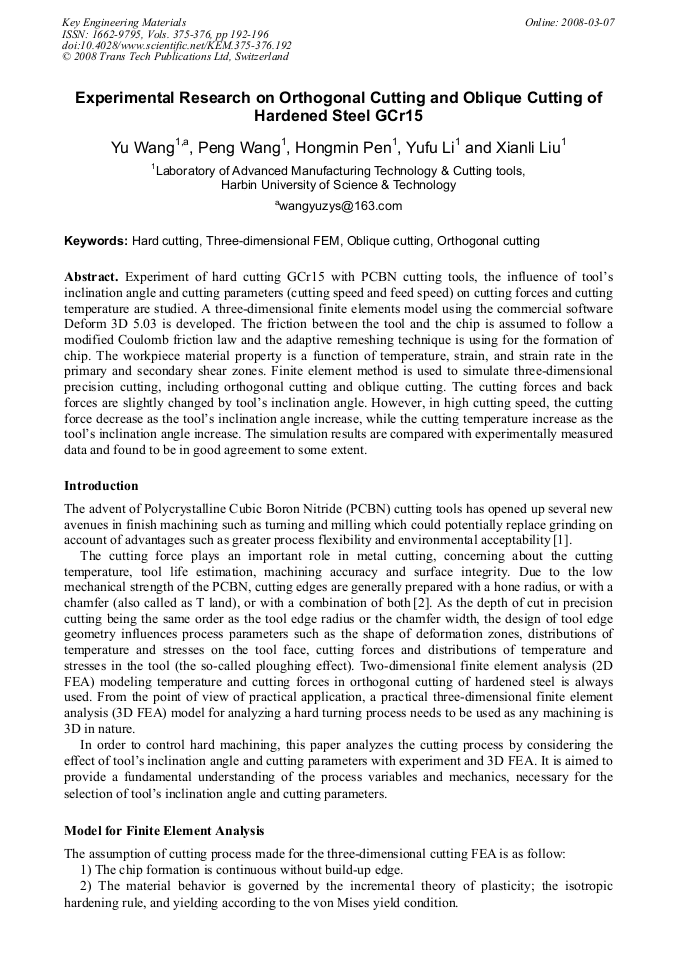
Experiment of hard cutting GCr15 with PCBN cutting tools, the influence of tool’s inclination angle and cutting parameters (cutting speed and feed speed) on cutting forces and cutting temperature are studied. A three-dimensional finite elements model using the commercial software Deform 3D 5.03 is developed. The friction between the tool and the chip is assumed to follow a modified Coulomb friction law and the adaptive remeshing technique is using for the formation of chip. The workpiece material property is a function of temperature, strain, and strain rate in the primary and secondary shear zones. Finite element method is used to simulate three-dimensional precision cutting, including orthogonal cutting and oblique cutting. The cutting forces and back forces are slightly changed by tool’s inclination angle. However, in high cutting speed, the cutting force decrease as the tool’s inclination angle increase, while the cutting temperature increase as the tool’s inclination angle increase. The simulation results are compared with experimentally measured data and found to be in good agreement to some extent.
Info:
Periodical:
Pages:
192-196
Citation:
Online since:
March 2008
Authors:
Price:
Сopyright:
© 2008 Trans Tech Publications Ltd. All Rights Reserved
Share:
Citation: