Comparison of Shot Peening and Nitriding Surface Treatments under Complex Fretting Loadings

Article Preview

Abstract:

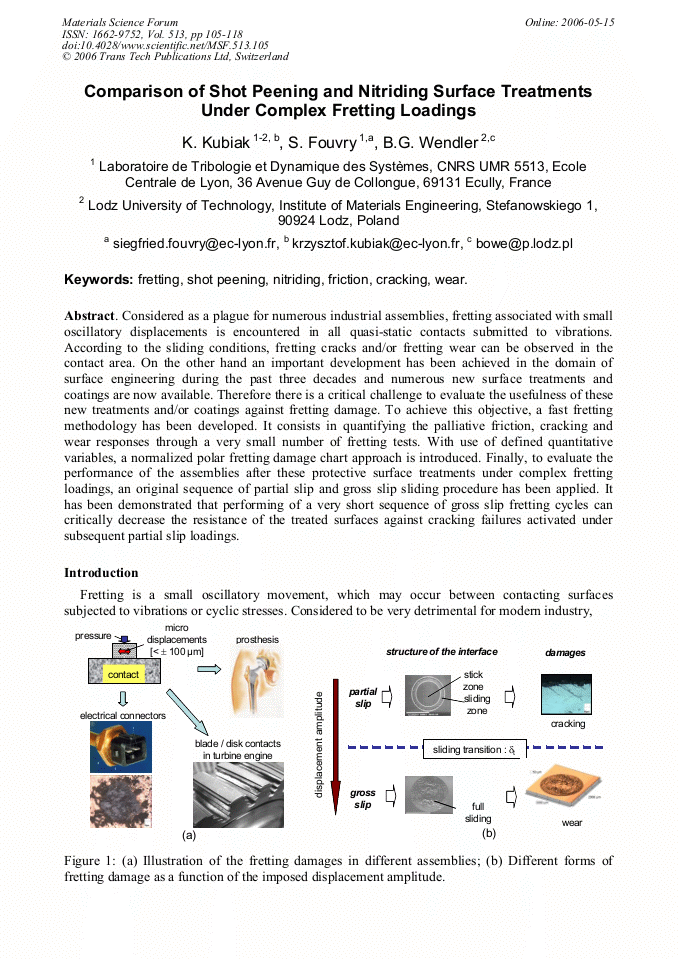
Considered as a plague for numerous industrial assemblies, fretting associated with small oscillatory displacements is encountered in all quasi-static contacts submitted to vibrations. According to the sliding conditions, fretting cracks and/or fretting wear can be observed in the contact area. On the other hand an important development has been achieved in the domain of surface engineering during the past three decades and numerous new surface treatments and coatings are now available. Therefore there is a critical challenge to evaluate the usefulness of these new treatments and/or coatings against fretting damage. To achieve this objective, a fast fretting methodology has been developed. It consists in quantifying the palliative friction, cracking and wear responses through a very small number of fretting tests. With use of defined quantitative variables, a normalized polar fretting damage chart approach is introduced. Finally, to evaluate the performance of the assemblies after these protective surface treatments under complex fretting loadings, an original sequence of partial slip and gross slip sliding procedure has been applied. It has been demonstrated that performing of a very short sequence of gross slip fretting cycles can critically decrease the resistance of the treated surfaces against cracking failures activated under subsequent partial slip loadings.
You might also be interested in these eBooks

Info:

Periodical:

Pages:

105-118

Citation:

Online since:

May 2006

Export:

Price:

Permissions CCC:

Permissions PLS:

Сopyright:

© 2006 Trans Tech Publications Ltd. All Rights Reserved

Share:

Citation:

[1] D. Hoeppner: Mechanisms of fretting fatigue and their impact on test methods development, ASTM STP No. 1159 (1992) p.23.

Google Scholar

[2] R.B. Waterhouse: Fretting Fatigue (R.B. Waterhouse, Ed. ), Applied Science, London, (1981).

Google Scholar

[3] O. Vingsbo, S. Soderberg: Wear Vol. 126 (1988) p.131.

Google Scholar

[4] L. Vincent: Fretting Fatigue, ESIS Vol. 18 (1994) p.323.

Google Scholar

[5] A.J. Araujo, D. Nowell: Journal of Fatigue Vol. 24 (2002) p.763.

Google Scholar

[6] C. Vallellano, J. Dominguez, A. Navarro: Fatigue Fract. Eng., M26 (5) (2003) p.469.

Google Scholar

[7] S. Fouvry, K. Elleuch, G. Simeon: Journal of Strain Analysis (ImechE) Vol. 37, No. 6 (2002) p.549.

Google Scholar

[8] H. Mohrbacher, B. Blanpain, J.P. Celis, R.J. R. oos: Wear Vol. 180 (1995) p.43.

Google Scholar

[9] S. Fouvry, Ph. Kapsa, L. Vincent: Wear Vol. 200 (1996) p.186.

Google Scholar

[10] S. Fouvry, P. Duo, Ph. Perruchaut: Wear, 2004, in press.

Google Scholar

[11] J.M. Voisin, A.B. Vannes, L. Vincent, J. Daviot, B. Giraud: Wear Vol. 181-183 (1995) p.826.

DOI: 10.1016/0043-1648(95)90202-3

Google Scholar

[12] H. Proudhon, S. Fouvry, J.Y. Buffière: International Journal of Fatigue, in press.

Google Scholar

[13] V. Fridrici, S. Fouvry, Ph. Kapsa, Ph. Perruchaut: Wear Vol. 255 (2003) p.875.

DOI: 10.1016/s0043-1648(03)00157-1

Google Scholar

[14] Z.R. Zhou, L. Vincent: Wear Vol. 225-229 (1999) p.962.

Google Scholar

[15] J. Archard: Appl. Phys. Vol. 24 (1953) p.981.

Google Scholar

[16] S. Fouvry, T. Liskiewicz, Ph. Kapsa, S. Hannel, S. Sauger: Wear Vol. 255 (2003) p.287.

DOI: 10.1016/s0043-1648(03)00117-0

Google Scholar

[17] E. Sauger, S. Fouvry, L. Ponsonnet, J.M. Martin, Ph. Kapsa, L. Vincent: Wear Vol. 245 (2000) p.39.

DOI: 10.1016/s0043-1648(00)00464-6

Google Scholar

[18] T. Liskiewicz, S. Fouvry: Tribology International Vol. 38 (2005) p.69.

Google Scholar

[19] J.F. Carton, A.B. Vannes, L. Vincent: Wear Vol. 185 (1995) p.47.

Google Scholar