p.153
p.161
p.169
p.177
p.183
p.191
p.197
p.203
p.209
Modeling the Role of Microstructure on Shear Instability with Reference to the Formability of Automotive Aluminium Alloys

Abstract:
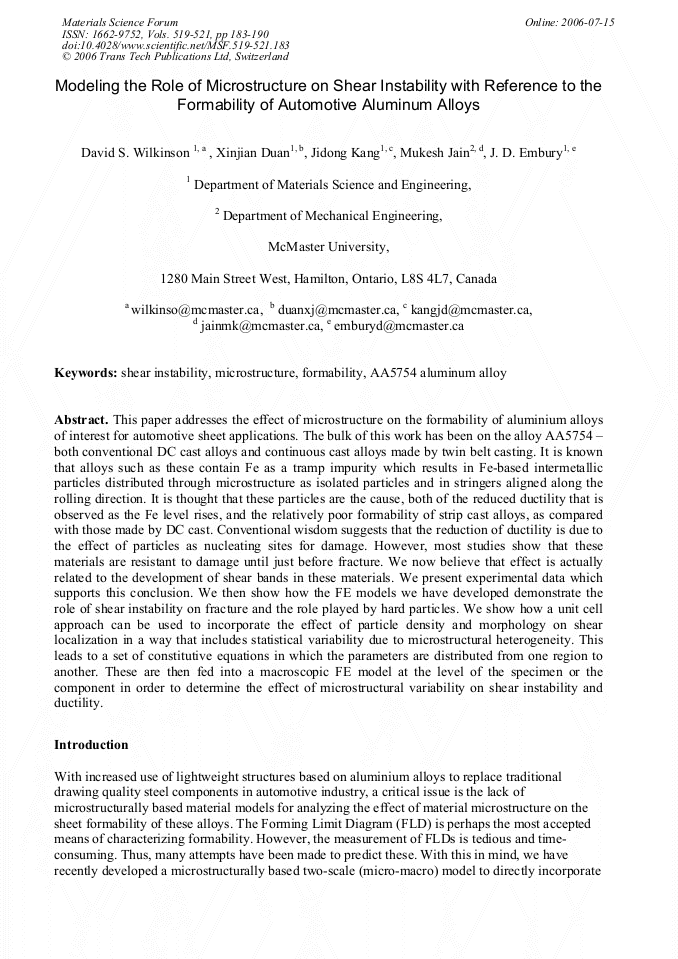
This paper addresses the effect of microstructure on the formability of aluminium alloys of interest for automotive sheet applications. The bulk of this work has been on the alloy AA5754 – both conventional DC cast alloys and continuous cast alloys made by twin belt casting. It is known that alloys such as these contain Fe as a tramp impurity which results in Fe-based intermetallic particles distributed through microstructure as isolated particles and in stringers aligned along the rolling direction. It is thought that these particles are the cause, both of the reduced ductility that is observed as the Fe level rises, and the relatively poor formability of strip cast alloys, as compared with those made by DC cast. Conventional wisdom suggests that the reduction of ductility is due to the effect of particles as nucleating sites for damage. However, most studies show that these materials are resistant to damage until just before fracture. We now believe that effect is actually related to the development of shear bands in these materials. We present experimental data which supports this conclusion. We then show how the FE models we have developed demonstrate the role of shear instability on fracture and the role played by hard particles. We show how a unit cell approach can be used to incorporate the effect of particle density and morphology on shear localization in a way that includes statistical variability due to microstructural heterogeneity. This leads to a set of constitutive equations in which the parameters are distributed from one region to another. These are then fed into a macroscopic FE model at the level of the specimen or the component in order to determine the effect of microstructural variability on shear instability and ductility.
Info:
Periodical:
Pages:
183-190
Citation:
Online since:
July 2006
Keywords:
Price:
Сopyright:
© 2006 Trans Tech Publications Ltd. All Rights Reserved
Share:
Citation: