p.76
p.79
p.83
p.87
p.91
p.95
p.98
p.101
p.105
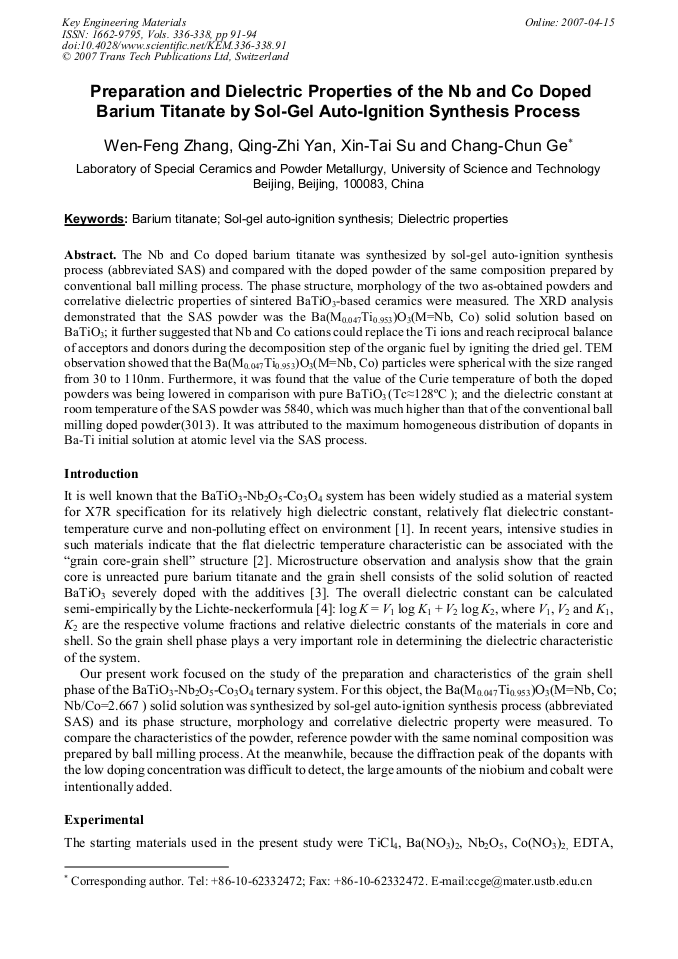
Preparation and Dielectric Properties of the Nb and Co Doped Barium Titanate by Sol-Gel Auto-Ignition Synthesis Process

Abstract:
The Nb and Co doped barium titanate was synthesized by sol-gel auto-ignition synthesis process (abbreviated SAS) and compared with the doped powder of the same composition prepared by conventional ball milling process. The phase structure, morphology of the two as-obtained powders and correlative dielectric properties of sintered BaTiO3-based ceramics were measured. The XRD analysis demonstrated that the SAS powder was the Ba(M0.047Ti0.953)O3(M=Nb, Co) solid solution based on BaTiO3; it further suggested that Nb and Co cations could replace the Ti ions and reach reciprocal balance of acceptors and donors during the decomposition step of the organic fuel by igniting the dried gel. TEM observation showed that the Ba(M0.047Ti0.953)O3(M=Nb, Co) particles were spherical with the size ranged from 30 to 110nm. Furthermore, it was found that the value of the Curie temperature of both the doped powders was being lowered in comparison with pure BaTiO3 (Tc≈128°C ); and the dielectric constant at room temperature of the SAS powder was 5840, which was much higher than that of the conventional ball milling doped powder(3013). It was attributed to the maximum homogeneous distribution of dopants in Ba-Ti initial solution at atomic level via the SAS process.
Info:
Periodical:
Pages:
91-94
Citation:
Online since:
April 2007
Authors:
Price:
Сopyright:
© 2007 Trans Tech Publications Ltd. All Rights Reserved
Share:
Citation: