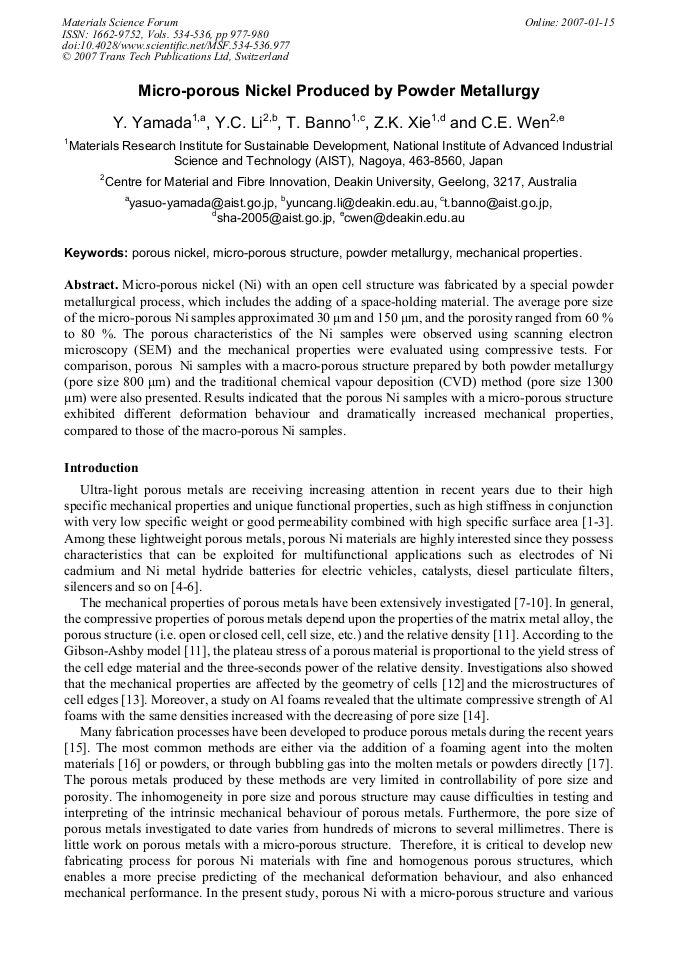
Micro-Porous Nickel Produced by Powder Metallurgy

Article Preview

Abstract:

Micro-porous nickel (Ni) with an open cell structure was fabricated by a special powder metallurgical process, which includes the adding of a space-holding material. The average pore size of the micro-porous Ni samples approximated 30 μm and 150 μm, and the porosity ranged from 60 % to 80 %. The porous characteristics of the Ni samples were observed using scanning electron microscopy (SEM) and the mechanical properties were evaluated using compressive tests. For comparison, porous Ni samples with a macro-porous structure prepared by both powder metallurgy (pore size 800 μm) and the traditional chemical vapour deposition (CVD) method (pore size 1300 μm) were also presented. Results indicated that the porous Ni samples with a micro-porous structure exhibited different deformation behaviour and dramatically increased mechanical properties, compared to those of the macro-porous Ni samples.
You might also be interested in these eBooks

Info:

Periodical:

Materials Science Forum (Volumes 534-536)

Pages:

977-980

Citation:

Online since:

January 2007

Export:

Price:

Permissions CCC:

Permissions PLS:

Сopyright:

© 2007 Trans Tech Publications Ltd. All Rights Reserved

Share:

Citation:

[1] J. Banhart and J. Baumeister: J. of Mater. Sci., Vol. 33, (1998), p.1431.

Google Scholar

[2] S.K. Maiti, L.J. Gibson, M.F. Ashby: Acta Mater. Vol. 32, (1984), p. (1963).

Google Scholar

[3] A.E. Simone, L.J. Gibson: Acta Mater. Vol. 46, (1998), p.2139.

Google Scholar

[4] J.L. Grenestedt, K. Tanaka: Scripta Mater. Vol. 40, (1999), p.71.

Google Scholar

[5] A.E. Simone, L.J. Gibson: Acta Mater. Vol. 46 (1998), p.3929.

Google Scholar

[6] Y. Yamada. K. Shimojima, Y. Sakaguchi, M. Mabuchi, M. Nakamura, T. Asahina, T. Mukai, H. Kanahashi, K. Higashi: Mater. Sci. Eng. Vol. A280, (2000), p.225.

DOI: 10.1002/(sici)1527-2648(200004)2:4<184::aid-adem184>3.0.co;2-w

Google Scholar

[7] Y. Yamada, K. Shimojima, Y. Sakaguchi, M. Mabuchi, M. Nakamura, T. Asahina, T. Mukai, H. Kanahashi, K. Higashi: Mater. Sci. Eng., A272, (1999), p.455.

DOI: 10.1023/a:1006677930532

Google Scholar

[8] T.G. Nieh, J. H. Kinney, J. Wadsworth, A.J.C. Ladd: Scripta Mater. Vol. 38, (1998), p.1487.

Google Scholar

[9] J.L. Grenestedt, K. Tanaka: Scripta Mater. Vol. 40, (1999), p.71.

Google Scholar

[10] C.E. Wen, M. Mabuchi, Y. Yamada, K. Shimojima, Y. Chino, T. Asahina: Scripta Mater. Vol. 45, (2001), p.1147.

DOI: 10.1016/s1359-6462(01)01132-0

Google Scholar

[11] L.J. Gibson, M.F. Ashby: Cellular Solids, Structure and Properties Cambridge University Press, (1997).

Google Scholar

[12] H. Bart-smith, A.F. Bastawros, D.R. Mumm, A.G. Evans, D.J. Sypeck, H.N.G. Wadley: Acta Mater. Vol. 46, (1998), p.3583.

DOI: 10.1016/s1359-6454(98)00025-1

Google Scholar

[13] P.H. Thornton, C.L. Magee: Metall. Trans. Vol. 6A, (1975), p.1253.

Google Scholar

[14] F. Simancik, J. Kovacik, N. Sediakova: Proc. of the 1998 Powder Metall. World Cong. & Exhibit. (European Powder Metall. Association, UK, 5, 1998).

Google Scholar

[15] J. Banhart: Prog. Mater. Sci. Vol. 46, (2001), p.559.

Google Scholar

[16] T. Miyoshi, M. Itoh, T. Mukai, H. Kanahashi, H. Kohzu, S. Tanabe, K. Higashi: Scripta Mater. Vol. 41 (1999), p.1055.

DOI: 10.1016/s1359-6462(99)00255-9

Google Scholar

[17] N.G. Davis, J. Teisen, C. Schuh, D.C. Dunand: J. Mater. Res. Vol. 16, (2001), p.1508.

Google Scholar

[18] V. Paserin, S. Marcuson, J. Shu, D.S. Willinson: Advanced Engineering Materials, Vol. 6, (2004).

Google Scholar