p.1
p.5
p.9
p.13
p.17
p.21
p.25
p.29
p.33
Application of a Complete Tooling Force Analysis for Simulation of Liquid Composite Moulding Processes

Abstract:
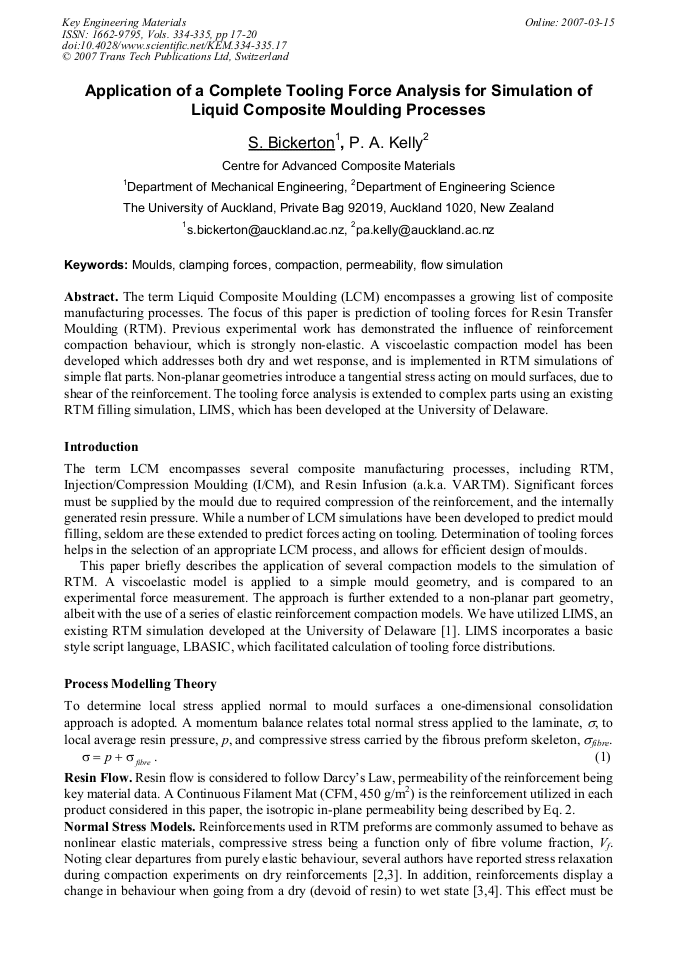
The term Liquid Composite Moulding (LCM) encompasses a growing list of composite manufacturing processes. The focus of this paper is prediction of tooling forces for Resin Transfer Moulding (RTM). Previous experimental work has demonstrated the influence of reinforcement compaction behaviour, which is strongly non-elastic. A viscoelastic compaction model has been developed which addresses both dry and wet response, and is implemented in RTM simulations of simple flat parts. Non-planar geometries introduce a tangential stress acting on mould surfaces, due to shear of the reinforcement. The tooling force analysis is extended to complex parts using an existing RTM filling simulation, LIMS, which has been developed at the University of Delaware.
Info:
Periodical:
Pages:
17-20
Citation:
Online since:
March 2007
Authors:
Keywords:
Price:
Сopyright:
© 2007 Trans Tech Publications Ltd. All Rights Reserved
Share:
Citation: