p.1437
p.1443
p.1449
p.1455
p.1461
p.1467
p.1473
p.1479
p.1485
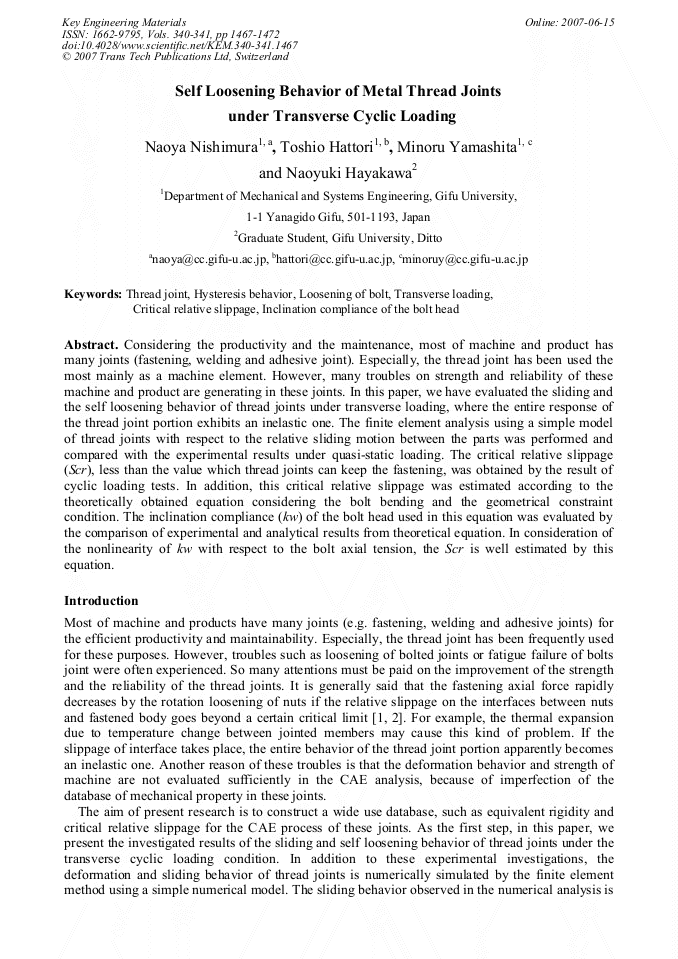
Self Loosening Behavior of Metal Thread Joints under Transverse Cyclic Loading

Abstract:
Considering the productivity and the maintenance, most of machine and product has many joints (fastening, welding and adhesive joint). Especially, the thread joint has been used the most mainly as a machine element. However, many troubles on strength and reliability of these machine and product are generating in these joints. In this paper, we have evaluated the sliding and the self loosening behavior of thread joints under transverse loading, where the entire response of the thread joint portion exhibits an inelastic one. The finite element analysis using a simple model of thread joints with respect to the relative sliding motion between the parts was performed and compared with the experimental results under quasi-static loading. The critical relative slippage (Scr), less than the value which thread joints can keep the fastening, was obtained by the result of cyclic loading tests. In addition, this critical relative slippage was estimated according to the theoretically obtained equation considering the bolt bending and the geometrical constraint condition. The inclination compliance (kw) of the bolt head used in this equation was evaluated by the comparison of experimental and analytical results from theoretical equation. In consideration of the nonlinearity of kw with respect to the bolt axial tension, the Scr is well estimated by this equation.
Info:
Periodical:
Pages:
1467-1472
Citation:
Online since:
June 2007
Price:
Сopyright:
© 2007 Trans Tech Publications Ltd. All Rights Reserved
Share:
Citation: