Impact of Augmented Reality (AR) in Civil Engineering

Article Preview

Abstract:

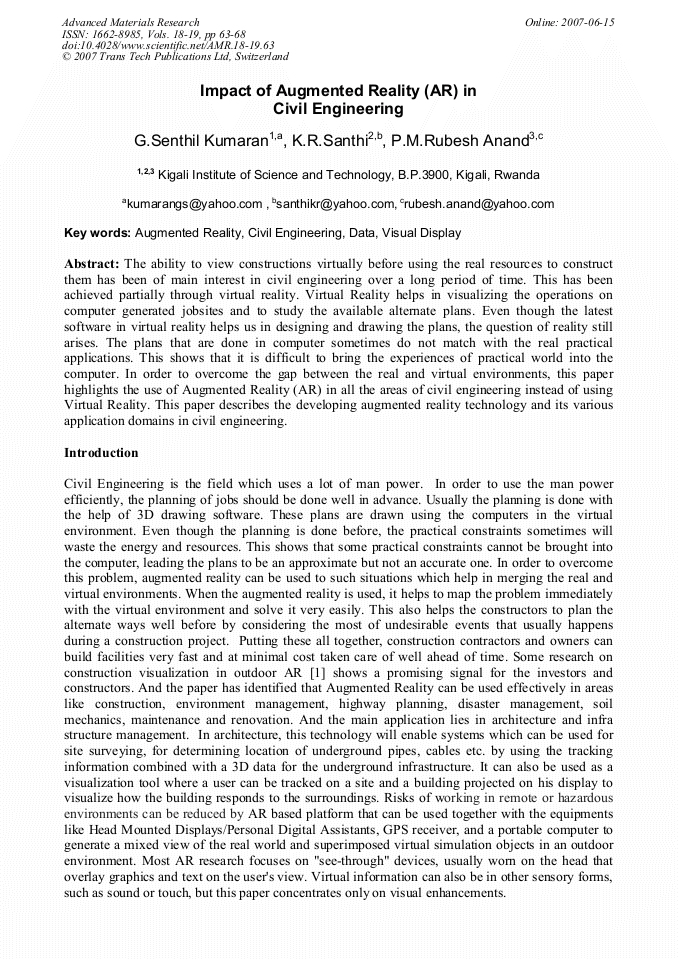
The ability to view constructions virtually before using the real resources to construct them has been of main interest in civil engineering over a long period of time. This has been achieved partially through virtual reality. Virtual Reality helps in visualizing the operations on computer generated jobsites and to study the available alternate plans. Even though the latest software in virtual reality helps us in designing and drawing the plans, the question of reality still arises. The plans that are done in computer sometimes do not match with the real practical applications. This shows that it is difficult to bring the experiences of practical world into the computer. In order to overcome the gap between the real and virtual environments, this paper highlights the use of Augmented Reality (AR) in all the areas of civil engineering instead of using Virtual Reality. This paper describes the developing augmented reality technology and its various application domains in civil engineering.

You might also be interested in these eBooks

Info:

Periodical:

Advanced Materials Research (Volumes 18-19)

Pages:

63-68

Citation:

Online since:

June 2007

Export:

Price:

Permissions CCC:

Permissions PLS:

Сopyright:

© 2007 Trans Tech Publications Ltd. All Rights Reserved

Share:

Citation:

[1] Xiangyu Wang, Phillip S. Dunston, Compatibility issues in Augmented Reality systems for AEC: An experimental prototype study, Automation in Construction 15 (2006) 314-326, Elsevier.

DOI: 10.1016/j.autcon.2005.06.002

Google Scholar

[2] P. Milgram, F. Kishino, A taxonomy of Mixed Reality visual displays, IEICE Transactions on Information and Systems E77-D (12) (1994) 1321-1329 (Special Issue on Networked Reality).

Google Scholar

[3] Yokokohji Y, Sugawara Y, Yoshikawa, T. Accurate image overlay on video see-through HMDs using vision and accelerometers, Proceedings of IEEE Virtual Reality, IEEE CS Press, 2000. pp.247-54.

DOI: 10.1109/vr.2000.840505

Google Scholar

[4] Azuma R, Lee JW, Jiang B, Park J, You S, Neumann U. Tracking in unprepared environments for augmented reality systems, Computers and Graphics (1999) 23(6): 787- 93.

DOI: 10.1016/s0097-8493(99)00104-1

Google Scholar

[5] Feldmann S, Kyamakya K, Zapater A, Lue Z. An indoor Bluetooth-based positioning system: concept, implementation and experimental evaluation", Proceedings of the International Conference on Wireless Networks, ICWN , 03, Las Vegas, Nevada, USA, 2003. pp.109-13.

Google Scholar

[6] Teresa Romao, Nuno Correia, Eduardo Dias, Jose Danado, Adelaide Trabuco, Carlos Santos, Rossana Santos, Antonio Camara, Edmundo Nobre, ANTS-Augmented Environments, Computers & Graphics 28 (2004) 625-633, Elsevier.

DOI: 10.1016/j.cag.2004.06.001

Google Scholar