The Relation of the Interlaminar Fracture Toughness and the Acoustic Emission (Ae) under the Enf Test

Article Preview

Abstract:

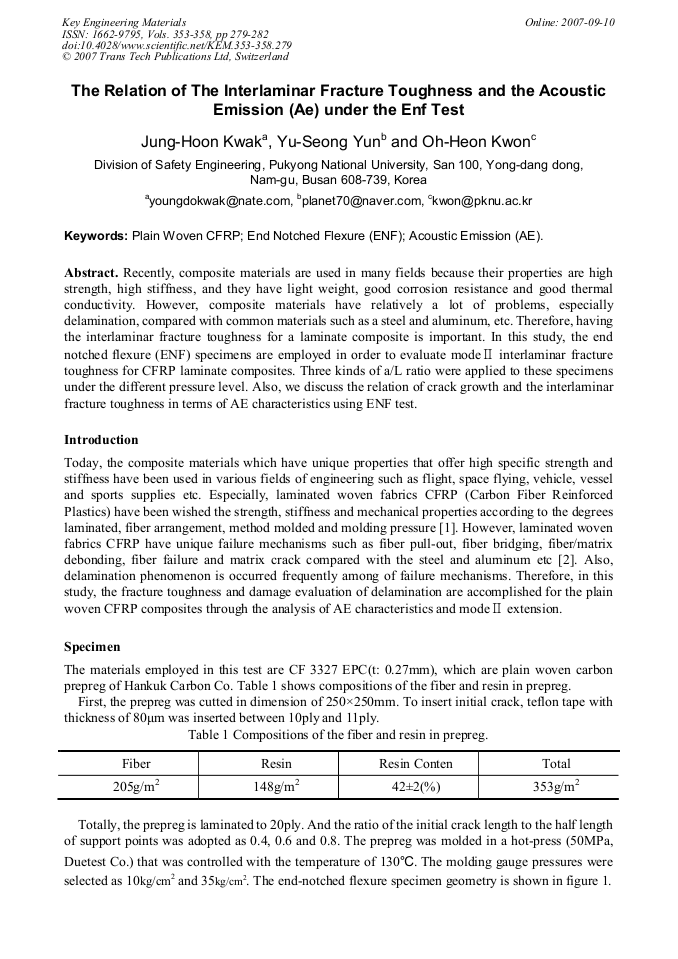
Recently, composite materials are used in many fields because their properties are high strength, high stiffness, and they have light weight, good corrosion resistance and good thermal conductivity. However, composite materials have relatively a lot of problems, especially delamination, compared with common materials such as a steel and aluminum, etc. Therefore, having the interlaminar fracture toughness for a laminate composite is important. In this study, the end notched flexure (ENF) specimens are employed in order to evaluate modeⅡ interlaminar fracture toughness for CFRP laminate composites. Three kinds of a/L ratio were applied to these specimens under the different pressure level. Also, we discuss the relation of crack growth and the interlaminar fracture toughness in terms of AE characteristics using ENF test.
You might also be interested in these eBooks

Info:

Periodical:

Key Engineering Materials (Volumes 353-358)

Pages:

279-282

Citation:

Online since:

September 2007

Export:

Price:

Permissions CCC:

Permissions PLS:

Сopyright:

© 2007 Trans Tech Publications Ltd. All Rights Reserved

Share:

Citation:

[1] L. Chiao and R. E. Lyon. A Fundamental Approach to Resin Cure Kinetic, Journal of Composite Meterials Vol. 24. (1990), pp.739-752.

DOI: 10.1177/002199839002400704

Google Scholar

[2] Hong C. S. Interlaminar Fracture Experimental Method of Composite Material, Transactions of KSME(A), Vol. 30(2) (1990), pp.172-179.

Google Scholar

[3] Gang Qi and Alan A. Barhorst, On Predicting the Fracture Behavior of CFR and GFR Composites Using Wavelet-Based AE Techniques, Engineering Fracture Mechanics Vol. 58 (1997), p.363.

DOI: 10.1016/s0013-7944(97)00090-8

Google Scholar

[4] Masaharu Iwamoto, Qing-Qing Ni, Teruhiko Fujiwara and Ken Kurashiki, Interlaminar fracture Mechanism in Unidirectional CFRP Composites Part Ⅰ : Interlaminar toughness and AE Characteristics, Enginering Fracture Mechanics, Vol. 64 (1999).

DOI: 10.1016/s0013-7944(99)00097-1

Google Scholar

[5] Standard test method for Tensile Properties of Polymer Matrix Composite Materials, ASTM D 3039, (2000).

Google Scholar

[6] P. J. Shull, Nondestructive Evaluation, Marcel Pekker, Inc, pp.370-371, (2000).

Google Scholar