Using of Ethylene Glycol as Pore-Form Agent to Form Interconnected Mesopores in Carbonized Phenol Resin

Article Preview

Abstract:

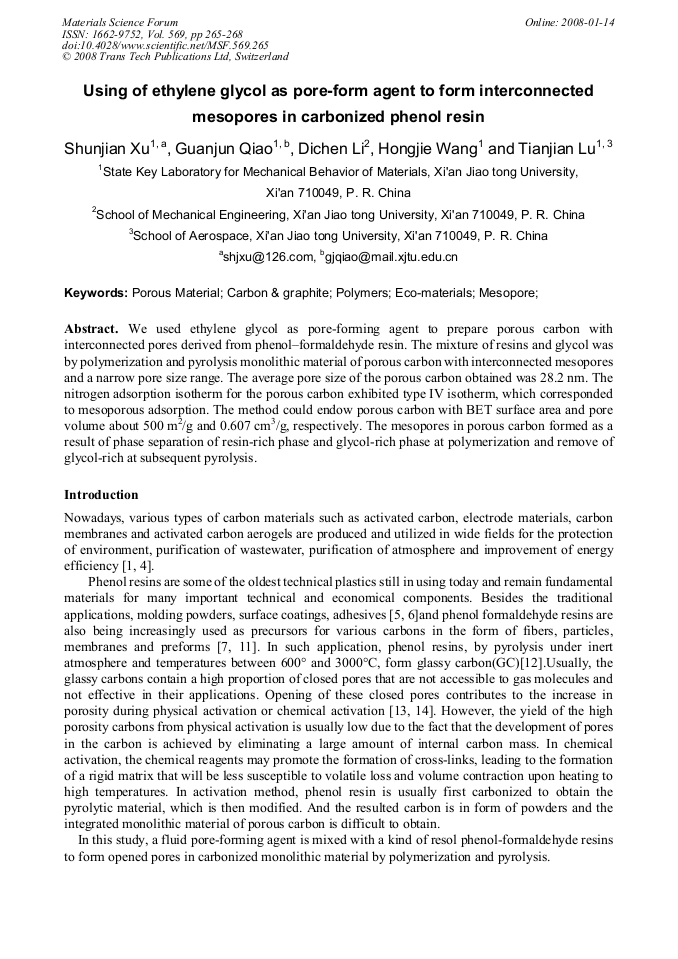
We used ethylene glycol as pore-forming agent to prepare porous carbon with interconnected pores derived from phenol–formaldehyde resin. The mixture of resins and glycol was by polymerization and pyrolysis monolithic material of porous carbon with interconnected mesopores and a narrow pore size range. The average pore size of the porous carbon obtained was 28.2 nm. The nitrogen adsorption isotherm for the porous carbon exhibited type IV isotherm, which corresponded to mesoporous adsorption. The method could endow porous carbon with BET surface area and pore volume about 500 m2/g and 0.607 cm3/g, respectively. The mesopores in porous carbon formed as a result of phase separation of resin-rich phase and glycol-rich phase at polymerization and remove of glycol-rich at subsequent pyrolysis.
You might also be interested in these eBooks

Info:

Periodical:

Pages:

265-268

Citation:

Online since:

January 2008

Export:

Price:

Permissions CCC:

Permissions PLS:

Сopyright:

© 2008 Trans Tech Publications Ltd. All Rights Reserved

Share:

Citation:

[1] I. Menendez, and B.A. Fuertes: Carbon Vol. 39 (2001), p.733.

Google Scholar

[2] A. Jänes, H. Kurig and E. Lust: Carbon Vol. 45 (2007), p.1226.

Google Scholar

[3] A. Merritt, R. Rajagopalan and H.C. Foley: Carbon Vol. 45 (2007), p.1267.

Google Scholar

[4] P.J.M. Carrott, F.L. Conceição and M.M.L. Ribeiro Carrott: Carbon Vol. 45 (2007), p.1310.

Google Scholar

[5] J. Wolfrum and G.W. Ehrenstein: J. Appl. Polymer Sci. Vol. 74 (1999), p.3173.

Google Scholar

[6] G.B. Yang, Y.J. Liu and G.J. Qiao: Key. Eng. Mater. Vol. 336-338 (2007), p.1361.

Google Scholar

[7] W. Wei, H. Hu, L. You and G. Chen: Carbon 40(2002), p.445.

Google Scholar

[8] M.A. Daley, D. Tandon, J. Economy and E.J. Hippo: Carbon Vol. 34 (1996), p.1191.

Google Scholar

[9] H. Toshihide, O. Keiko and M. Katsuhiko: Carbon Vol. 41 (2003), p.465.

Google Scholar

[10] J. Ozaki, N. Endo and W. Ohizumi: Carbon Vol. 35 (1997), p.1031.

Google Scholar

[11] Z.Z. Cui, D.C. Li, G.J. Qiao and J.S. Li: J. Inorg. Mater. Vol. 21 (2006), p.848.

Google Scholar

[12] A. Braun , M. Bärtsch and B. Schnyder: J. Non-Cryst Solids Vol. 260 (1999), p.1.

Google Scholar

[13] H. Teng and S.C. Wang: Carbon Vol. 38 (2000), p.817.

Google Scholar

[14] M.C. Huang and H. Teng: Carbon Vol. 40 (2002), p.955.

Google Scholar

[15] E.E. Hucke, U. S Patent 3, 859, 421. (1975).

Google Scholar

[16] K.S.W. Sing , D.H. Everett, R.A.W. Haul, L. Moscou, R.A. Pierotti, J. Rouquerol, T. Siemieniewska: Pure & Appl. Chem. Vol. 57 (1985), p.603.

DOI: 10.1002/9783527619474.ch11

Google Scholar