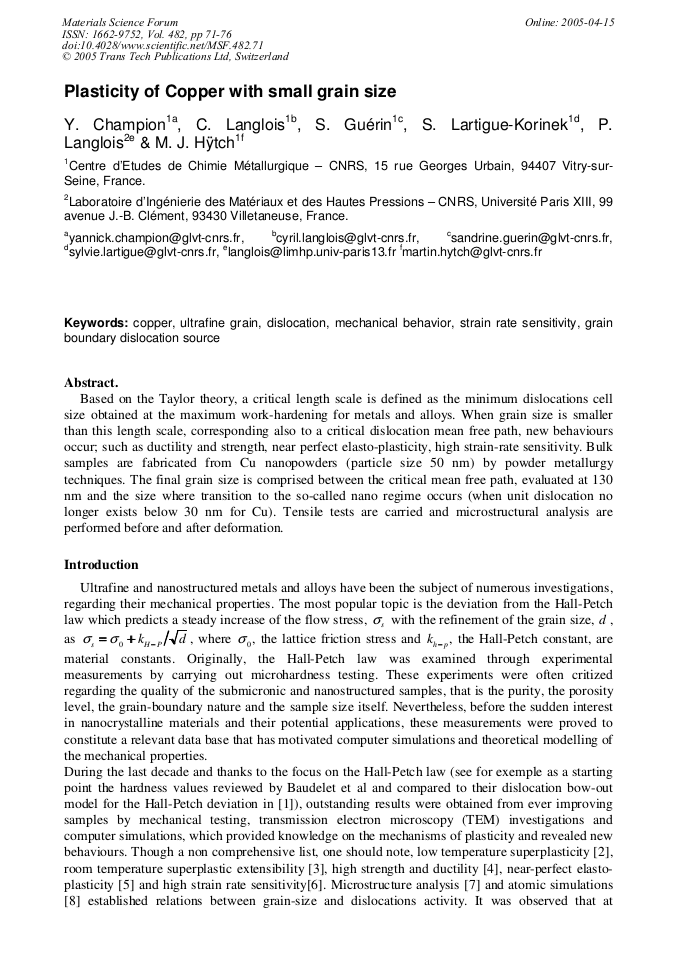
Plasticity of Copper with Small Grain Size

Article Preview

Abstract:

Based on the Taylor theory, a critical length scale is defined as the minimum dislocations cell size obtained at the maximum work-hardening for metals and alloys. When grain size is smaller than this length scale, corresponding also to a critical dislocation mean free path, new behaviours occur; such as ductility and strength, near perfect elasto-plasticity, high strain-rate sensitivity. Bulk samples are fabricated from Cu nanopowders (particle size 50 nm) by powder metallurgy techniques. The final grain size is comprised between the critical mean free path, evaluated at 130 nm and the size where transition to the so-called nano regime occurs (when unit dislocation no longer exists below 30 nm for Cu). Tensile tests are carried and microstructural analysis are performed before and after deformation.
You might also be interested in these eBooks

Info:

Periodical:

Pages:

71-76

Citation:

Online since:

April 2005

Export:

Price:

Permissions CCC:

Permissions PLS:

Сopyright:

© 2005 Trans Tech Publications Ltd. All Rights Reserved

Share:

Citation:

[1] J. Lian and B. Baudelet: Nanostruct. Mater. Vol2 (1993) p.415.

Google Scholar

[2] S.X. McFadden, R.S. Mishra, R.Z. Valiev, A.P. Zhilyaev and A.K. Mukherjee: Nature Vol 398, (1999) p.684.

Google Scholar

[3] L. Lu, M.L. Sui and K. Lu: Science Vol 287, (2000) p.1463.

Google Scholar

[4] Y. Wang, M. Chen, F. Zhou and E. Ma: Nature Vol 419, (2002) p.912.

Google Scholar

[5] Y. Champion, C. Langlois, S. Guérin-Mailly, P. Langlois, J-L. Bonnentien and M. J. Hÿtch : Science Vol 300, (2003) p.310.

DOI: 10.1126/science.1081042

Google Scholar

[6] Y.M. Wang and E. Ma: Acta Mater. Vol 52, (2004) p.1699.

Google Scholar

[7] M. Legros, B.R. Elliott M.N. Rittner, J.R. Weertman and K.J. Hemker: Phil Mag. A Vol 80 (2000) p.1017.

Google Scholar

[8] H. Van Swygenhoven, P.M. Derlet and A. Hasnaoui: Phys. Rev. B Vol 66 (2002) p.024101.

Google Scholar

[9] S. Cheng, J.A. Spencer and W.W. Milligan: Acta Mater. Vol 51 (2003), p.4505.

Google Scholar

[10] R.Z. Valiev, R.K. Islamgliev and I. V. Alexandrov: Prog. Mater. Sci. Vol 45 (2000), p.103.

Google Scholar

[11] R.Z. Valiev, I.V. Alexandrov, Y.T. Zhu and T.C. Lowe: J. Mater. Res. Vol 17 (2002) p.5.

Google Scholar

[12] A.H. Cottrell: Dislocations and plastic flow in crystals. (Oxford University Press, UK 1953).

Google Scholar

[13] M.R. Staker and D.L. Holt: Acta Metall. Vol 16 (1982) p.569.

Google Scholar

[14] Y. Champion, J. Bigot, Scripta Mater. 35, 517 (1996).

Google Scholar

[15] N. Cheggour, et al Superconducting materials , 403 (IITT international, Paris, 1993).

Google Scholar

[16] Y. Champion, S. Guérin-Mailly, J-L. Bonnentien, P. Langlois, Scripta Mater. 44, 1609 (2001).

DOI: 10.1016/s1359-6462(01)00782-5

Google Scholar

[17] E.W. Hart: Acta Metall. Vol. 15 (1967) p.35.

Google Scholar