p.1
p.14
p.23
p.31
p.39
p.46
p.54
p.62
p.70
Effect of Indenter Materials on Indentation Fracture of Alumina Ceramics

Abstract:
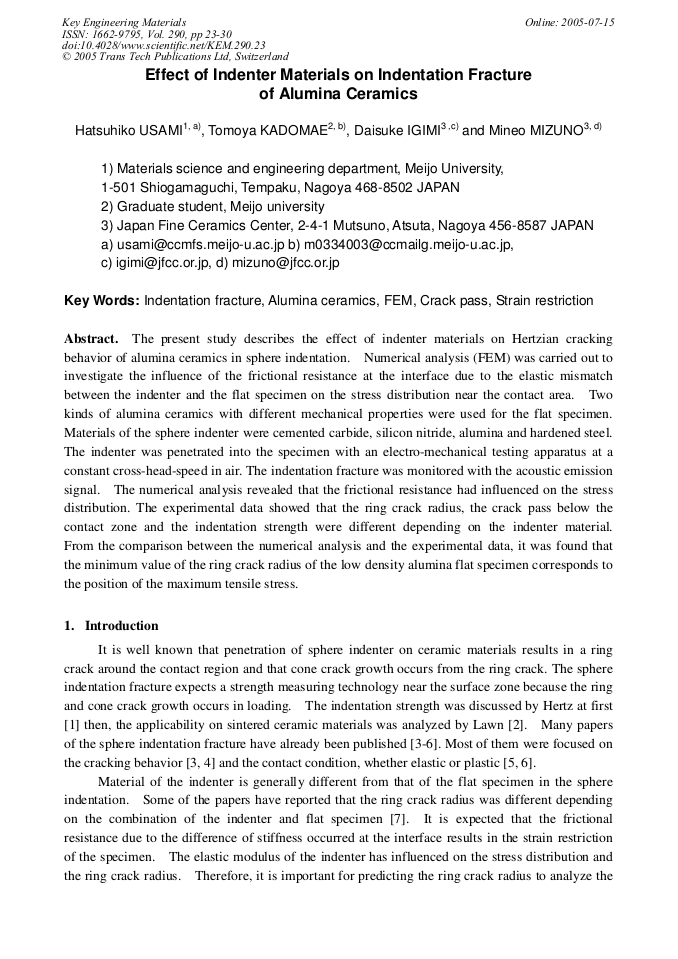
The present study describes the effect of indenter materials on Hertzian cracking behavior of alumina ceramics in sphere indentation. Numerical analysis (FEM) was carried out to investigate the influence of the frictional resistance at the interface due to the elastic mismatch between the indenter and the flat specimen on the stress distribution near the contact area. Two kinds of alumina ceramics with different mechanical properties were used for the flat specimen. Materials of the sphere indenter were cemented carbide, silicon nitride, alumina and hardened steel. The indenter was penetrated into the specimen with an electro-mechanical testing apparatus at a constant cross-head-speed in air. The indentation fracture was monitored with the acoustic emission signal. The numerical analysis revealed that the frictional resistance had influenced on the stress distribution. The experimental data showed that the ring crack radius, the crack pass below the contact zone and the indentation strength were different depending on the indenter material. From the comparison between the numerical analysis and the experimental data, it was found that the minimum value of the ring crack radius of the low density alumina flat specimen corresponds to the position of the maximum tensile stress.
Info:
Periodical:
Pages:
23-30
DOI:
Citation:
Online since:
July 2005
Authors:
Price:
Сopyright:
© 2005 Trans Tech Publications Ltd. All Rights Reserved
Share:
Citation: