Nanocrystalline Structure in Steels Produced by Various Severe Plastic Deformation Processes

Article Preview

Abstract:

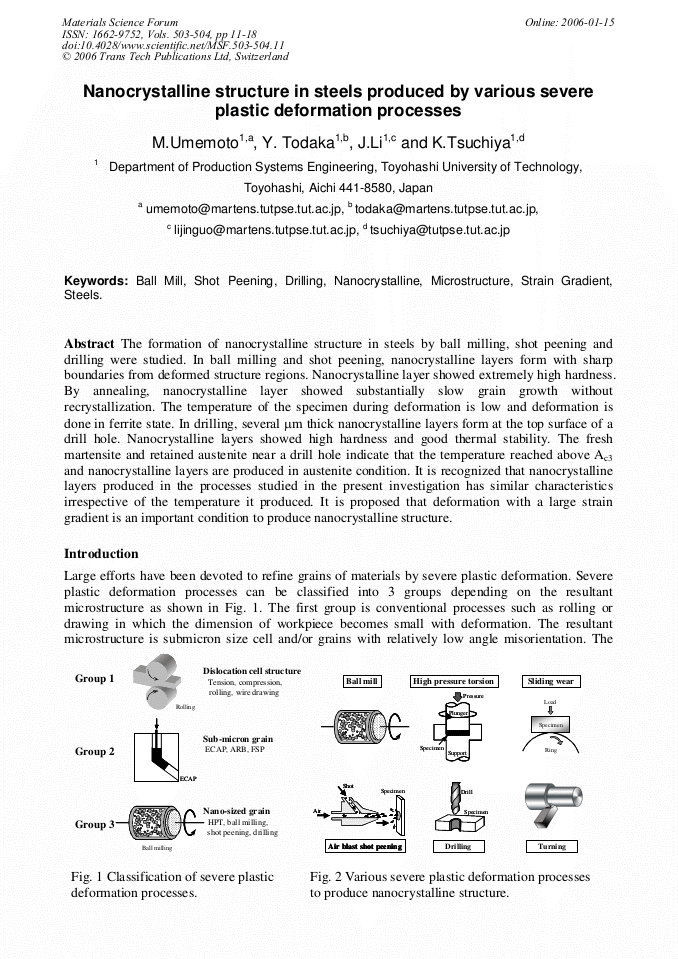
The formation of nanocrystalline structure in steels by ball milling, shot peening and drilling were studied. In ball milling and shot peening, nanocrystalline layers form with sharp boundaries from deformed structure regions. Nanocrystalline layer showed extremely high hardness. By annealing, nanocrystalline layer showed substantially slow grain growth without recrystallization. The temperature of the specimen during deformation is low and deformation is done in ferrite state. In drilling, several μm thick nanocrystalline layers form at the top surface of a drill hole. Nanocrystalline layers showed high hardness and good thermal stability. The fresh martensite and retained austenite near a drill hole indicate that the temperature reached above Ac3 and nanocrystalline layers are produced in austenite condition. It is recognized that nanocrystalline layers produced in the processes studied in the present investigation has similar characteristics irrespective of the temperature it produced. It is proposed that deformation with a large strain gradient is an important condition to produce nanocrystalline structure.
You might also be interested in these eBooks

Info:

Periodical:

Materials Science Forum (Volumes 503-504)

Pages:

11-18

Citation:

Online since:

January 2006

Export:

Price:

Permissions CCC:

Permissions PLS:

Сopyright:

© 2006 Trans Tech Publications Ltd. All Rights Reserved

Share:

Citation:

[1] R.Z. Valiev, N.A. Krasilnikov and N.K. Tsenev: Mater. Sci. Eng. A 137 (1991) p.35.

Google Scholar

[2] Y. Saito, H. Utsunomiya, N. Tsuji and T. Sakai: Acta Mater. 47 (1999) p.579.

Google Scholar

[3] J.S.C. Jang and C.C. Koch: Sripta Metal. 24 (1990) p.1599.

Google Scholar

[4] R.Z. Valiev, Y.V. Ivanisenko, E.F. Rauch and B. Baudelet: Acta Mater. 44 (1996) p.4705.

Google Scholar

[5] P. Heilmann, W. A.T. Clark and D.A. Rigney: Acta Metall. 31 (1983) p.1293.

Google Scholar

[6] N.R. Tao, M.L. Sui, J. Ku and K. Lu: NanoStructured Mater. 11 (1999) p.433.

Google Scholar

[7] M. Umemoto, Y. Todaka, K. Tsuchiya: Mater. Trans. 44 (2003) p.1488.

Google Scholar

[8] Y. Todaka, M. Umemoto, S. Tanaka and K. Tsuchiya: Mater. Trans. 45 (2004) p.376.

Google Scholar

[9] S. Akcan, S. Shah, S.P. Moylan, S.N. Chhabra, S. Chandrasekar, H.T.Y. Yang : Metal. Mater. Trans. A, 33A(2002) p.1245.

Google Scholar

[10] B.J. Griffiths: J. Tribology 109 (1987) p.525.

Google Scholar

[11] M. Umemoto: Mater. Trans. 44 (2003) p. (1900).

Google Scholar

[12] N. Kamikawa, N. Tsuji, T. Sakai and Y. Minamino: Proc. of the 25th RISO Int. Symp. on Mater. Sci., (2004) p.369.

Google Scholar

[13] H. Lin, C. Xu, B.Q. Han, E.J. Lavernia and T.G. Langdon : Proceeding of Ultrafine Grained Materials III TMS (2004) p.523.

Google Scholar

[14] R. Kaibyshev, I. Kazakulov, T. Sakai, A. Belyakov : ISUGS (2001) p.152.

Google Scholar

[15] A.P. Zhilyaev, S. Lee, G.V. Nurislamova, R.Z. Valiev, and T.G. Langdon : Scripta mater. 44(2001) p.2753.

DOI: 10.1016/s1359-6462(01)00955-1

Google Scholar

[16] M. F. Ashby : Philos. Mag. 21(1970) p.399.

Google Scholar

[17] J. Gil Sevillano : Proc. of 25th Riso International. Symposium on Materials Sciece (2004) p.1.

Google Scholar