p.1
p.19
p.25
p.31
p.37
p.45
p.51
p.57
p.63
Microstructure Evolution in Rapidly Solidified Immiscible Alloys

Abstract:
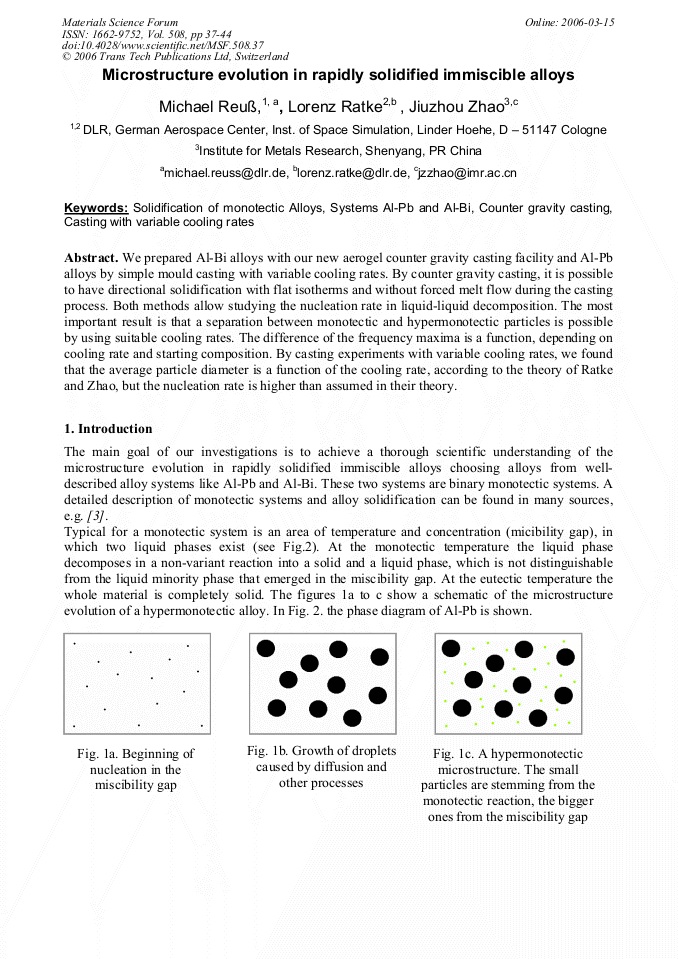
We prepared Al-Bi alloys with our new aerogel counter gravity casting facility and Al-Pb alloys by simple mould casting with variable cooling rates. By counter gravity casting, it is possible to have directional solidification with flat isotherms and without forced melt flow during the casting process. Both methods allow studying the nucleation rate in liquid-liquid decomposition. The most important result is that a separation between monotectic and hypermonotectic particles is possible by using suitable cooling rates. The difference of the frequency maxima is a function, depending on cooling rate and starting composition. By casting experiments with variable cooling rates, we found that the average particle diameter is a function of the cooling rate, according to the theory of Ratke and Zhao, but the nucleation rate is higher than assumed in their theory.
Info:
Periodical:
Pages:
37-44
DOI:
Citation:
Online since:
March 2006
Authors:
Price:
Сopyright:
© 2006 Trans Tech Publications Ltd. All Rights Reserved
Share:
Citation: