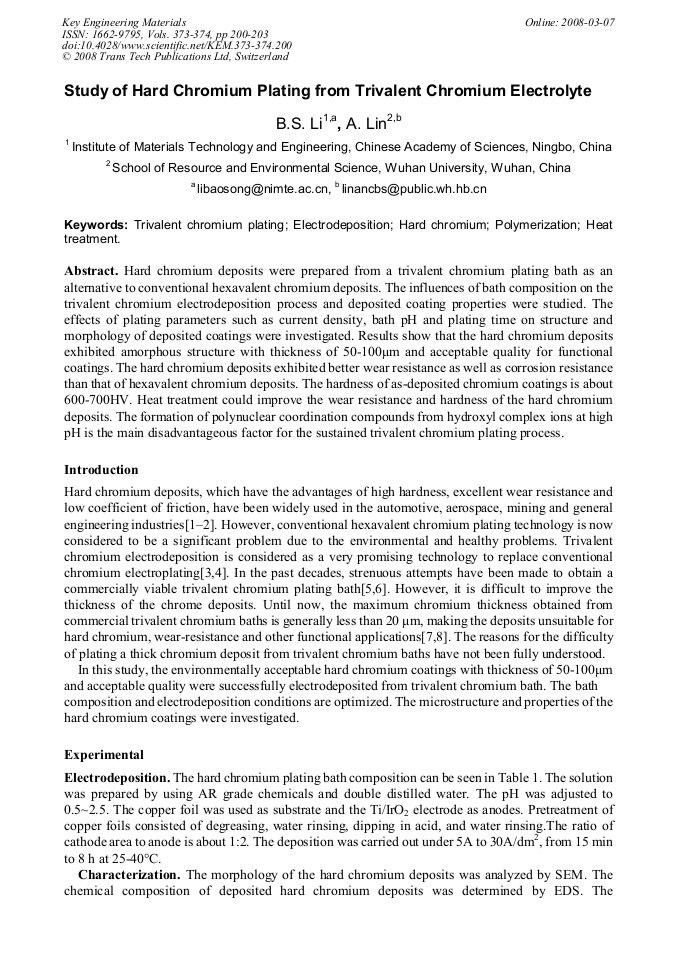
Study of Hard Chromium Plating from Trivalent Chromium Electrolyte

Article Preview

Abstract:

Hard chromium deposits were prepared from a trivalent chromium plating bath as an alternative to conventional hexavalent chromium deposits. The influences of bath composition on the trivalent chromium electrodeposition process and deposited coating properties were studied. The effects of plating parameters such as current density, bath pH and plating time on structure and morphology of deposited coatings were investigated. Results show that the hard chromium deposits exhibited amorphous structure with thickness of 50-100μm and acceptable quality for functional coatings. The hard chromium deposits exhibited better wear resistance as well as corrosion resistance than that of hexavalent chromium deposits. The hardness of as-deposited chromium coatings is about 600-700HV. Heat treatment could improve the wear resistance and hardness of the hard chromium deposits. The formation of polynuclear coordination compounds from hydroxyl complex ions at high pH is the main disadvantageous factor for the sustained trivalent chromium plating process.
You might also be interested in these eBooks

Info:

Periodical:

Key Engineering Materials (Volumes 373-374)

Pages:

200-203

Citation:

Online since:

March 2008

Authors:

Export:

Price:

Permissions CCC:

Permissions PLS:

Сopyright:

© 2008 Trans Tech Publications Ltd. All Rights Reserved

Share:

Citation:

[1] G. Hong, K.S. Siow, G. Zhiqiang, Plat. Surf. Finish. Vol. 88 (2001), p.69.

Google Scholar

[2] B.S. Li, A. Lin and F.X. Gan, Surf. Coat. Technol. Vol. 201 (2006), p.2578.

Google Scholar

[3] S.C. Kwon, M. Kim, S.U. Park, D.Y. Kim, D. Kim, K.S. Nam and Y. Choi, Surf. Coat. Technol. Vol. 183 (2004), p.151.

Google Scholar

[4] J.C. Kang and B. Lalvani, J. Appl. Electrochem. Vol. 22 (1992), p.787.

Google Scholar

[5] A.A. Edigaryan, Y.M. Polukarov, Russ. J. Appl. Chem. Vol. 76 (2003), p.323.

Google Scholar

[6] B.S. Li etal. J. Alloys Compd. (2006), doi: 10. 1016/j. jallcom. 2006. 11. 162. in press.

Google Scholar

[7] Y.B. Song, D.T. Chin, Plat. Surf. Finish. Vol. 87 (2000), p.80.

Google Scholar

[8] V.V. Kuznetsov, E.G. Vinokurov, O.E. Azarko, Russ. J. Electrochem. Vol. 35 (1999), p.698.

Google Scholar

[9] B.S. Li, A. Lin and F.X. Gan, Trans. Nonferrous Met. Soc. China Vol. 16 (2006), p.1193.

Google Scholar

[10] M. El-Sharif, J. McDougall, C.U. Chisholm, Trans. Inst. Met. Finish. Vol. 77 (1999), p.139.

Google Scholar

[11] M. Ghorbani, A. Iraji zad, A.G. Dolati, J. Alloys Compd. Vol. 386 (2005), p.43.

Google Scholar

[12] B.S. Li, A. Lin, F.X. Gan, Rare Metal Materials and Engineering Vol. 36 (2007), p.245.

Google Scholar

[13] Y.M. Polukarov, V.A. Safonov, A.A. Edigaryan, Prot. Met. Vol. 37 (2001), p.447.

Google Scholar

[14] D.B. Lee, J.H. Ko, S.C. Kwon, Mater. Sci. Eng. A Vol. 380 (2004), p.73.

Google Scholar

[15] J.P. Branciaroli, J.H. Lindsay, Plat. Surf. Finish. Vol. 88 (2001), p.12.

Google Scholar