Transition from External to Internal Oxidation of Single Phase Binary Alloys

Article Preview

Abstract:

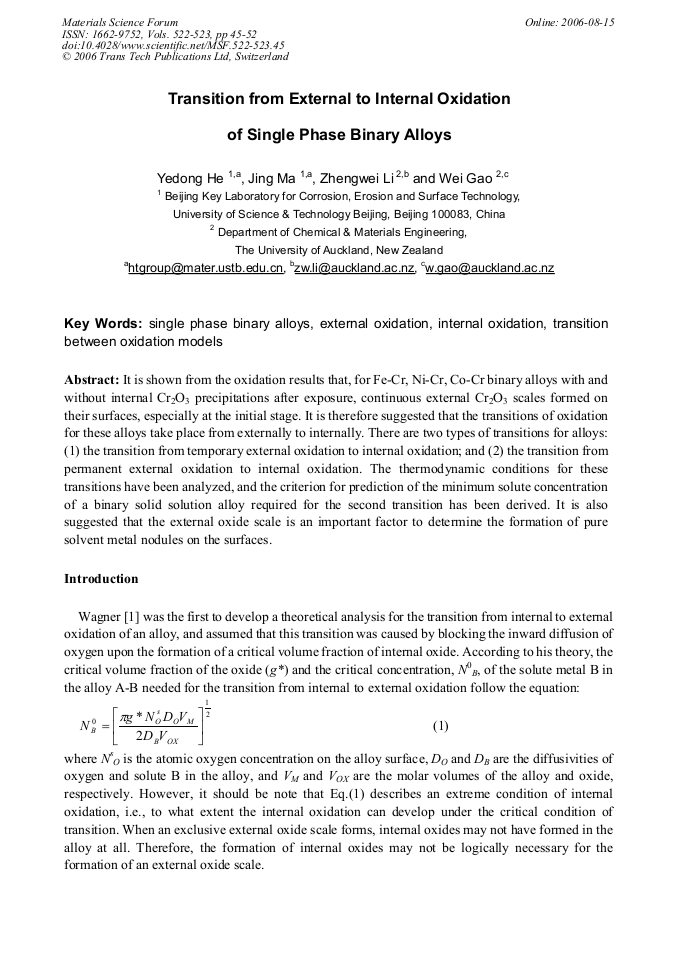
It is shown from the oxidation results that, for Fe-Cr, Ni-Cr, Co-Cr binary alloys with and without internal Cr2O3 precipitations after exposure, continuous external Cr2O3 scales formed on their surfaces, especially at the initial stage. It is therefore suggested that the transitions of oxidation for these alloys take place from externally to internally. There are two types of transitions for alloys: (1) the transition from temporary external oxidation to internal oxidation; and (2) the transition from permanent external oxidation to internal oxidation. The thermodynamic conditions for these transitions have been analyzed, and the criterion for prediction of the minimum solute concentration of a binary solid solution alloy required for the second transition has been derived. It is also suggested that the external oxide scale is an important factor to determine the formation of pure solvent metal nodules on the surfaces.
You might also be interested in these eBooks

Info:

Periodical:

Materials Science Forum (Volumes 522-523)

Pages:

45-52

Citation:

Online since:

August 2006

Export:

Price:

Permissions CCC:

Permissions PLS:

Сopyright:

© 2006 Trans Tech Publications Ltd. All Rights Reserved

Share:

Citation:

[1] C. Wagner, Z. Elektrochem., 63(7) (1959), 772-782.

Google Scholar

[2] C. Wagner, J. Electrochem. Soc., 99(10) (1952), 369-380.

Google Scholar

[3] G. Wang, B. Gleeson and D.L. Douglass, Oxid. Met., 35 (1991), 317-332.

Google Scholar

[4] Y.D. He, Z.W. Li, and W. Gao, Mater. High Temp., 18S (2000), 17-22.

Google Scholar

[5] W. Gao, Z.W. Li, and Y.D. He, Mater. High Temp., 18S (2000), 23-30.

Google Scholar

[6] D.R. Wang, Y.D. He, S. Li, and W. Gao, J. Chin. Soc. Corr. Protect., 22(2) (2002), 79-83.

Google Scholar

[7] W. Gao, Z.W. Li, Z. Wu, S. Li and Y.D. He, Intermetallics, 10, (2002), 263-270.

Google Scholar

[8] P. Kofstad, Nonstoichiometry, Diffusion and Electrical Conductivity in Binary Metal Oxides, Wiley & Sons, New York, (1972).

Google Scholar

[9] J. Stringer, Mater. Sci. Eng., A120 (1989), 129-137.

Google Scholar

[10] Y.D. He, Z.F. Huang, H.B. Qi, D.R. Wang, Z.W. Li, and W. Gao, Mater. Lett., 45 (2000), 75-85.

Google Scholar

[11] Y.D. He, H.B. Qi, X. Bai, D.R. Wang, Z.W. Li, C.H. Xu, and W. Gao, High Temp. Mater. Process., 19(2) (2000), 71-77.

Google Scholar

[12] S. Guruswamy, S.M. Park, J.P. Hirth, and R.A. Rapp. Oxid. Met., 26(1986), 77-100.

Google Scholar

[13] D.L. Douglass, Oxid. Met., 44(1/2) (1995), 81-111.

Google Scholar