p.48
p.53
p.57
p.63
p.67
p.71
p.77
p.81
p.87
Measurement of Thermal Expansion Coefficients of Thin Film of Different Organic Coatings by Shearography

Abstract:
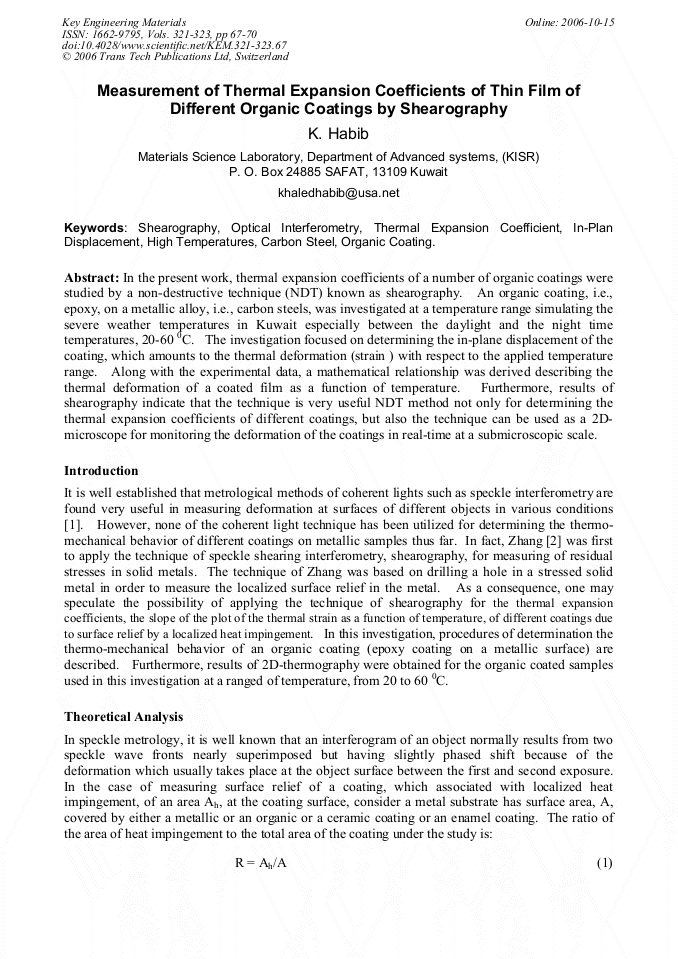
In the present work, thermal expansion coefficients of a number of organic coatings were studied by a non-destructive technique (NDT) known as shearography. An organic coating, i.e., epoxy, on a metallic alloy, i.e., carbon steels, was investigated at a temperature range simulating the severe weather temperatures in Kuwait especially between the daylight and the night time temperatures, 20-60 0C. The investigation focused on determining the in-plane displacement of the coating, which amounts to the thermal deformation (strain ) with respect to the applied temperature range. Along with the experimental data, a mathematical relationship was derived describing the thermal deformation of a coated film as a function of temperature. Furthermore, results of shearography indicate that the technique is very useful NDT method not only for determining the thermal expansion coefficients of different coatings, but also the technique can be used as a 2Dmicroscope for monitoring the deformation of the coatings in real-time at a submicroscopic scale.
Info:
Periodical:
Pages:
67-70
Citation:
Online since:
October 2006
Authors:
Price:
Сopyright:
© 2006 Trans Tech Publications Ltd. All Rights Reserved
Share:
Citation: