p.117
p.123
p.131
p.137
p.145
p.151
p.157
p.163
p.169
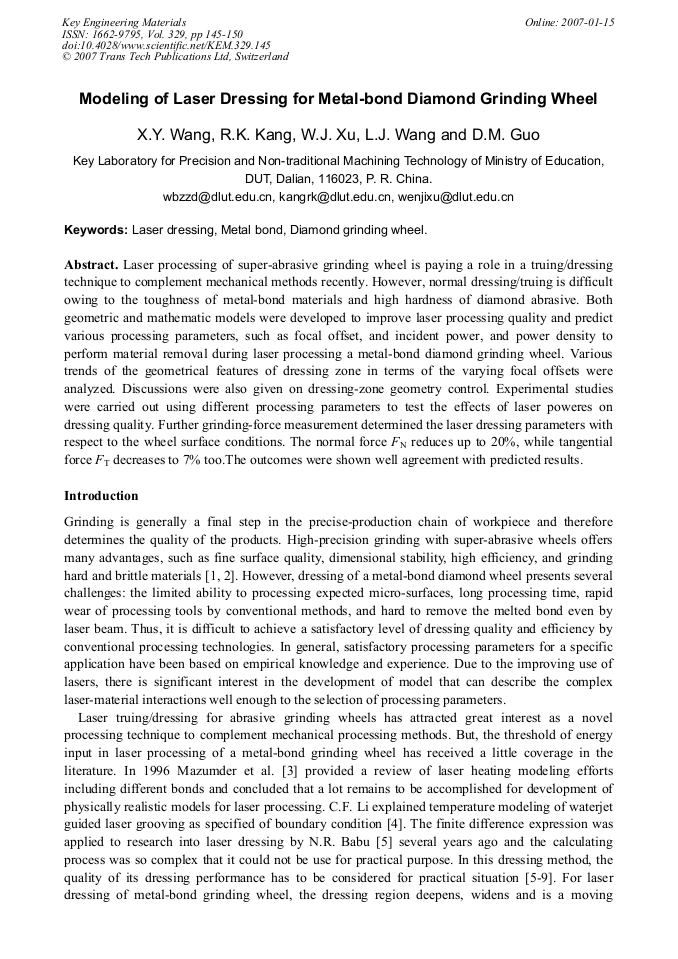
Modeling of Laser Dressing for Metal-Bond Diamond Grinding Wheel

Abstract:
Laser processing of super-abrasive grinding wheel is paying a role in a truing/dressing technique to complement mechanical methods recently. However, normal dressing/truing is difficult owing to the toughness of metal-bond materials and high hardness of diamond abrasive. Both geometric and mathematic models were developed to improve laser processing quality and predict various processing parameters, such as focal offset, and incident power, and power density to perform material removal during laser processing a metal-bond diamond grinding wheel. Various trends of the geometrical features of dressing zone in terms of the varying focal offsets were analyzed. Discussions were also given on dressing-zone geometry control. Experimental studies were carried out using different processing parameters to test the effects of laser poweres on dressing quality. Further grinding-force measurement determined the laser dressing parameters with respect to the wheel surface conditions. The normal force FN reduces up to 20%, while tangential force FT decreases to 7% too.The outcomes were shown well agreement with predicted results.
Info:
Periodical:
Pages:
145-150
DOI:
Citation:
Online since:
January 2007
Authors:
Keywords:
Price:
Сopyright:
© 2007 Trans Tech Publications Ltd. All Rights Reserved
Share:
Citation: