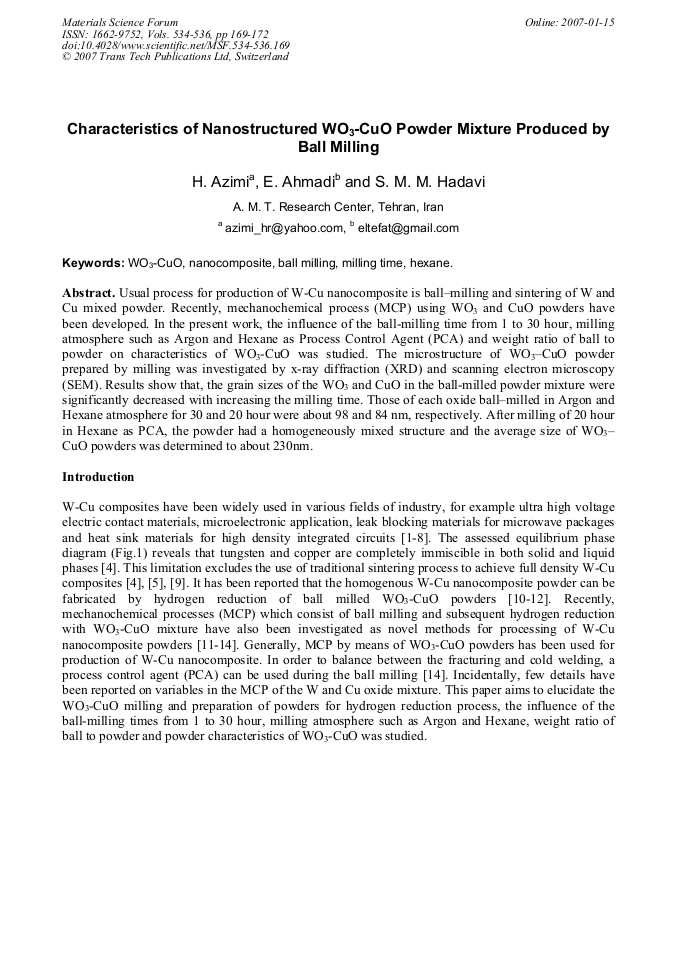
Characteristics of Nanostructured WO3-CuO Powder Mixture Produced by Ball Milling

Article Preview

Abstract:

Usual process for production of W-Cu nanocomposite is ball–milling and sintering of W and Cu mixed powder. Recently, mechanochemical process (MCP) using WO3 and CuO powders have been developed. In the present work, the influence of the ball-milling time from 1 to 30 hour, milling atmosphere such as Argon and Hexane as Process Control Agent (PCA) and weight ratio of ball to powder on characteristics of WO3-CuO was studied. The microstructure of WO3–CuO powder prepared by milling was investigated by x-ray diffraction (XRD) and scanning electron microscopy (SEM). Results show that, the grain sizes of the WO3 and CuO in the ball-milled powder mixture were significantly decreased with increasing the milling time. Those of each oxide ball–milled in Argon and Hexane atmosphere for 30 and 20 hour were about 98 and 84 nm, respectively. After milling of 20 hour in Hexane as PCA, the powder had a homogeneously mixed structure and the average size of WO3– CuO powders was determined to about 230nm.
You might also be interested in these eBooks

Info:

Periodical:

Materials Science Forum (Volumes 534-536)

Pages:

169-172

Citation:

Online since:

January 2007

Export:

Price:

Permissions CCC:

Permissions PLS:

Сopyright:

© 2007 Trans Tech Publications Ltd. All Rights Reserved

Share:

Citation:

[1] D. G. Kim, S. T. Oh, H. Jeon, C. H. Lee and Y. D. Kim, Journal of Alloys and Compounds, 354 (2003) 239-242.

Google Scholar

[2] H. J. Ryun, S. H. Hong, Materials Science and Engineering, A 363 (2003) 179- 184.

Google Scholar

[3] W. S. Wang, and K. S. Hwang, Metallurgical and Materials Transactions, A 29 A, May (1998) 1509-1516.

Google Scholar

[4] L. J. Kecskes, M. D. Trexler, B. R. Klotz, k. C. Cho and R. J. Dowding, Metallurgical and Materials Transactions A, 32 A, November (2001) 2885-2893.

DOI: 10.1007/s11661-001-1039-0

Google Scholar

[5] S. K. Joo, S. W. Lee, T. H. Ihn, Metallurgical and Materials Transactions A 25 A August (1994) 1575-1578.

Google Scholar

[6] D. G. Kim, K. W. Lee, S. T Oh and Young D. Kim, Materials Letters 58 (2004) 1199-1203.

Google Scholar

[7] S. Lee, M. H. Hong, J. W. Noh and W. H. Baek, Metallurgical and Materials Transactions A, 33 A April( 2002) 1069-1074.

Google Scholar

[8] H. K. Kang and S. B. Kang, Scripta Materialia 49 (2003) 1169-1174.

Google Scholar

[9] J. C. Kim, S. S. Ryu, H. Lee and I. H. Moon, International Journal of Powder Metallurgy 35, No 7 (1999) 47-55.

Google Scholar

[10] D. G. Kim, G. S. Kim, M. J. Suk, S. T. Oh, Scripta Matrialia, 51 (2004) 677-681.

Google Scholar

[11] D. G. Kim, K. H. Min, S. Y. Chang, S. T. Oh, C. H. Lee and Y. D. Kim, Materials Science and Engineering A, 399(2005) 326- 331.

Google Scholar

[12] W. S. Shim, D. G. Kim, T. Sekino, J. W. Noh, Journal of Ceramic Process Research, 3 (2002), 109-113.

Google Scholar

[13] Y. Li, X. Qu, Z. Zheng, C. Lei, , International Journal of RM & HM, 21 (2003) 259-264.

Google Scholar

[14] Y. F. Zhang, L. Lu, S. M. Yap, Journal of Materials Processing Technology, 89-90 (1999) 260265.

Google Scholar

[15] E. S. Yoon, J. S. Lee, S. T. Oh, B. K. Kim, International Journal of RM & HM, 20 (2002) 201206.

Google Scholar