Nanoindentation-Induced Collective Dislocation Behavior and Nanoplasticity

Article Preview

Abstract:

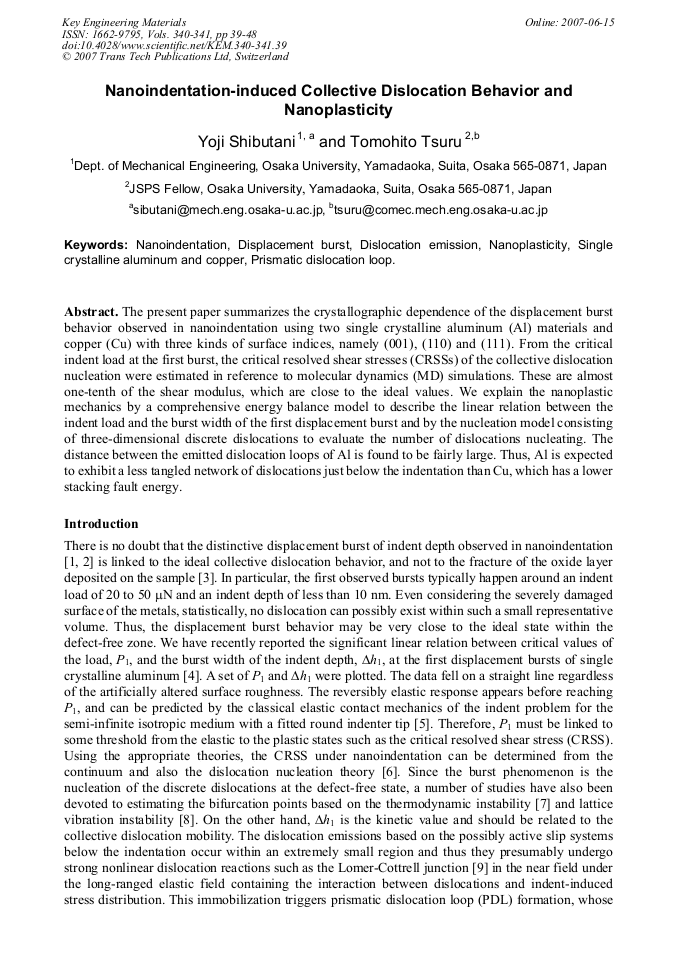
The present paper summarizes the crystallographic dependence of the displacement burst behavior observed in nanoindentation using two single crystalline aluminum (Al) materials and copper (Cu) with three kinds of surface indices, namely (001), (110) and (111). From the critical indent load at the first burst, the critical resolved shear stresses (CRSSs) of the collective dislocation nucleation were estimated in reference to molecular dynamics (MD) simulations. These are almost one-tenth of the shear modulus, which are close to the ideal values. We explain the nanoplastic mechanics by a comprehensive energy balance model to describe the linear relation between the indent load and the burst width of the first displacement burst and by the nucleation model consisting of three-dimensional discrete dislocations to evaluate the number of dislocations nucleating. The distance between the emitted dislocation loops of Al is found to be fairly large. Thus, Al is expected to exhibit a less tangled network of dislocations just below the indentation than Cu, which has a lower stacking fault energy.
You might also be interested in these eBooks

Info:

Periodical:

Key Engineering Materials (Volumes 340-341)

Pages:

39-48

Citation:

Online since:

June 2007

Export:

Price:

Permissions CCC:

Permissions PLS:

Сopyright:

© 2007 Trans Tech Publications Ltd. All Rights Reserved

Share:

Citation:

[1] S. Suresh, T. -G. Nieh and B.W. Choi: Scripta Materialia, Vol. 41 (1999), p.951.

Google Scholar

[2] A. Gouldstone, H. -J. Koh, K. -Y. Zeng, A.E. Gannakopoulos and S. Suresh: Acta mater., Vol. 48 (2000), p.2277.

Google Scholar

[3] M. Seo and M. Chiba: Electrochemica Acta, Vol. 47 (2001), p.319.

Google Scholar

[4] Y. Shibutani and A. Koyama: J. Mater. Res., Vol. 19 (2004), p.183.

Google Scholar

[5] I.N. Sneddon: Int. J. Eng. Sci., Vol. 3 (1965), p.47.

Google Scholar

[6] T. A Michalske and J. E Houston: Acta mater., Vol. 46 (1998), p.391.

Google Scholar

[7] K.J. Van Vliet, J. Li, T. Zhu, S. Yip and S. Suresh: Phys. Rev. B, Vol. 67 (2003), p.104105.

Google Scholar

[8] S.V. Dmitriev, J. Li, N. Yoshikawa and Y. Shibutani: Phil. Mag., Vol. 85 (2005), p.2177.

Google Scholar

[9] J. P Hirsh and J. Lothe: Theory of Dislocations (Krieger Publishing Company, 1982).

Google Scholar

[10] M.F. Ashby and L. Johnson: Phil. Mag., Vol. 20 (1969), p.1009.

Google Scholar

[11] Y. Shibutani and T. Tsuru: Trans. of JSME, Vol. 70 (2004), p.947 (in Japanese).

Google Scholar

[12] T. Tsuru and Y. Shibutani: Modelling and Simul. in Mat. Sci. & Eng. modeling, Vol. 14 (2006), p. S55.

Google Scholar

[13] D. Tabor: The Hardness of Metals (Oxford University Press, 1951).

Google Scholar

[14] C.B. Carter and I.L. F Ray: Philos. Mag., Vol. 35 (1977), p.189.

Google Scholar

[15] L.E. Murr: Interfacial Phenomena in Metals and Alloys (Addison-Wesley, 1975).

Google Scholar

[16] Y. Shibutani, A. Koyama and T. Tsuru, in: IUTAM Symposium on Multiscale Modeling and Characterization of elastic-Inelastic Behavior of Engineering Materials, edited by S. Ahzi, et al., p.125, Kluwer Academic Publishers (2004).

DOI: 10.1007/978-94-017-0483-0_16

Google Scholar

[17] M.C. Fivel, C.F. Robertson, G.R. Canova and L. Boulanger: Acta mater., Vol. 46 (1998), p.6183.

Google Scholar

[18] J.D. Kiely, R.Q. Hwang and J.E. Hamilton: Phys. Rev. Lett., Vol. 81 (1998), p.4422.

Google Scholar

[19] K.L. Johnson: Contact Mechanics (Cambridge University Press, 1985).

Google Scholar