Crystallization Kinetics and Texture Evolution in Iron-Based Amorphous Alloys under a Magnetic Field

Article Preview

Abstract:

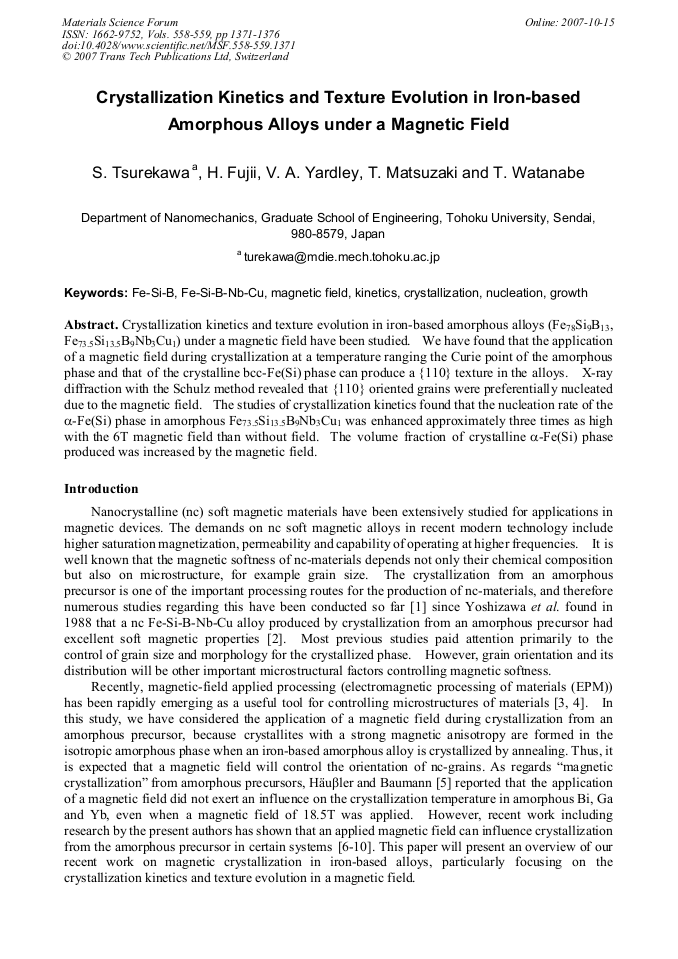
Crystallization kinetics and texture evolution in iron-based amorphous alloys (Fe78Si9B13, Fe73.5Si13.5B9Nb3Cu1) under a magnetic field have been studied. We have found that the application of a magnetic field during crystallization at a temperature ranging the Curie point of the amorphous phase and that of the crystalline bcc-Fe(Si) phase can produce a {110} texture in the alloys. X-ray diffraction with the Schulz method revealed that {110} oriented grains were preferentially nucleated due to the magnetic field. The studies of crystallization kinetics found that the nucleation rate of the α-Fe(Si) phase in amorphous Fe73.5Si13.5B9Nb3Cu1 was enhanced approximately three times as high with the 6T magnetic field than without field. The volume fraction of crystalline α-Fe(Si) phase produced was increased by the magnetic field.
You might also be interested in these eBooks

Info:

Periodical:

Materials Science Forum (Volumes 558-559)

Pages:

1371-1376

Citation:

Online since:

October 2007

Export:

Price:

Permissions CCC:

Permissions PLS:

Сopyright:

© 2007 Trans Tech Publications Ltd. All Rights Reserved

Share:

Citation:

[1] M. E. McHenry, M. A. Willard and D. E. Laughlin: Prog. Mater. Sci. Vol. 44 (1999), p.291.

Google Scholar

[2] Y. Yoshizawa, S. Ogura and K. Yamaguchi: J. Appl. Phys. Vol. 64 (1988), p.6044.

Google Scholar

[3] T. Watanabe, S. Tsurekawa, X. Zhao and L. Zuo: Scripta Mater. Vol. 54 (2006), p.969.

Google Scholar

[4] For example: Proc. of 5 th Intern. Symp. on Electromagnetic Processing of Materials (EPM 2006), The Iron and Steel Institute of Japan (ISIJ), (2006).

Google Scholar

[5] P. Häuβler and F. Baumann: Z. Physik B Vol. 38 (1980), p.43.

Google Scholar

[6] Y. Wolfus, Y. Yeshurun, I. Felner and J. Wolny: Phil. Mag. B Vol. 56 (1987), p.963.

Google Scholar

[7] Y. Otani, H. Sun, J. M. D. Coey, H. A. Davis, A. Manaf and R. A. Buckley: J. Appl. Phys. Vol. 67 (1990), p.4616.

Google Scholar

[8] X. Wang, M. Qi and S. Yi: Scripta Mater. Vol. 51 (2004), p.1047.

Google Scholar

[9] H. Fujii, S. Tsurekawa, T. Matsuzaki and T. Watanabe: Phil. Mag. Lett. Vol. 86 (2006), p.113.

Google Scholar

[10] H. Fujii, T. Matsuzaki and S. Tsurekawa: Proc. of 5 th Intern. Symp. on Electromagnetic Processing of Materials (EPM 2006), The Iron and Steel Institute of Japan, (2006). p.567.

Google Scholar

[11] D. B. Williams and C. B. Carter, in: Transmission Electron Microscopy - Spectrometry IV, Plenum Press, New York (1996).

Google Scholar

[12] P. Allia, M. Baricco, P. Tiberto, and F. Vinai: J. Appl. Phys. Vol. 74 (1993), p.3137.

Google Scholar

[13] M. Muller, N. Mattern and L. Illgen: Z. Metallkd Vol. 82 (1991), p.895.

Google Scholar

[14] Y. Takahara: J. Jpn. Inst. Met. Vol. 63 (1999), p.367 (in Japanese).

Google Scholar

[15] L. Kaufman and H. Bernstein, in: Computer Calculation of Phase Diagrams with Special Reference to Refractory Metals, Academic Press, New York, (1970).

Google Scholar

[16] N. Saunders and A. P. Miodownik, in: CALPHAD (CALculation of PHase Diagrams) A Comprehensive Guide, Pergamon Materials Series: vol. 1, ed. R. W. Cahn, Elsevier, Oxford, (1998).

DOI: 10.1016/s1470-1804(98)80018-7

Google Scholar