p.1923
p.1927
p.1931
p.1935
p.1939
p.1944
p.1948
p.1952
p.1956
Distributions of Residual Stresses in Diffusion Bonding of Dissimilar Materials Intermetallics TiAl to Steel 40Cr and Effect of Interlayer

Abstract:
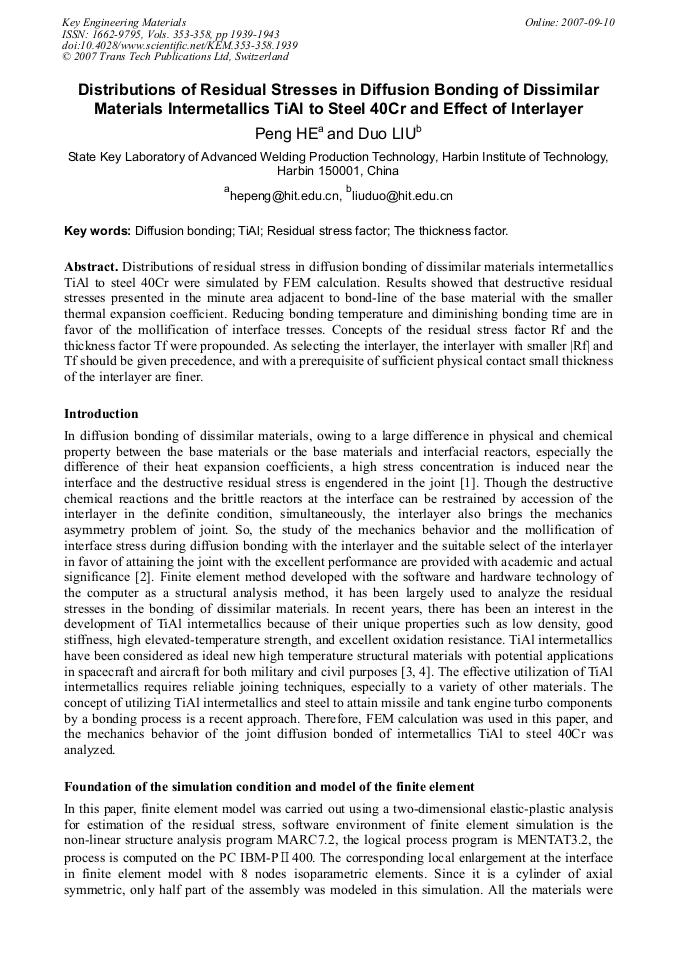
Distributions of residual stress in diffusion bonding of dissimilar materials intermetallics TiAl to steel 40Cr were simulated by FEM calculation. Results showed that destructive residual stresses presented in the minute area adjacent to bond-line of the base material with the smaller thermal expansion coefficient. Reducing bonding temperature and diminishing bonding time are in favor of the mollification of interface tresses. Concepts of the residual stress factor Rf and the thickness factor Tf were propounded. As selecting the interlayer, the interlayer with smaller |Rf| and Tf should be given precedence, and with a prerequisite of sufficient physical contact small thickness of the interlayer are finer.
Info:
Periodical:
Pages:
1939-1943
Citation:
Online since:
September 2007
Keywords:
Price:
Сopyright:
© 2007 Trans Tech Publications Ltd. All Rights Reserved
Share:
Citation: