Balancing Global Project Resources Utilising a Genetic Algorithm Approach with Stochastic Resource Assignments

Article Preview

Abstract:

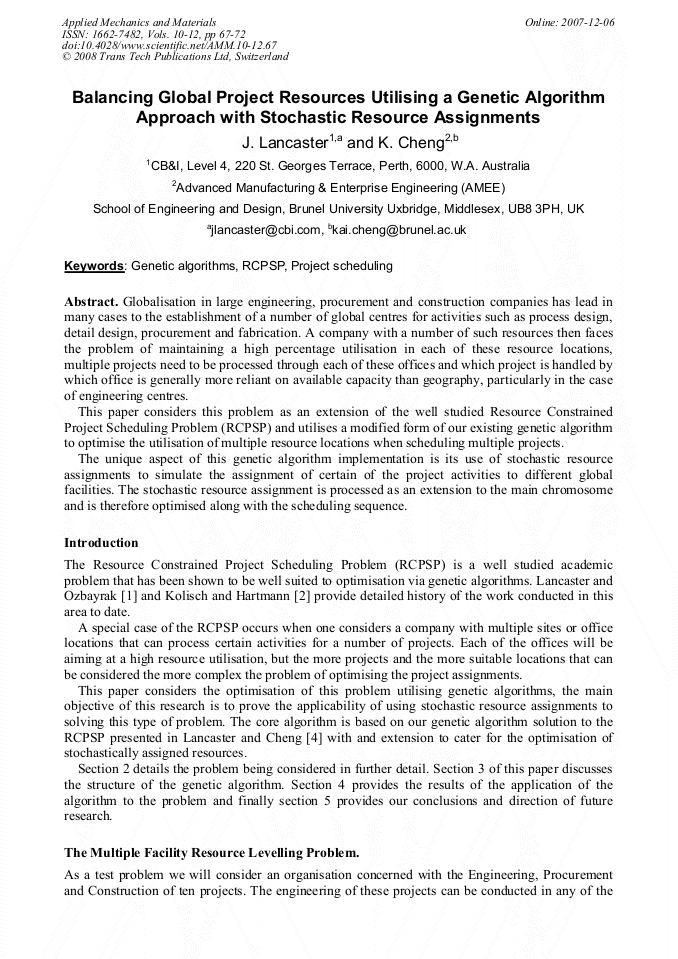
Globalisation in large engineering, procurement and construction companies has lead in many cases to the establishment of a number of global centres for activities such as process design, detail design, procurement and fabrication. A company with a number of such resources then faces the problem of maintaining a high percentage utilisation in each of these resource locations, multiple projects need to be processed through each of these offices and which project is handled by which office is generally more reliant on available capacity than geography, particularly in the case of engineering centres. This paper considers this problem as an extension of the well studied Resource Constrained Project Scheduling Problem (RCPSP) and utilises a modified form of our existing genetic algorithm to optimise the utilisation of multiple resource locations when scheduling multiple projects. The unique aspect of this genetic algorithm implementation is its use of stochastic resource assignments to simulate the assignment of certain of the project activities to different global facilities. The stochastic resource assignment is processed as an extension to the main chromosome and is therefore optimised along with the scheduling sequence.

You might also be interested in these eBooks

Info:

Periodical:

Pages:

67-72

Citation:

Online since:

December 2007

Export:

Price:

Permissions CCC:

Permissions PLS:

Сopyright:

© 2008 Trans Tech Publications Ltd. All Rights Reserved

Share:

Citation:

[1] J. Lancaster and M. Ozbayrak: International Journal of Production Research, Vol. 45 (2007) No. 2, pp.425-450.

Google Scholar

[2] R. Kolisch and S. Hartmann: Experimental Investigation of Heuristics for Resource Constrained Project Scheduling: An Update. To appear in European Journal of Operations Research. (2005).

DOI: 10.1016/j.ejor.2005.01.065

Google Scholar

[3] Information on http: /www. 129. 187. 106. 231/psplib.

Google Scholar

[4] J. Lancaster and K. Cheng: Toward the application of Genetic Algorithms to Real World Resource Constrained Project Scheduling Problems. To appear in the proceedings of IPROMS (2007).

Google Scholar

[5] J. Holland: Adaptation in Natural and Artificial Systems: An Introductory Analysis with Application to Biology, Control and Artificial Intelligence. Massachusetts Institute of Technology Press. ISBN 0-262-58111-6.

Google Scholar

[6] J. Lancaster and K. Cheng: Accepted for publication in the International Journal of Production Research (2007).

Google Scholar

[7] D. Todd: Multiple Criteria Genetic Algorithms in Engineering Design and Operation. Ph.D. Thesis, University of Newcastle, UK, (1997).

Google Scholar

[8] T. Murata and H. Ishibuchi: Proceedings of the first IEEE conference on Evolutionary Computation, (1994), pp.812-817.

Google Scholar

[9] A. Eiben, R. Hinterding, and Z. Michalewicz: IEEE Transactions of Evolutionary Computation, Vol. 3 (1999) No. 2, pp.124-141.

DOI: 10.1109/4235.771166

Google Scholar

[10] S. Hartmann: Naval Research Logistics, Vol. 49 (2002), pp.433-448.

Google Scholar

[11] W. Herroelen, E. Demuelemeester and B. De Reyck: Project Scheduling: A research Handbook, ISBN 1-402-07051-9, (Springer 1999).

Google Scholar