p.1
p.5
p.9
p.13
p.15
p.19
p.23
p.27
Microwave Dielectric Properties of A-Site Modified Pb(Mg1/2W1/2)O3

Abstract:
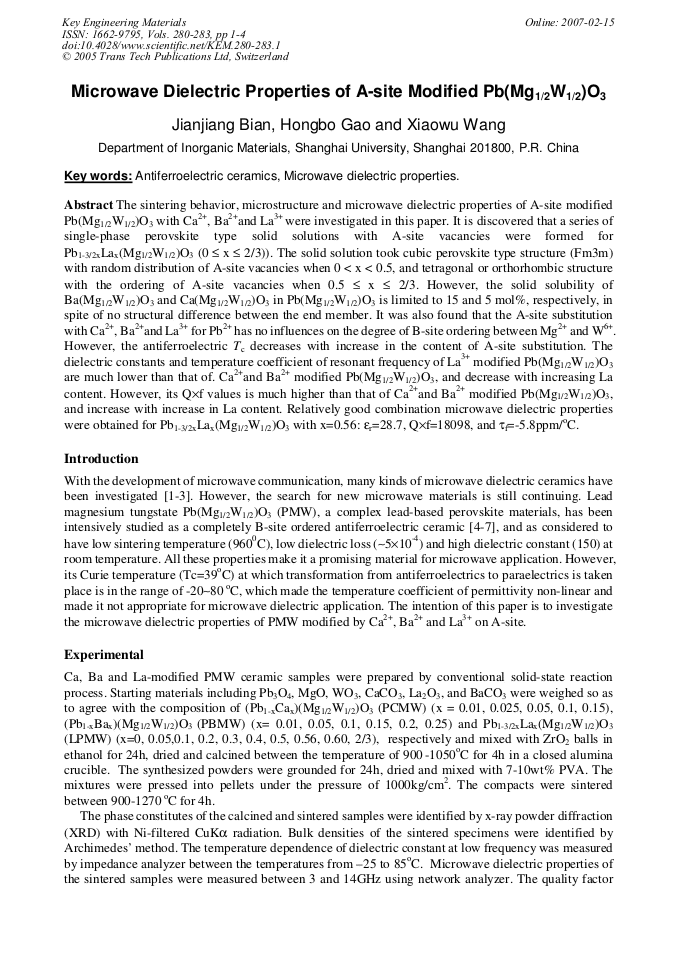
The sintering behavior, microstructure and microwave dielectric properties of A-site modified Pb(Mg1/2W1/2)O3 with Ca2+, Ba2+and La3+ were investigated in this paper. It is discovered that a series of single-phase perovskite type solid solutions with A-site vacancies were formed for Pb1-3/2xLax(Mg1/2W1/2)O3 (0 £ x £ 2/3)). The solid solution took cubic perovskite type structure (Fm3m)with random distribution of A-site vacancies when 0 < x < 0.5, and tetragonal or orthorhombic structure with the ordering of A-site vacancies when 0.5 £ x £ 2/3. However, the solid solubility of Ba(Mg1/2W1/2)O3 and Ca(Mg1/2W1/2)O3 in Pb(Mg1/2W1/2)O3 is limited to 15 and 5 mol%, respectively, in spite of no structural difference between the end member. It was also found that the A-site substitution with Ca2+, Ba2+and La3+ for Pb2+ has no influences on the degree of B-site ordering between Mg2+ and W6+. However, the antiferroelectric Tc decreases with increase in the content of A-site substitution. The dielectric constants and temperature coefficient of resonant frequency of La3+ modified Pb(Mg1/2W1/2)O3 are much lower than that of. Ca2+and Ba2+ modified Pb(Mg1/2W1/2)O3, and decrease with increasing La content. However, its Q×f values is much higher than that of Ca2+and Ba2+ modified Pb(Mg1/2W1/2)O3, and increase with increase in La content. Relatively good combination microwave dielectric properties were obtained for Pb1-3/2xLax(Mg1/2W1/2)O3 with x=0.56: er=28.7, Q×f=18098, and tf=-5.8ppm/oC.
Info:
Periodical:
Pages:
1-4
DOI:
Citation:
Online since:
February 2007
Authors:
Price:
Сopyright:
© 2005 Trans Tech Publications Ltd. All Rights Reserved
Share:
Citation: