A New Deformation Mechanism in Nanoscale Fe-C Composite as a Result of a Stress-Induced α→γ Transformation

Article Preview

Abstract:

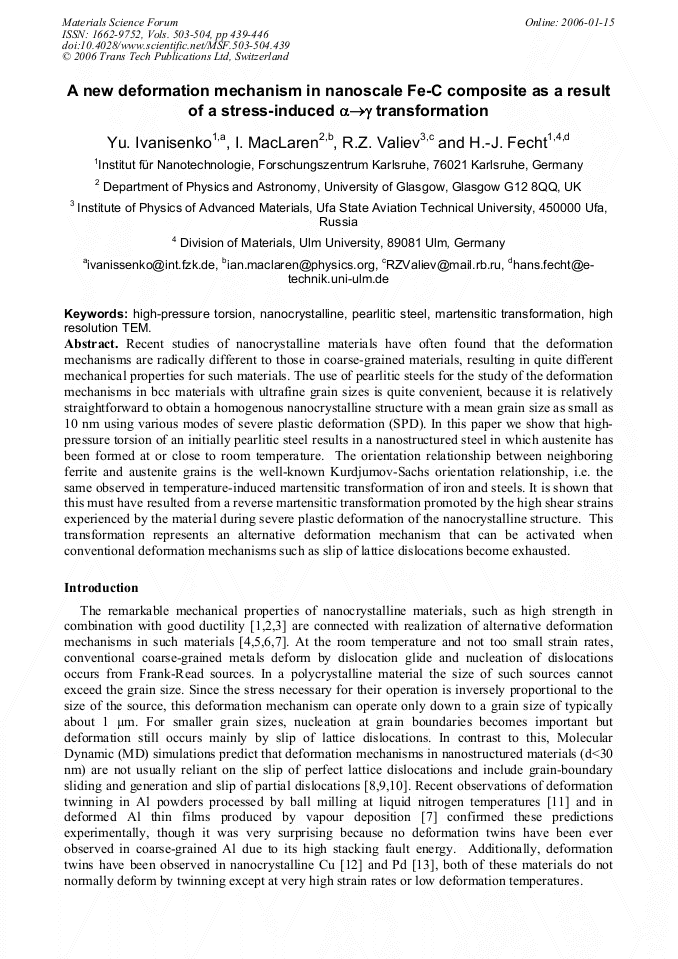
Recent studies of nanocrystalline materials have often found that the deformation mechanisms are radically different to those in coarse-grained materials, resulting in quite different mechanical properties for such materials. The use of pearlitic steels for the study of the deformation mechanisms in bcc materials with ultrafine grain sizes is quite convenient, because it is relatively straightforward to obtain a homogenous nanocrystalline structure with a mean grain size as small as 10 nm using various modes of severe plastic deformation (SPD). In this paper we show that highpressure torsion of an initially pearlitic steel results in a nanostructured steel in which austenite has been formed at or close to room temperature. The orientation relationship between neighboring ferrite and austenite grains is the well-known Kurdjumov-Sachs orientation relationship, i.e. the same observed in temperature-induced martensitic transformation of iron and steels. It is shown that this must have resulted from a reverse martensitic transformation promoted by the high shear strains experienced by the material during severe plastic deformation of the nanocrystalline structure. This transformation represents an alternative deformation mechanism that can be activated when conventional deformation mechanisms such as slip of lattice dislocations become exhausted.
You might also be interested in these eBooks

Info:

Periodical:

Materials Science Forum (Volumes 503-504)

Pages:

439-446

Citation:

Online since:

January 2006

Export:

Price:

Permissions CCC:

Permissions PLS:

Сopyright:

© 2006 Trans Tech Publications Ltd. All Rights Reserved

Share:

Citation:

[1] R. Z. Valiev, I. V. Alexandrov, Y. T. Zhu and T. C. Lowe: J. Mater. Res. Vol. 17 (2002), p.5.

Google Scholar

[2] H. Zhang, H. Wang, R. O. Scattergood, J. Narayan, C. C. Koch, A. V. Sergueeva and A. K. Mukherje: Appl. Phys. Lett. Vol. 81 (2002), p.823.

Google Scholar

[3] D. Jia, Y. M. Wang, K. T. Ramesh, E. Ma, Y. T. Zhu and R. Z. Valiev: Appl. Phys. Lett. Vol. 79 (2001), p.611.

Google Scholar

[4] J. Schiøtz, F. D. Ditolla and K. W. Jacobsen: Nature (London) Vol. 391 (1998), p.561.

Google Scholar

[5] H. Van Swygenhoven: Science Vol. 296 (2002), p.66.

Google Scholar

[6] V. Yamakov, D. Wolf, S. R. Phillpot, A. K. Mukherjee and H. Gleiter: Nature Materials Vol. 1 (2002), p.1.

Google Scholar

[7] M. W. Chen, E. Ma, K. J. Hemker, H. W. Sheng, Y. M. Wang and X. M. Cheng: Science Vol. 300 (2003), p.1275.

Google Scholar

[8] H. Van Swygenhoven: Science: Vol. 296 (2002), p.66.

Google Scholar

[9] V. Yamakov, D. Wolf, M. Salasar, S.R. Phillpot and H Gleiter: Acta Mater: Vol. 49 (2001), p.2713.

Google Scholar

[10] D. Wolf, V. Yamakov, S.R. Phillpot, A. K. Mukherjee and H. Gleiter: Acta Mater: Vol. 53 (2005), p.1.

Google Scholar

[11] X.Z. Liao, F. Zhou, E.J. Lavernia, S.G. Srinivasan, M.I. Baskes, D.W. He and Y.T. Zhu: Appl Phys Lett. Vol. 83 (2003) p.632.

Google Scholar

[12] X.Z. Liao, Y.H. Zhao, S.G. Srinivasan, Y.T. Zhu, R.Z. Valiev and D.V. Gunderov: Appl Phys Lett. Vol. 84 (2004), p.592.

Google Scholar

[13] J. Markmann, P. Bunzel, H. Rösner, K.W. Liu, K.A. Padmanahan, R. Birringer, H. Gleiter and J. Weissmüller: Scripta Mater. Vol. 49 (2003), p.637.

Google Scholar

[14] A.V. Korznikov, Yu.V. Ivanisenko, D.V. Laptionok, I.M. Safarov, V. P Pilyugin and R.Z. Valiev: NanoSrtuctured Materials Vol. 4 (1994), p.159.

DOI: 10.1016/0965-9773(94)90075-2

Google Scholar

[15] Yu. Ivanisenko, W. Lojkowski, R.Z. Valiev and H. -J. Fecht: Acta Mater. Vol. 51 (2003), p.5555.

Google Scholar

[16] Yu. Ivanisenko, I. MacLaren, R.Z. Valiev and H. -J. Fecht, submitted to Nature Materials, (under consideration).

Google Scholar

[17] G. Kurdjumov and G. Sachs: Z Phys Vol. 64 (1930), p.325.

Google Scholar

[18] R.P. Agarwala, H. Wilman: Proc Phys Soc. Vol. 66B (1953), p.717.

Google Scholar

[19] J. Barry and G. Byrne: Mat Sci Eng A Vol. A325 (2002), p.356.

Google Scholar

[20] Z.G. Liu, H.J. Fecht, Y. Xu, J. Yin, K. Tsuchiya and M. Umemoto Mat Sci Eng A Vol. A362 (2003), p.322.

Google Scholar

[21] E.Z. Scheil: Z. Anorg. Allg. Chem. Vol. 207 (1932), p.21.

Google Scholar

[22] Z. Nishiyama: Martensitic Transformations. (Academic Press, New York 1978).

Google Scholar

[23] J.R. Patel and M. Cohen: Acta Metal. Vol. 1 (1953) p.531.

Google Scholar

[24] E. Hornbogen: Acta Metall. Vol. 33 (1985), p.595.

Google Scholar

[25] J.P. Hirth and J. Lothe: Theory of dislocations. (Wiley, New York 1982).

Google Scholar

[26] A. Latapie and D. Farkas: Modelling Simul. Mat Sci Eng A Vol. 11 (2003) p.745.

Google Scholar