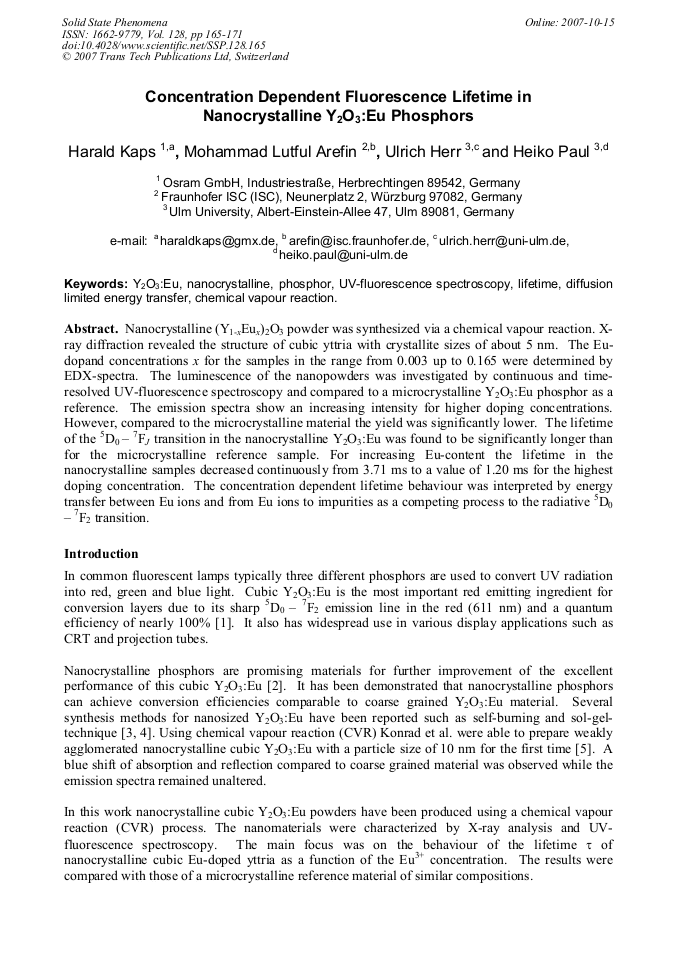
Concentration Dependent Fluorescence Lifetime in Nanocrystalline Y2O3:Eu Phosphors

Article Preview

Abstract:

Nanocrystalline (Y1-xEux)2O3 powder was synthesized via a chemical vapour reaction. Xray diffraction revealed the structure of cubic yttria with crystallite sizes of about 5 nm. The Eudopand concentrations x for the samples in the range from 0.003 up to 0.165 were determined by EDX-spectra. The luminescence of the nanopowders was investigated by continuous and timeresolved UV-fluorescence spectroscopy and compared to a microcrystalline Y2O3:Eu phosphor as a reference. The emission spectra show an increasing intensity for higher doping concentrations. However, compared to the microcrystalline material the yield was significantly lower. The lifetime of the 5D0 – 7FJ transition in the nanocrystalline Y2O3:Eu was found to be significantly longer than for the microcrystalline reference sample. For increasing Eu-content the lifetime in the nanocrystalline samples decreased continuously from 3.71 ms to a value of 1.20 ms for the highest doping concentration. The concentration dependent lifetime behaviour was interpreted by energy transfer between Eu ions and from Eu ions to impurities as a competing process to the radiative 5D0 – 7F2 transition.
You might also be interested in these eBooks

Info:

Periodical:

Solid State Phenomena (Volume 128)

Pages:

165-171

Citation:

Online since:

October 2007

Export:

Price:

Permissions CCC:

Permissions PLS:

Сopyright:

© 2007 Trans Tech Publications Ltd. All Rights Reserved

Share:

Citation:

[1] G. Blasse and B.C. Grabmaier: Luminescent Materials (Springer Verlag, Berlin, 1994).

Google Scholar

[2] U. Herr, H. Kaps and A. Konrad: Solid State Phenomena Vol. 94 (2003) p.85.

Google Scholar

[3] M. Kottaisamy, D. Jeyakumar, R. Jagannathan and M. Mohan Rao: Mater. Res. Bull. Vol. 31 (1996) p.1013.

Google Scholar

[4] Y. Tao, G. Zhao, X. Ju, X. Shao, W. Zhang and S. Xia: Mater. Lett. Vol. 28 (1996) p.137.

Google Scholar

[5] A. Konrad, T. Fries, A. Gahn, F. Kummer, U. Herr, R. Tidecks and K. Samwer: J. Appl. Phys. Vol. 86 (1999) p.3129.

DOI: 10.1063/1.371177

Google Scholar

[6] D.L. Dexter: J. Chem. Phys. Vol 21 (1953) p.836.

Google Scholar

[7] M. Yokota and O. Tanimoto: J. Phys. Soc. Jpn. Vol. 22 (1967) p.779.

Google Scholar

[8] M.J. Weber: Phys Rev. B Vol. 4 (1971) p.2932.

Google Scholar

[9] P.G. de Gennes: J. Phys. Chem. Solids Vol. 7 (1958) p.345.

Google Scholar

[10] A. Konrad, T. Fries, A. Gahn, F. Kummer, U. Herr, R. Tiedecks and K. Samwer: Chem. Vap. Deposition Vol. 5 (1999).

DOI: 10.1002/(sici)1521-3862(199910)5:5<207::aid-cvde207>3.0.co;2-5

Google Scholar

[13] represented by the outlined symbols also fit well into the concentration behavior.

Google Scholar

[11] JCPDS Powder Diffraction File, Joint Commitee on Powder Diffraction Data (JCPDS International Centre for Diffraction Standards, Swarthmore).

DOI: 10.1017/s0885715600011325

Google Scholar

[12] J. Heber, K.H. Hellwege, U. Köbler and H. Murmann: Z. Physik Vol. 237 (1970) p.189.

Google Scholar

[13] R. Schmechel, M. Kennedy, H. von Seggern, H. Winkler, M. Kolbe, R.A. Fischer, L. Xaomao, A. Benker, M. Winterer and H. Hahn, J. Appl. Phys. Vol. 89 (2001) p.1679.

DOI: 10.1063/1.1333033

Google Scholar