Pinning Fermi Level of p-GaN due to Three Different (Zr, Ti, and Cr) Metal Contact
p.262
p.262
Effects of Indium Depositions on Porous Silicon Nanostructure (PSN)
p.267
p.267
Modification of Epoxy Resin Using Liquid Natural Rubber
p.272
p.272
Comparative Studies on Li/LiI-Li2WO4-Li3PO4/Metal Oxide Electrochemical Cells
p.275
p.275
Studies on the Corrosion Protection Property of Acrylic Resin Mixed with Curcumin and Dammar
p.278
p.278
Investigation on Ag/Ti Ohmic Contacts to Si-Doped n-Type Al0.27Ga0.73N and the Effect of Post Annealing Treatments
p.281
p.281
Photovoltaic Properties of Semiconductor (ZnSe)/Polymer (PEO - Chitosan Blend) Junction for Solar Cells Applications
p.287
p.287
Characteristics of Paints Prepared from Lawsonia Pigment and Dammar from Dipterocarpus Grandifoleus
p.290
p.290
Salicylic Acid and Dibuthyl Phatalate (DBP) Interaction in PMMA-Based Gel Electrolytes
p.294
p.294
Characteristics of Paints Prepared from Lawsonia Pigment and Dammar from Dipterocarpus Grandifoleus

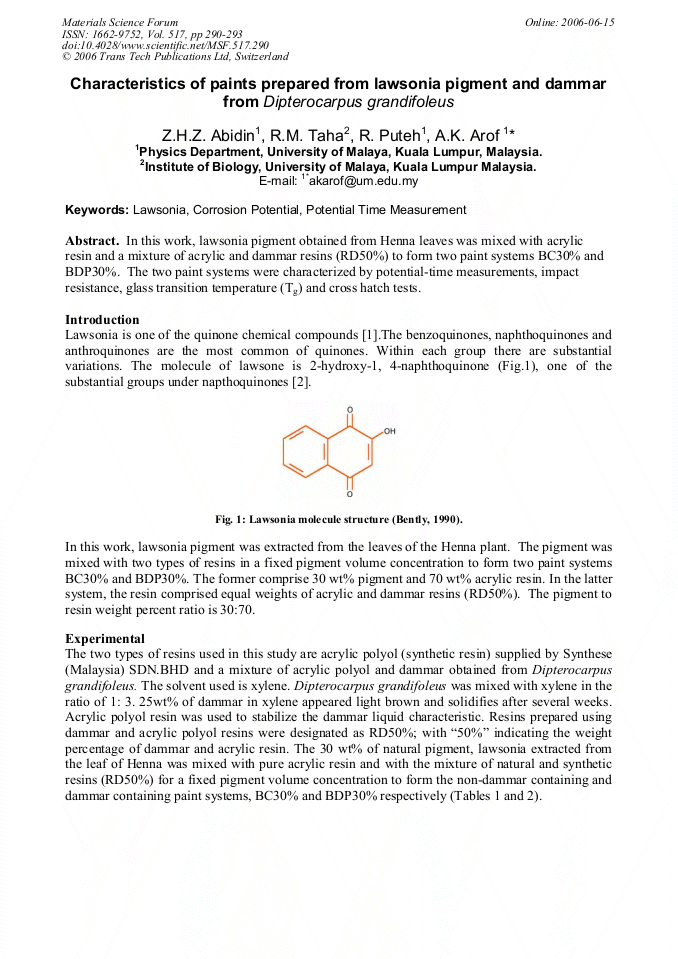
Abstract:
In this work, lawsonia pigment obtained from Henna leaves was mixed with acrylic resin and a mixture of acrylic and dammar resins (RD50%) to form two paint systems BC30% and BDP30%. The two paint systems were characterized by potential-time measurements, impact resistance, glass transition temperature (Tg) and cross hatch tests.
You might also be interested in these eBooks
Info:
Periodical:
Materials Science Forum (Volume 517)
Pages:
290-293
DOI:
Citation:
Online since:
June 2006
Authors:
Keywords:
Price:
Сopyright:
© 2006 Trans Tech Publications Ltd. All Rights Reserved
Share:
Citation: