Electrical Properties of Perovskite-Based Ferroelectric Thin Films Modified Using Rare-Earth Elements

Article Preview

Abstract:

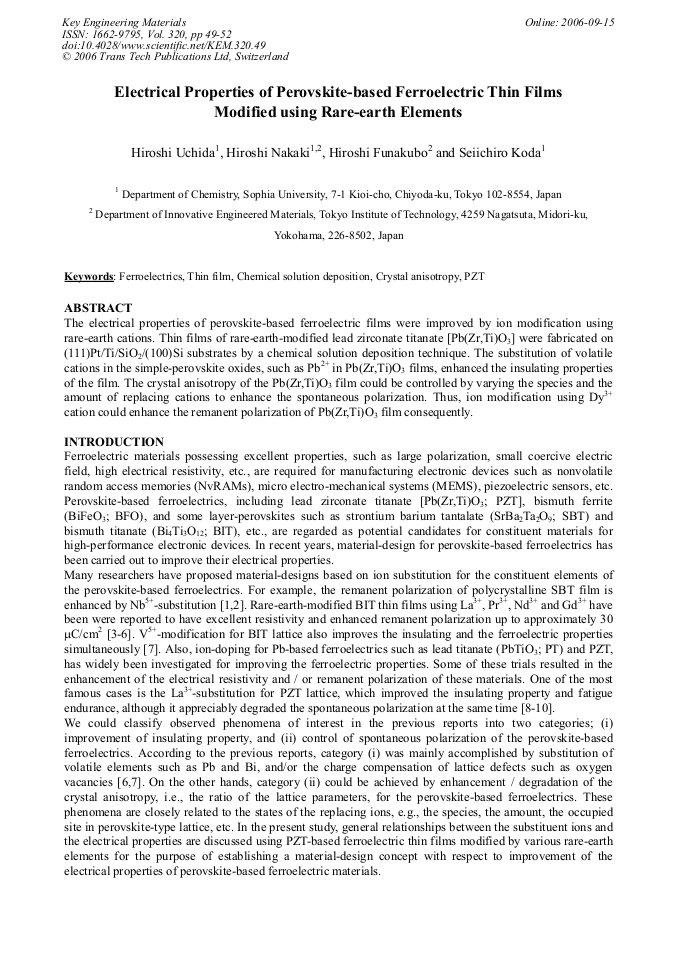
The electrical properties of perovskite-based ferroelectric films were improved by ion modification using rare-earth cations. Thin films of rare-earth-modified lead zirconate titanate [Pb(Zr,Ti)O3] were fabricated on (111)Pt/Ti/SiO2/(100)Si substrates by a chemical solution deposition technique. The substitution of volatile cations in the simple-perovskite oxides, such as Pb2+ in Pb(Zr,Ti)O3 films, enhanced the insulating properties of the film. The crystal anisotropy of the Pb(Zr,Ti)O3 film could be controlled by varying the species and the amount of replacing cations to enhance the spontaneous polarization. Thus, ion modification using Dy3+ cation could enhance the remanent polarization of Pb(Zr,Ti)O3 film consequently.
You might also be interested in these eBooks

Info:

Periodical:

Pages:

49-52

Citation:

Online since:

September 2006

Export:

Price:

Permissions CCC:

Permissions PLS:

Сopyright:

© 2006 Trans Tech Publications Ltd. All Rights Reserved

Share:

Citation:

[1] H. Watanabe, T. Mihara, H. Yoshimori and C. A. Paz de Araujo, Jpn. J. Appl. Phys., 34 (1995) p.5240.

Google Scholar

[2] A. Furuya and J. D. Cuchiaro, J. Appl. Phys., 84 (1998) p.6788.

Google Scholar

[3] B. H. Park, B. S. Kang, S. D. Bu, T. W. Noh, J. Lee and W. Jo, Nature, 401 (1999) p.682.

Google Scholar

[4] T. Kojima, T. Sakai, T. Watanabe, H. Funakubo, K. Saito and M. Osada: Appl. Phys. Lett. 80 (2002) p.2764.

Google Scholar

[5] H. Uchida, H. Yoshikawa, I. Okada, H. Matsuda, T. Iijima, T. Watanabe and H. Funakubo, Jpn. J. Appl. Phys., 41 (2002) p.6820.

Google Scholar

[6] T. Goto, Y. Noguchi, M. Soga and M. Miyayama, Mater. Res. Bull., 40 (2005) p.1044.

Google Scholar

[7] Y. Noguchi and M. Miyayama, Appl. Phys. Lett., 78 (2001) p. (1903).

Google Scholar

[8] E. C. F. Souza, A. Z. Simoes, M. Cilense, E. Longo and J. A. Varela, Mater. Chem. Phys., 88 (2004) p.155.

Google Scholar

[9] K. Tominaga, A. Shirayanagi, T. Takagi and M. Okada, Jpn. J. Appl. Phys., 32 (1993) p.4082.

Google Scholar

[10] S. R. Shannigrahi, F. E. H. Tay, K. Yao and R. N. P. Choudhary, J. Eur. Ceram. Soc., 24 (2004) p.164.

Google Scholar

[11] R. D. Shannon, Acta Crystallogr. Sect. A, 32 (1976) p.751.

Google Scholar

[12] H. B. Park, C. Y. Park, Y. S. Hong, K. Kim and S. J. Kim, J. Am. Ceram. Soc., 82 (1999) p.94.

Google Scholar

[13] T. J. Boyle, P. G. Clem, B. A. Tuttle, G. L. Brennecka, J. T. Dawley, M. A. Rodriguez, T. D. Dunbar and W. H. Hammetter, J. Mater. Res., 17 (2002) p.871.

DOI: 10.1557/jmr.2002.0126

Google Scholar

[14] H. Nakaki, H. Uchida, K. Nishida, M. Osada, H. Funakubo, T. Katoda and S. Koda, Jpn. J. Appl. Phys., 44 (2005) p.6905.

DOI: 10.1143/jjap.44.6905

Google Scholar

[15] T. Kawakubo, S. Komatsu, K. Abe, K. Sano, N. Yanase and N. Fukushima, Jpn. J. Appl. Phys., 37 (1998) p.5108.

Google Scholar

[16] H. Nakaki, H. Uchida, S. Koda, S. Okamoto, H. Funakubo, K. Nishida, T. Katoda and K. Saito, Appl. Phys. Lett., 87 (2005).

DOI: 10.1063/1.2125123

Google Scholar