Influence of Cooling Rate on the Size of the Precipitates and Thermal Characteristic of Al-Si Cast Alloys

Article Preview

Abstract:

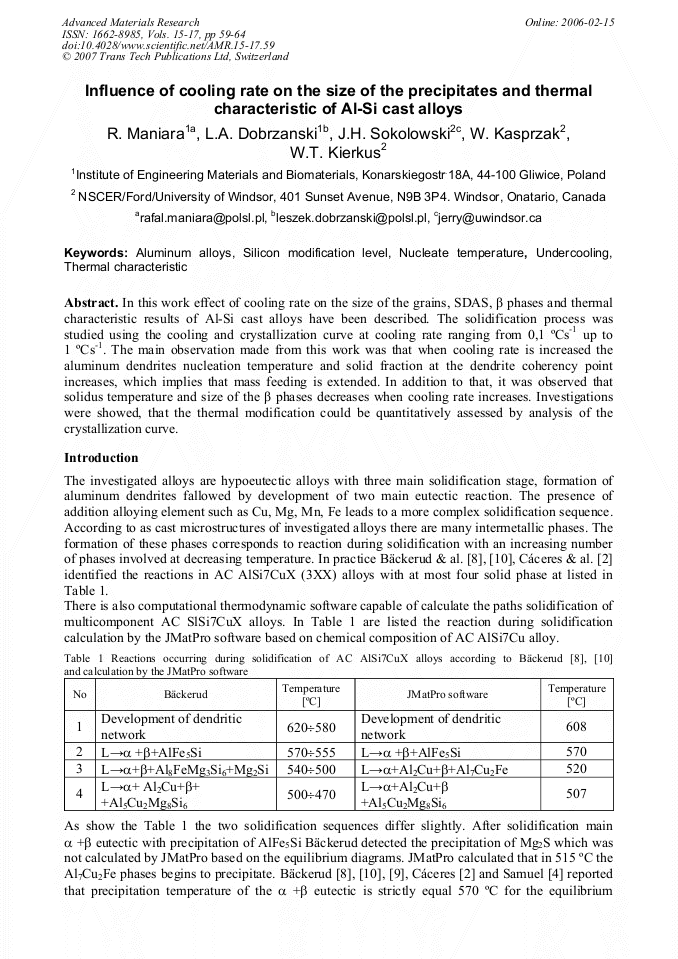
In this work effect of cooling rate on the size of the grains, SDAS, β phases and thermal characteristic results of Al-Si cast alloys have been described. The solidification process was studied using the cooling and crystallization curve at cooling rate ranging from 0,1 °Cs-1 up to 1 °Cs-1. The main observation made from this work was that when cooling rate is increased the aluminum dendrites nucleation temperature and solid fraction at the dendrite coherency point increases, which implies that mass feeding is extended. In addition to that, it was observed that solidus temperature and size of the β phases decreases when cooling rate increases. Investigations were showed, that the thermal modification could be quantitatively assessed by analysis of the crystallization curve.
You might also be interested in these eBooks

Info:

Periodical:

Advanced Materials Research (Volumes 15-17)

Pages:

59-64

Citation:

Online since:

February 2006

Export:

Price:

Permissions CCC:

Permissions PLS:

Сopyright:

© 2007 Trans Tech Publications Ltd. All Rights Reserved

Share:

Citation:

[1] R. MacKay, M. Durdjevic, J. Sokolowski: The effect of cooling rate on the fraction solid of the metallurgical reaction in the 319 alloy, AFS Transaction, (2000).

Google Scholar

[2] C. H Cáceres, M.B. Djurdjevic, T.J. Stockwell, J.H. Sokolowski: Cast Al: The effect of cu content on the level of microporosity in Al-Si-Cu-Mg casting alloys, Scripta Materiala, (1999).

DOI: 10.1016/s1359-6462(98)00492-8

Google Scholar

[3] J.M. Boileau, J.W. Zindel and J.E. Allison: The effect of solidification time on the mechanical properties in a cast A356-T6 aluminum alloy, Society of Automotive Engineers, Inc., (1997).

DOI: 10.4271/970019

Google Scholar

[4] A.M. Samuel, A. Gotmare, F.H. Samuel: Effect of solidification rate and metal feedability on porosity and SiC/Al2O3 particle distributing in an Al-Si-Mg (359) alloy, composite Science and Technology, (1994).

DOI: 10.1016/0266-3538(95)00001-1

Google Scholar

[5] S. Pietrowski: Krystalizacja siluminów w aspekcie oceny metodą ATD, Przegląd Odlewnictwa, Warszawa, (1994).

Google Scholar

[6] S. Pietrowski, R. Władysiak: Estimation of modification and crystallization effect of hypereutectoid silumin by ATD method, International Foundry Conference Solidification and Crystallization of Metals, Gliwce, (1992).

Google Scholar

[7] J. Sakwa: Ocena zmian procesu krystalizacji stopów aluminium pod wpływem dodatków stopowych i domieszek, za pomocą analizy termicznej i derywacyjnej, Prace Instytutu Odlewnictwa Politechniki Śląskiej, Gliwice, (1989).

Google Scholar

[8] L. Backerud, E. Król, J. Tamminen: Solidification characteristics of aluminum alloys, Vol. 1, Universitetsforlaget, Oslo (1986).

Google Scholar

[9] L. Backerud, G. Chai J. Tamminen: Solidification characteristics of aluminum alloys, Vol. 2. AFS (1992).

Google Scholar

[10] L. Backerud, G. Chai: Solidification characteristics of aluminum alloys, Vol. 3, AFS (1992).

Google Scholar

[11] Z. Poniewierski: Krystalizacjia struktura i własności siluminów, WNT, Warszawa (1989).

Google Scholar

[12] American Foundry Society, (AFS): Chart for microstructure control in hypoeutectic aluminum silicon alloys, American Foundry Society, Inc., Des Plaines, Illinois.

Google Scholar