Engineering Biomaterials Surfaces Using Micropatterning

Article Preview

Abstract:

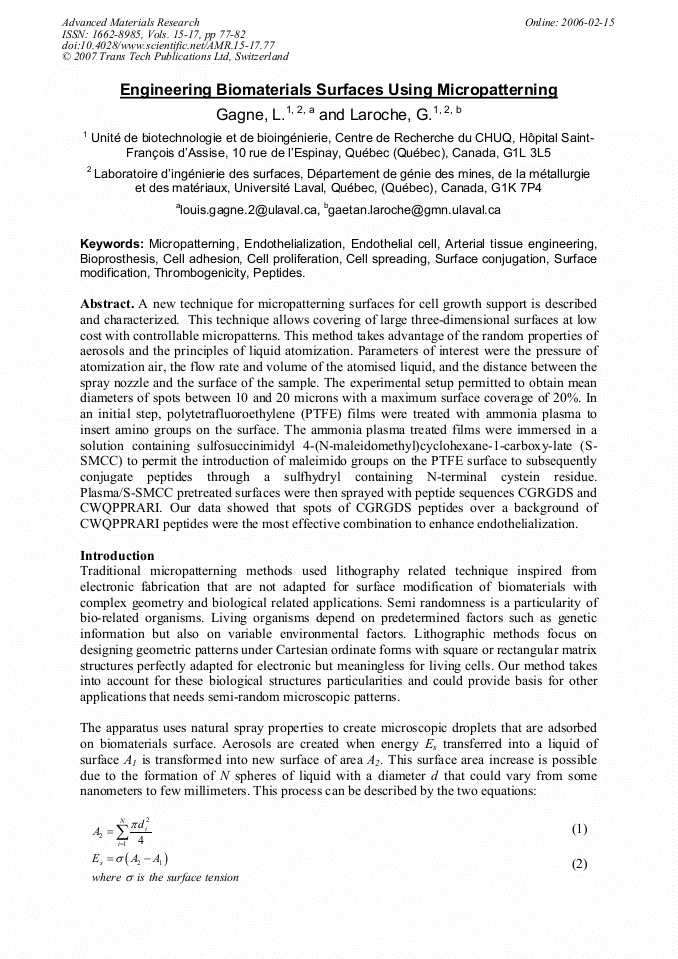
A new technique for micropatterning surfaces for cell growth support is described and characterized. This technique allows covering of large three-dimensional surfaces at low cost with controllable micropatterns. This method takes advantage of the random properties of aerosols and the principles of liquid atomization. Parameters of interest were the pressure of atomization air, the flow rate and volume of the atomised liquid, and the distance between the spray nozzle and the surface of the sample. The experimental setup permitted to obtain mean diameters of spots between 10 and 20 microns with a maximum surface coverage of 20%. In an initial step, polytetrafluoroethylene (PTFE) films were treated with ammonia plasma to insert amino groups on the surface. The ammonia plasma treated films were immersed in a solution containing sulfosuccinimidyl 4-(N-maleidomethyl)cyclohexane-1-carboxy-late (SSMCC) to permit the introduction of maleimido groups on the PTFE surface to subsequently conjugate peptides through a sulfhydryl containing N-terminal cystein residue. Plasma/S-SMCC pretreated surfaces were then sprayed with peptide sequences CGRGDS and CWQPPRARI. Our data showed that spots of CGRGDS peptides over a background of CWQPPRARI peptides were the most effective combination to enhance endothelialization.
You might also be interested in these eBooks

Info:

Periodical:

Advanced Materials Research (Volumes 15-17)

Pages:

77-82

Citation:

Online since:

February 2006

Export:

Price:

Permissions CCC:

Permissions PLS:

Сopyright:

© 2007 Trans Tech Publications Ltd. All Rights Reserved

Share:

Citation:

[1] S. Sadik and Y. Zimmels: J Colloid Interface Sci. Vol 259 (2003), pp.261-274.

Google Scholar

[3] B.M. Gumbiner: Nature Vol 6 (2005), pp.622-634.

Google Scholar

[3] Ch. Ffrench Constant and H. Collognato: Trends Cell Bio. Vol. 14 (2004), pp.668-686.

Google Scholar

[4] A. Woods, J.B. McCarthy, L.T. Furcht and J.R. Couchman: The American Society for Cell Biology Vol 4 (1993), pp.605-613.

Google Scholar

[5] S.W. Akhtar, and A.J. Yule: An experimental approach to producing uniform multiple droplet streams. (ILASS-Europe, Toulouse 1999).

Google Scholar

[6] J.S. Baek, J.Y. Huh, H. Lee, J.H. Jeong and J.H. Choi: Ann Nucl. Energy Vol 23 (1996) pp.1079-1090.

Google Scholar

[7] D. Mantovani et al: Plasmas Polym Vol 4 (1999) pp.207-228.

Google Scholar

[8] S. Sadik, and Y Zimmels: J Colloid Interface Sci. Vol 259 (2003) pp.261-74.

Google Scholar

[9] V. Gauvreau, G. Laroche: Bioconjugate Chem. Vol 16 (2005) pp.1088-1097.

Google Scholar

[10] G.M. Whitesides, E. Ostuni, S. Takayama, X. Jiang, D.E. Ingber: Annu Rev. Biomed. Eng. Vol 3 (2001) pp.335-373.

DOI: 10.1146/annurev.bioeng.3.1.335

Google Scholar

[11] C.S. Chen, M. Mrksich, S. Huang, G.M. Whitesides, and D.E. Ingber: Science Vol 276 (1997) pp.1425-28.

Google Scholar

[12] S. Kulkarni, R. Orth, M. Ferrari, and G. Moldovanni: Biosens Biolectron Vol 19 (2004) pp.1401-1407.

Google Scholar

[13] M. Morra, and C. Cassinelli: Plasmas Polymers Vol 7 (2002) pp.89-101.

Google Scholar

[14] R.G. Flemming, et al: Biomaterials Vol 20 (1999) pp.573-588.

Google Scholar