Room Temperature Creep and its Effect on Fatigue Crack Growth in a X70 Steel with Various Microstructures

Article Preview

Abstract:

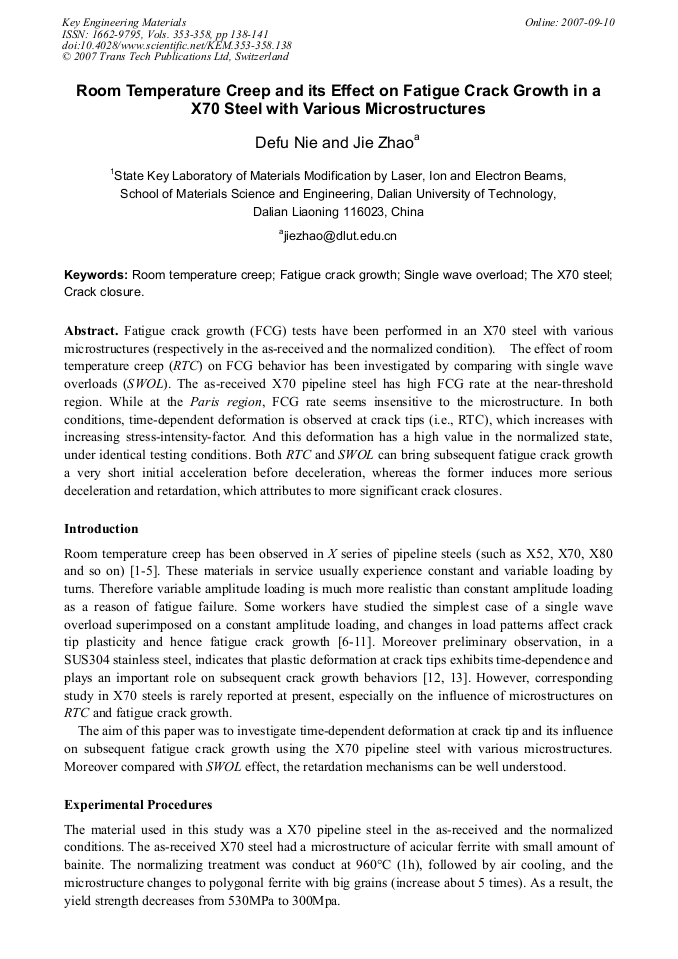
Fatigue crack growth (FCG) tests have been performed in an X70 steel with various microstructures (respectively in the as-received and the normalized condition). The effect of room temperature creep (RTC) on FCG behavior has been investigated by comparing with single wave overloads (SWOL). The as-received X70 pipeline steel has high FCG rate at the near-threshold region. While at the Paris region, FCG rate seems insensitive to the microstructure. In both conditions, time-dependent deformation is observed at crack tips (i.e., RTC), which increases with increasing stress-intensity-factor. And this deformation has a high value in the normalized state, under identical testing conditions. Both RTC and SWOL can bring subsequent fatigue crack growth a very short initial acceleration before deceleration, whereas the former induces more serious deceleration and retardation, which attributes to more significant crack closures.
You might also be interested in these eBooks

Info:

Periodical:

Key Engineering Materials (Volumes 353-358)

Pages:

138-141

Citation:

Online since:

September 2007

Authors:

Export:

Price:

Permissions CCC:

Permissions PLS:

Сopyright:

© 2007 Trans Tech Publications Ltd. All Rights Reserved

Share:

Citation:

[1] S.H. Wang, Y.G. Zhang and W.X. Chen: J. Mater. Sci. Vol. 36 (2001) , p.1931-(1938).

Google Scholar

[2] S.H. Wang and W.X. Chen: Mater. Sci. Eng. A301 (2001), pp.147-153.

Google Scholar

[3] S.H. Wang and W.X. Chen: Mater. Sci. Eng. A325 (2002), pp.144-15.

Google Scholar

[4] D.F. Nie, J. Zhao and T. Mo: J. Mater. Eng. Vol. 6 (2006) , pp.58-61 (in Chinese).

Google Scholar

[5] D.F. Nie, H.X. Zhang and J. Zhao: Transactions of Materials and Heat Treatment. Vol. 27 No. 4 (2006), pp.47-51 (in Chinese).

Google Scholar

[6] C.S. Shin and S.H. Hsu: Int. J. Fatigue. Vol. 15 No. 3 (1993), pp.181-192.

Google Scholar

[7] M. Shimojo, M. Chujo, Y. Higo and S. Nunomura: Int. J. Fatigue. Vol. 20 No. 5 (1998), pp.365-371.

Google Scholar

[8] H. Bao and A.J. McEvily: Int. J. Fatigue. Vol. 20 No. 6 (1998), pp.441-448.

Google Scholar

[9] K. Sadananda, A.K. Vasudevan, R.L. Holtz and E.U. Lee: Int. J. Fatigue. Vol. 21 (1999), p. S233-S246.

Google Scholar

[10] M. darvish and S. Johansson: Eng. Fract. Mech. Vol. 52 No. 2 (2003), pp.295-319.

Google Scholar

[11] L.P. Borrego, J.M. Ferreira, J.M. Pinho da Cruz and J. M. Costa: Eng. Fract. Mech. Vol. 70 (2003), pp.1379-1397.

Google Scholar

[12] J. Zhao, T. Mo, D.F. Nie, M.F. Ren and X.L. Guo, Journal of Materials Science. In press.

Google Scholar

[13] J. Zhao, T. Mo, W.X. Chen and F.G. Wang: Key Engineering Materials. (2005), Advances in Fracture and Strength, pp.1083-1088.

Google Scholar

[14] ASTM Standard E647-05: Standarc Test Method for Measurement of Fatigue Crack Growth Rates. (2005).

Google Scholar

[15] T.H. Alden: Metall. Trans. A 18 A (1987), pp.811-825.

Google Scholar

[16] T.H. Alden: Metall. Trans. A 18 A (1987), pp.51-62.

Google Scholar