p.71
p.77
p.83
p.91
p.97
p.103
p.109
p.117
p.125
Experimental Study on Surface Finishing Performances in Quick-Point Grinding

Abstract:
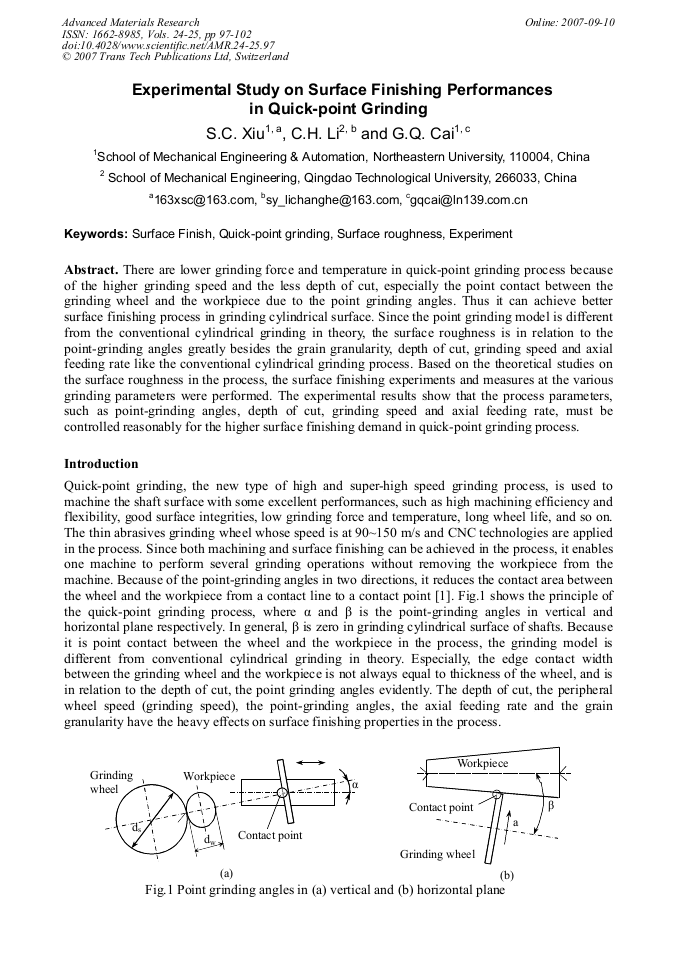
There are lower grinding force and temperature in quick-point grinding process because of the higher grinding speed and the less depth of cut, especially the point contact between the grinding wheel and the workpiece due to the point grinding angles. Thus it can achieve better surface finishing process in grinding cylindrical surface. Since the point grinding model is different from the conventional cylindrical grinding in theory, the surface roughness is in relation to the point-grinding angles greatly besides the grain granularity, depth of cut, grinding speed and axial feeding rate like the conventional cylindrical grinding process. Based on the theoretical studies on the surface roughness in the process, the surface finishing experiments and measures at the various grinding parameters were performed. The experimental results show that the process parameters, such as point-grinding angles, depth of cut, grinding speed and axial feeding rate, must be controlled reasonably for the higher surface finishing demand in quick-point grinding process.
Info:
Periodical:
Pages:
97-102
DOI:
Citation:
Online since:
September 2007
Authors:
Price:
Сopyright:
© 2007 Trans Tech Publications Ltd. All Rights Reserved
Share:
Citation: