p.955
p.961
p.967
p.971
p.977
p.983
p.989
p.995
p.1001
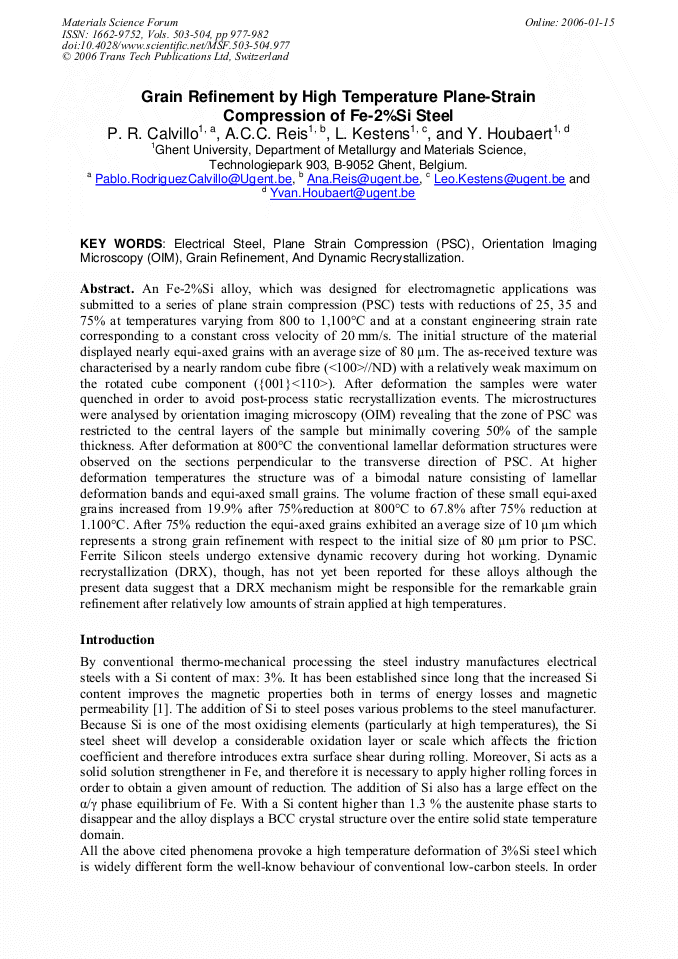
Grain Refinement by High Temperature Plane-Strain Compression of Fe-2%Si Steel

Abstract:
An Fe-2%Si alloy, which was designed for electromagnetic applications was submitted to a series of plane strain compression (PSC) tests with reductions of 25, 35 and 75% at temperatures varying from 800 to 1,100°C and at a constant engineering strain rate corresponding to a constant cross velocity of 20 mm/s. The initial structure of the material displayed nearly equi-axed grains with an average size of 80 μm. The as-received texture was characterised by a nearly random cube fibre (<100>//ND) with a relatively weak maximum on the rotated cube component ({001}<110>). After deformation the samples were water quenched in order to avoid post-process static recrystallization events. The microstructures were analysed by orientation imaging microscopy (OIM) revealing that the zone of PSC was restricted to the central layers of the sample but minimally covering 50% of the sample thickness. After deformation at 800°C the conventional lamellar deformation structures were observed on the sections perpendicular to the transverse direction of PSC. At higher deformation temperatures the structure was of a bimodal nature consisting of lamellar deformation bands and equi-axed small grains. The volume fraction of these small equi-axed grains increased from 19.9% after 75%reduction at 800°C to 67.8% after 75% reduction at 1.100°C. After 75% reduction the equi-axed grains exhibited an average size of 10 μm which represents a strong grain refinement with respect to the initial size of 80 μm prior to PSC. Ferrite Silicon steels undergo extensive dynamic recovery during hot working. Dynamic recrystallization (DRX), though, has not yet been reported for these alloys although the present data suggest that a DRX mechanism might be responsible for the remarkable grain refinement after relatively low amounts of strain applied at high temperatures.
Info:
Periodical:
Pages:
977-982
Citation:
Online since:
January 2006
Price:
Сopyright:
© 2006 Trans Tech Publications Ltd. All Rights Reserved
Share:
Citation: