p.229
p.235
p.241
p.249
p.255
p.262
p.266
p.274
p.282
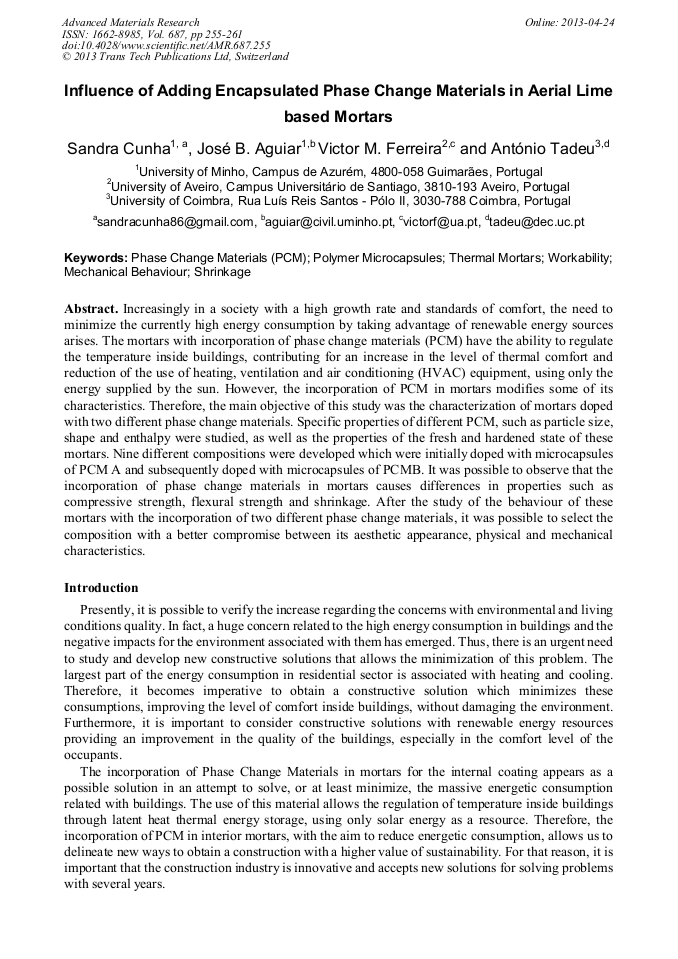
Influence of Adding Encapsulated Phase Change Materials in Aerial Lime Based Mortars

Abstract:
Increasingly in a society with a high growth rate and standards of comfort, the need to minimize the currently high energy consumption by taking advantage of renewable energy sources arises. The mortars with incorporation of phase change materials (PCM) have the ability to regulate the temperature inside buildings, contributing for an increase in the level of thermal comfort and reduction of the use of heating, ventilation and air conditioning (HVAC) equipment, using only the energy supplied by the sun. However, the incorporation of PCM in mortars modifies some of its characteristics. Therefore, the main objective of this study was the characterization of mortars doped with two different phase change materials. Specific properties of different PCM, such as particle size, shape and enthalpy were studied, as well as the properties of the fresh and hardened state of these mortars. Nine different compositions were developed which were initially doped with microcapsules of PCM A and subsequently doped with microcapsules of PCM B. It was possible to observe that the incorporation of phase change materials in mortars causes differences in properties such as compressive strength, flexural strength and shrinkage. After the study of the behaviour of these mortars with the incorporation of two different phase change materials, it was possible to select the composition with a better compromise between its aesthetic appearance, physical and mechanical characteristics.
Info:
Periodical:
Pages:
255-261
DOI:
Citation:
Online since:
April 2013
Authors:
Price:
Permissions CCC:
Permissions PLS:
Сopyright:
© 2013 Trans Tech Publications Ltd. All Rights Reserved
Share:
Citation: