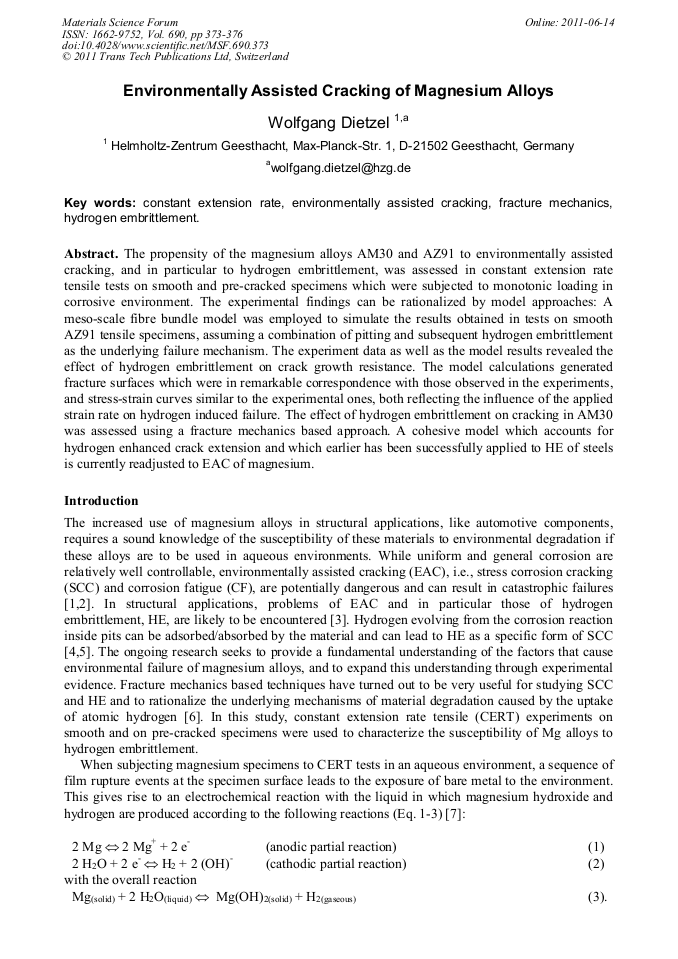
Environmentally Assisted Cracking of Magnesium Alloys

Article Preview

Abstract:

The propensity of the magnesium alloys AM30 and AZ91 to environmentally assisted cracking, and in particular to hydrogen embrittlement, was assessed in constant extension rate tensile tests on smooth and pre-cracked specimens which were subjected to monotonic loading in corrosive environment. The experimental findings can be rationalized by model approaches: A meso-scale fibre bundle model was employed to simulate the results obtained in tests on smooth AZ91 tensile specimens, assuming a combination of pitting and subsequent hydrogen embrittlement as the underlying failure mechanism. The experiment data as well as the model results revealed the effect of hydrogen embrittlement on crack growth resistance. The model calculations generated fracture surfaces which were in remarkable correspondence with those observed in the experiments, and stress-strain curves similar to the experimental ones, both reflecting the influence of the applied strain rate on hydrogen induced failure. The effect of hydrogen embrittlement on cracking in AM30 was assessed using a fracture mechanics based approach. A cohesive model which accounts for hydrogen enhanced crack extension and which earlier has been successfully applied to HE of steels is currently readjusted to EAC of magnesium.
You might also be interested in these eBooks

Info:

Periodical:

Pages:

373-376

Citation:

Online since:

June 2011

Authors:

Export:

Price:

Permissions CCC:

Permissions PLS:

Сopyright:

© 2011 Trans Tech Publications Ltd. All Rights Reserved

Share:

Citation:

[1] E. Ghali, W. Dietzel and K.U. Kainer: Journal of Materials Engineering and Performance Vol. 13, 1 (2004), p.7.

Google Scholar

[2] W. Dietzel and A. Turnbull, in: Comprehensive Structural Integrity, Addendum 2007, edited by K. -H. Schwalbe, Mechanical Characterization of Materials. Elsevier, Oxford, UK (2007), p.43.

Google Scholar

[3] N. Winzer, A. Atrens, G. Song, E. Ghali, W. Dietzel, K.U. Kainer, N. Hort and C. Blawert: Adv. Advanced Engineering Materials Vol. 8 (2005), p.659.

DOI: 10.1002/adem.200500071

Google Scholar

[4] N. Winzer, A. Atrens, W. Dietzel and K.U. Kainer: Metallurgical and Materials Transactions A. Vol. 39, 5 (2008), p.1157.

Google Scholar

[5] W. Dietzel, M. Pfuff and N. Winzer: Engineering Fracture Mechanics Vol. 77, 2 (2010), p.257.

Google Scholar

[6] N. Winzer, A. Atrens, W. Dietzel, G. Song, V.S. Raja and K.U. Kainer: Materials Science & Engineering A Vol. 488 (2008), p.339.

DOI: 10.1016/j.msea.2007.11.064

Google Scholar

[7] A. Atrens and W. Dietzel: Advanced Engineering Materials Vol. 9, (2007), p.292.

Google Scholar

[8] W. Dietzel and K. -H. Schwalbe, in: Hydrogen Effects on Material Behaviour, edited by N.R. Moody and A.W. Thompson, The Minerals, Metals & Materials Society, Warrendale, PA (1990), p.975.

Google Scholar

[9] W. Dietzel and K. -H. Schwalbe: Zeitschrift fuer Materialprüfung/Materials Testing Vol. 28 (1986), p.368.

Google Scholar

[10] N. Winzer, A. Atrens, W. Dietzel, G. Song and K.U. Kainer: Advanced Engineering Materials Vol. 10, 5 (2008), p.453.

Google Scholar

[11] R. Falkenberg, W. Brocks, W. Dietzel and I. Scheider: Key Engineering Materials Vols. 417-418 (2010), p.329.

Google Scholar