Performance and Modeling of a Pilot-Scale Up-Flow Anaerobic Sludge Blanket (UASB) Treating Pharmaceutical Wastewater Containing Berberine

Article Preview

Abstract:

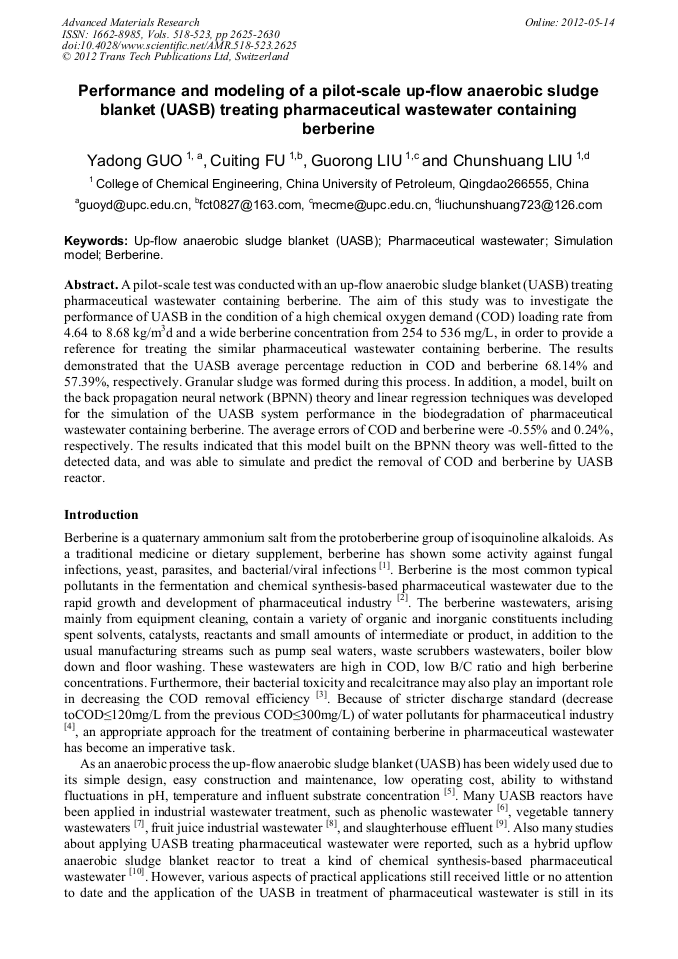
A pilot-scale test was conducted with an up-flow anaerobic sludge blanket (UASB) treating pharmaceutical wastewater containing berberine. The aim of this study was to investigate the performance of UASB in the condition of a high chemical oxygen demand (COD) loading rate from 4.64 to 8.68 kg/m3d and a wide berberine concentration from 254 to 536 mg/L, in order to provide a reference for treating the similar pharmaceutical wastewater containing berberine. The results demonstrated that the UASB average percentage reduction in COD and berberine 68.14% and 57.39%, respectively. Granular sludge was formed during this process. In addition, a model, built on the back propagation neural network (BPNN) theory and linear regression techniques was developed for the simulation of the UASB system performance in the biodegradation of pharmaceutical wastewater containing berberine. The average errors of COD and berberine were -0.55% and 0.24%, respectively. The results indicated that this model built on the BPNN theory was well-fitted to the detected data, and was able to simulate and predict the removal of COD and berberine by UASB reactor.
You might also be interested in these eBooks

Info:

Periodical:

Advanced Materials Research (Volumes 518-523)

Pages:

2625-2630

Citation:

Online since:

May 2012

Export:

Price:

Permissions CCC:

Permissions PLS:

Сopyright:

© 2012 Trans Tech Publications Ltd. All Rights Reserved

Share:

Citation:

[1] D.C. Wang, L. Yu and H. Xiang: FEMS Microbiology Letters Vol. 279 (2008), p.217

Google Scholar

[2] H. Xiao, S.XIAO and Y.SONG: Journal of Environmental Engineering Technology Vol. 1 (2011), p.15 (in Chinese)

Google Scholar

[3] C.Z. Huang, P. Feng and Y.F. Li.: Analytica Chimica Acta Vol. 538 (2005), p.337

Google Scholar

[4] The Peoples Republic of China Ministry of Environmental Protection, Integrated Wastewater Discharge Standard GB 21906-2008 (2008).

Google Scholar

[5] Y.T. Ahn, S.T. Kang and S.R. Chae: Desalination Vol. 202 (2007), p.114

Google Scholar

[6] Athar Hussain, Pradeep Kumar and Indu Mehrotra: Desalination Vol. 250 (2010), p.35

Google Scholar

[7] A. Mannucci, G. Munz and G.Mori: Desalination Vol. 264 (2010), p.1

Google Scholar

[8] Hala El-Kamah and Ahmed Tawfik: Desalination Vol. 253 (2010), p.158

Google Scholar

[9] I.R. de Nardi, V. Del Nery and A.K.B. Amorim: Desalination Vol. 269(2011), p.184

Google Scholar

[10] Shreeshivadasan Chelliapan, Thomas Wilby and Ali Yuzir: Desalination Vol. 271 (2011), p.257

Google Scholar

[11] B. Kasapgil Ince, A. Selcuk and O. Ince: Journal of Chemical Technology & Biotechnology Vol. 77 (2002), p.711

Google Scholar

[12] K. Yetilmezsoy and S. Sakar: Journal of Hazardous Materials Vol. 153 (2008), p.532

Google Scholar

[13] A. Tawfik, A. Ohashi and H. Harada: Biochemical Engineering Journal Vol. 29 (2006), p.210

Google Scholar

[14] N. Mahmoud: Bioresource Technology Vol. 99 (2008), p.7531

Google Scholar

[15] Z. Chen, N. Ren and A. Wang: Water Research Vol. 42 (2008), p.3385

Google Scholar

[16] Y. Shi, X.T. Zhao and Y.M. Zhang: Journal of Biotechnology Vol. 144 (2009), p.70

Google Scholar

[17] D. Hanbay, I. Turkoglu and Y. Demir: Expert Systems with Applications Vol. 34 (2008), p.1038

Google Scholar