Optical Properties of PTCDA Bulk Crystals and Ultrathin Films

Article Preview

Abstract:

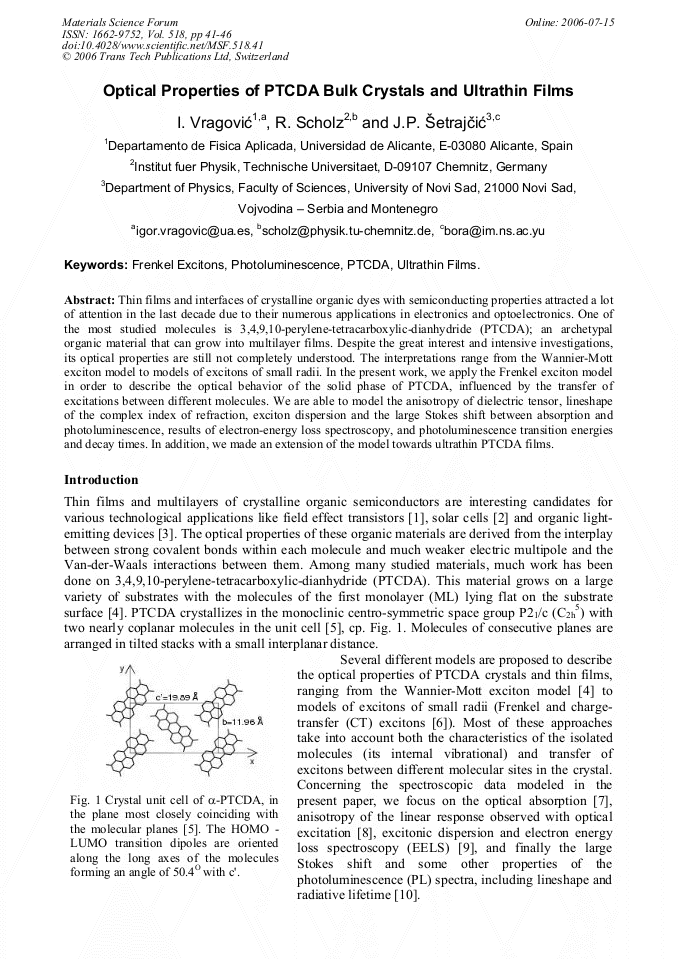
Thin films and interfaces of crystalline organic dyes with semiconducting properties attracted a lot of attention in the last decade due to their numerous applications in electronics and optoelectronics. One of the most studied molecules is 3,4,9,10-perylene-tetracarboxylic-dianhydride (PTCDA); an archetypal organic material that can grow into multilayer films. Despite the great interest and intensive investigations, its optical properties are still not completely understood. The interpretations range from the Wannier-Mott exciton model to models of excitons of small radii. In the present work, we apply the Frenkel exciton model in order to describe the optical behavior of the solid phase of PTCDA, influenced by the transfer of excitations between different molecules. We are able to model the anisotropy of dielectric tensor, lineshape of the complex index of refraction, exciton dispersion and the large Stokes shift between absorption and photoluminescence, results of electron-energy loss spectroscopy, and photoluminescence transition energies and decay times. In addition, we made an extension of the model towards ultrathin PTCDA films.
You might also be interested in these eBooks

Info:

Periodical:

Pages:

41-46

Citation:

Online since:

July 2006

Export:

Price:

Permissions CCC:

Permissions PLS:

Сopyright:

© 2006 Trans Tech Publications Ltd. All Rights Reserved

Share:

Citation:

[1] R. Hajlaoui, G. Horowitz, F. Garnier, A. Arce-Brouchet, L. Laigre, A. El Kassimi, F. Demanze and K. Kouki: Adv. Mater. Vol. 9 (1997), p.389.

DOI: 10.1002/adma.19970090504

Google Scholar

[2] J. Simon and J. -J. Andre: Molecular Semiconductors (Springer, Berlin 1985).

Google Scholar

[3] H. Neureiter, W. Gebauer, C. Vaeterlein, M. Sokolowski, P. Baeuerle and E. Umbach: Synth. Met. Vol. 67 (1994), p.173.

Google Scholar

[4] S.R. Forrest: Chem. Rev. Vol. 97 (1997), p.1793.

Google Scholar

[5] A.J. Lovinger, S.R. Forrest, M.L. Kaplan, P.H. Schmidt and T. Venkatesan: J. Appl. Phys. Vol. 55 (1984), p.476.

Google Scholar

[6] M. Hoffmann, K. Schmidt, T. Fritz, T. Hasche, V.M. Agranovich and K. Leo: Chem. Phys. Vol. 258 (2000), p.73.

Google Scholar

[7] A. Djurisic, T. Fritz and K. Leo: Opt. Commun. Vol. 183 (2000), p.123.

Google Scholar

[8] M.I. Alonso, M. Garriga, N. Karl, J.O. Osso and F. Schreiber: Organic Electronics Vol. 3 (2002), p.23.

Google Scholar

[9] M. Knupfer, T. Schwieger, J. Fink, K. Leo and M. Hoffmann: Phys. Rev. B Vol. 66 (2002), p.035208.

Google Scholar

[10] A. Yu. Kobitiski, R. Scholz, I. Vragovic, H.P. Wagner and D.R.T. Zahn: Phys. Rev. B Vol. 66 (2002), p.153204.

Google Scholar

[11] U. Gomez, M. Leonhardt, H. Port and H.C. Wolf: Chem. Phys. Lett. Vol. 268 (1997), p.1.

Google Scholar

[12] V.M. Agranovich and M.D. Galanin: Electronic Excitation Energy Transfer in Condensed Matter (North-Holland, Amsterdam 1982).

Google Scholar

[13] I. Vragovic, R. Scholz and M. Schreiber: Europhys. Lett. Vol. 57 (2002), p.288; I. Vragovic and R. Scholz: Phys. Rev. B Vol. 68 (2003), p. 155202I; I. Vragovic: PhD thesis (Technische Universitaet Chemnitz 2003).

Google Scholar

[14] J.P.R. Bolton and M. Chen: Ultramicroscopy Vol. 60 (1995), p.247; J. Phys. C Vol. 7 (1995), p.3405.

Google Scholar

[15] R. Scholz, I. Vragovic, A. Yu. Kobitski, M. Schreiber, H.P. Wagner and D.R.T. Zahn: Phys. Stat. Sol. (b) Vol. 234 (2002), p.402.

Google Scholar

[16] J.P. Setrajcic, S.M. Stojkovic, S.B. Lazarev, I.D. Vragovic and D. Lj. Mirjanic: SPIE-PL Proc. 5 th Conf. Dielectric and Related Phenomena 37DP Vol. 162 (1999).

Google Scholar

[17] V. Sajfert, B.S. Tosic, M.M. Marinkovic and U.F. Kozmidis-Luburic: Physica A Vol. 166 (1990), p.430.

Google Scholar

[18] V.M. Agranovich, K. Schmidt and K. Leo: Chem. Phys. Lett. Vol. 325 (2000), p.308.

Google Scholar