Detection Properties of CdZnTe Semiconductor for Diagnostic X-Ray Spectroscopic Applications

Article Preview

Abstract:

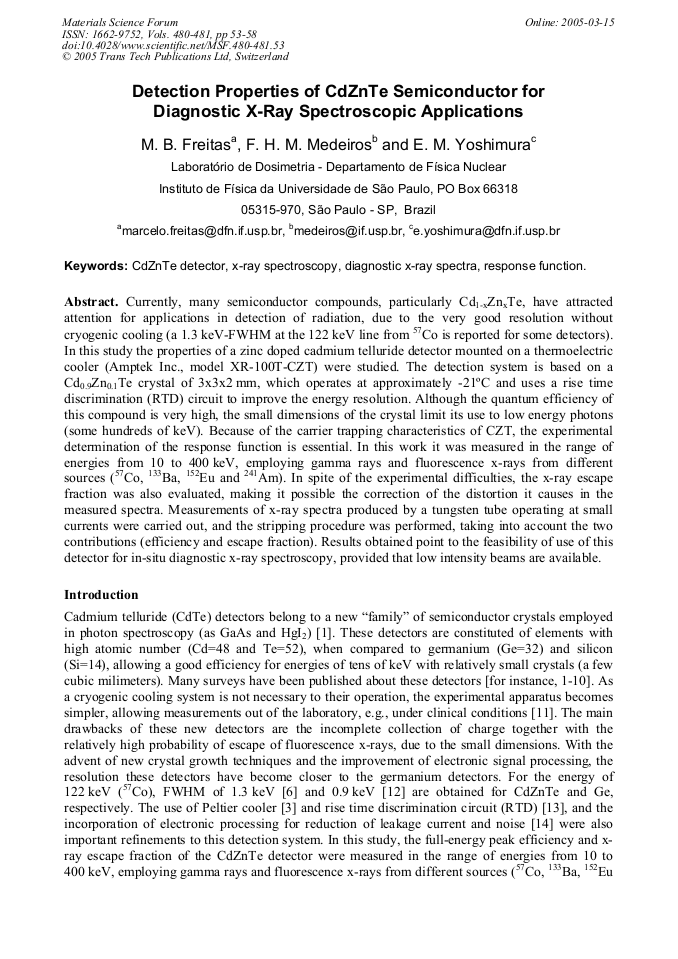
Currently, many semiconductor compounds, particularly Cd1-xZnxTe, have attracted attention for applications in detection of radiation, due to the very good resolution without cryogenic cooling (a 1.3 keV-FWHM at the 122 keV line from 57Co is reported for some detectors). In this study the properties of a zinc doped cadmium telluride detector mounted on a thermoelectric cooler (Amptek Inc., model XR-100T-CZT) were studied. The detection system is based on a Cd0.9Zn0.1Te crystal of 3x3x2 mm, which operates at approximately -21°C and uses a rise time discrimination (RTD) circuit to improve the energy resolution. Although the quantum efficiency of this compound is very high, the small dimensions of the crystal limit its use to low energy photons (some hundreds of keV). Because of the carrier trapping characteristics of CZT, the experimental determination of the response function is essential. In this work it was measured in the range of energies from 10 to 400 keV, employing gamma rays and fluorescence x-rays from different sources (57Co, 133Ba, 152Eu and 241Am). In spite of the experimental difficulties, the x-ray escape fraction was also evaluated, making it possible the correction of the distortion it causes in the measured spectra. Measurements of x-ray spectra produced by a tungsten tube operating at small currents were carried out, and the stripping procedure was performed, taking into account the two contributions (efficiency and escape fraction). Results obtained point to the feasibility of use of this detector for in-situ diagnostic x-ray spectroscopy, provided that low intensity beams are available.
You might also be interested in these eBooks

Info:

Periodical:

Materials Science Forum (Volumes 480-481)

Pages:

53-58

Citation:

Online since:

March 2005

Export:

Price:

Permissions CCC:

Permissions PLS:

Сopyright:

© 2005 Trans Tech Publications Ltd. All Rights Reserved

Share:

Citation:

[1] McGregor, D. S. and Hermon, H., Nucl. Instr. and Meth. A395, 101 (1997).

Google Scholar

[2] Di Castro, E., Pani, R., Pellegrini, R. and Bacci, C., Phys. Med. Biol. 29(9), 1117 (1984).

Google Scholar

[3] Khusainov, A. Kh., Nucl. Instr. and Meth. A322, 335 (1992).

Google Scholar

[4] Conti, M. et al., Nucl. Instr. and Meth. A322, 591 (1992).

Google Scholar

[5] Eisen, Y., Nucl. Instr. and Meth. A380, 431 (1996).

Google Scholar

[6] Becker, P. H. B., Espectrometria de feixes de raios X com detector de telureto de cádmio e zinco. Master thesis (in Portuguese). Instituto Militar de Engenharia (IME), Rio de Janeiro (1997).

DOI: 10.18605/2175-7275/cereus.v10n2p137-141

Google Scholar

[7] Dardenne, Y. X. et al., Nucl. Instr. and Meth. A422, 159 (1999).

Google Scholar

[8] Miyajima, S., Sakuragi, H. and Matsumoto, M., Nucl. Instr. and Meth. A485, 533 (2002).

Google Scholar

[9] Miyajima, S., Imagawa, K., and Matsumoto, M., Med. Phys. 29(7), 1421 (2002).

Google Scholar

[10] Miyajima, S., Med. Phys. 30(5), 771 (2003).

Google Scholar

[11] Matsumoto, M., Yamamoto, A., Honda, I., Taniguchi, A. and Kanamori, H., Med. Phys. 27(7), 1490 (2000).

Google Scholar

[12] Debertin, K. and Helmer, R., G., Gamma and x-ray spectrometry with semiconductor detectors. (North-Holland , Netherlands, 1988).

Google Scholar

[13] Ritcher, M. and Siffert, P., Nucl. Instr. and Meth. A322, 529 (1992).

Google Scholar

[14] Redus, R. et al., Nucl. Instr. and Meth. A353, 59 (1994).

Google Scholar

[15] Milner, W. T., VAXPAK programs notes - private comunications, ORNL - OAK Ridge National Laboratory, USA (1986).

Google Scholar

[16] Seelenntag, W. W. and Panzer, W., Phys. Med. Biol. 24(4), 767 (1979).

Google Scholar

[17] Seuntjens, J., Thierens, H., Van der Plaetsen, A. and Segaert, O., Phys. Med. Biol. 32(5), 595 (1987).

Google Scholar