p.381
p.385
p.389
p.393
p.397
p.401
p.405
p.409
p.413
In Vitro Degradation of Medical Polyacrylamide Hydrogel I.Oxidation

Abstract:
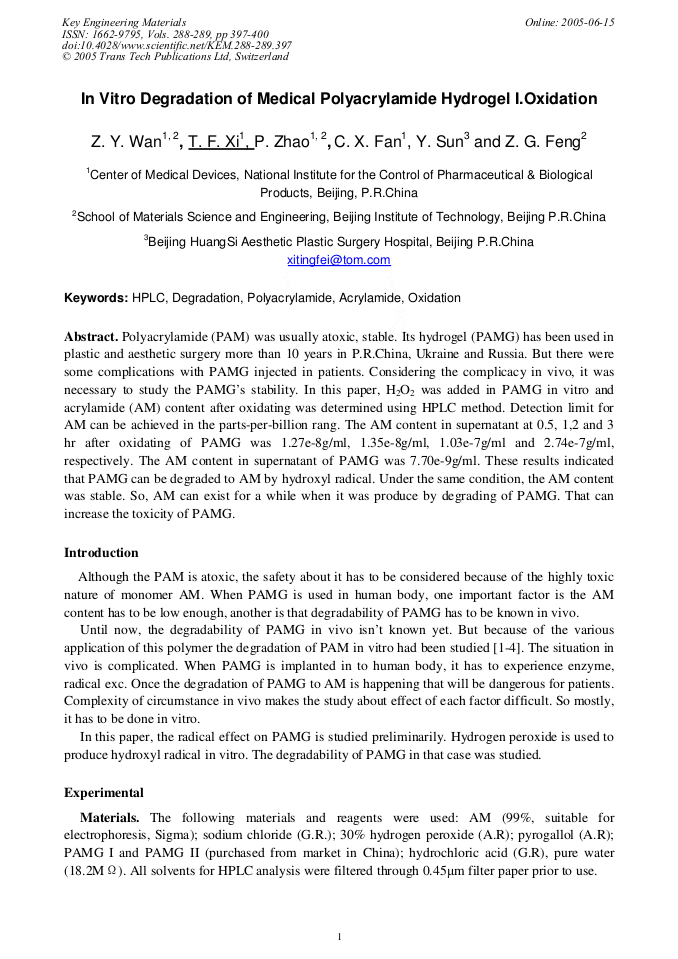
Polyacrylamide (PAM) was usually atoxic, stable. Its hydrogel (PAMG) has been used in plastic and aesthetic surgery more than 10 years in P.R.China, Ukraine and Russia. But there were some complications with PAMG injected in patients. Considering the complicacy in vivo, it was necessary to study the PAMG’s stability. In this paper, H2O2 was added in PAMG in vitro and acrylamide (AM) content after oxidating was determined using HPLC method. Detection limit for AM can be achieved in the parts-per-billion rang. The AM content in supernatant at 0.5, 1,2 and 3 hr after oxidating of PAMG was 1.27e-8g/ml, 1.35e-8g/ml, 1.03e-7g/ml and 2.74e-7g/ml, respectively. The AM content in supernatant of PAMG was 7.70e-9g/ml. These results indicated that PAMG can be degraded to AM by hydroxyl radical. Under the same condition, the AM content was stable. So, AM can exist for a while when it was produce by degrading of PAMG. That can increase the toxicity of PAMG.
Info:
Periodical:
Pages:
397-400
Citation:
Online since:
June 2005
Authors:
Price:
Сopyright:
© 2005 Trans Tech Publications Ltd. All Rights Reserved
Share:
Citation: