p.131
p.137
p.143
p.149
p.157
p.167
p.173
p.179
p.185
The Use of Rodrigues-Frank Space for Representing Discrete Misorientation Distributions

Abstract:
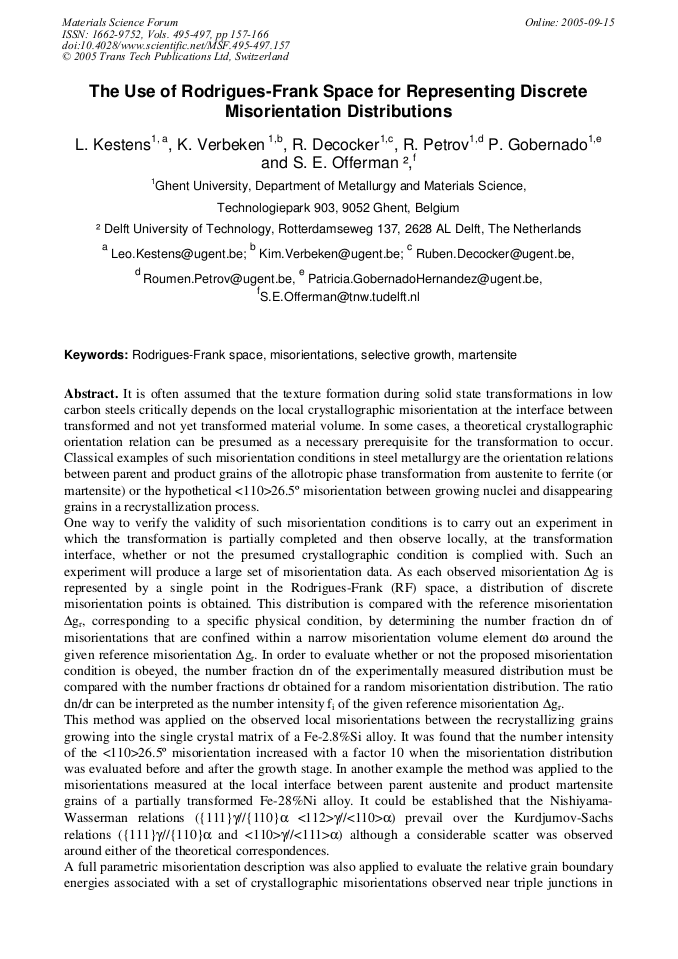
It is often assumed that the texture formation during solid state transformations in low carbon steels critically depends on the local crystallographic misorientation at the interface between transformed and not yet transformed material volume. In some cases, a theoretical crystallographic orientation relation can be presumed as a necessary prerequisite for the transformation to occur. Classical examples of such misorientation conditions in steel metallurgy are the orientation relations between parent and product grains of the allotropic phase transformation from austenite to ferrite (or martensite) or the hypothetical <110>26.5º misorientation between growing nuclei and disappearing grains in a recrystallization process. One way to verify the validity of such misorientation conditions is to carry out an experiment in which the transformation is partially completed and then observe locally, at the transformation interface, whether or not the presumed crystallographic condition is complied with. Such an experiment will produce a large set of misorientation data. As each observed misorientation Dg is represented by a single point in the Rodrigues-Frank (RF) space, a distribution of discrete misorientation points is obtained. This distribution is compared with the reference misorientation Dgr, corresponding to a specific physical condition, by determining the number fraction dn of misorientations that are confined within a narrow misorientation volume element dw around the given reference misorientation Dgr. In order to evaluate whether or not the proposed misorientation condition is obeyed, the number fraction dn of the experimentally measured distribution must be compared with the number fractions dr obtained for a random misorientation distribution. The ratio dn/dr can be interpreted as the number intensity fi of the given reference misorientation Dgr. This method was applied on the observed local misorientations between the recrystallizing grains growing into the single crystal matrix of a Fe-2.8%Si alloy. It was found that the number intensity of the <110>26.5º misorientation increased with a factor 10 when the misorientation distribution was evaluated before and after the growth stage. In another example the method was applied to the misorientations measured at the local interface between parent austenite and product martensite grains of a partially transformed Fe-28%Ni alloy. It could be established that the Nishiyama- Wasserman relations ({111}g//{110}a <112>g//<110>a) prevail over the Kurdjumov-Sachs relations ({111}g//{110}a and <110>g//<111>a) although a considerable scatter was observed around either of the theoretical correspondences. A full parametric misorientation description was also applied to evaluate the relative grain boundary energies associated with a set of crystallographic misorientations observed near triple junctions in Fe-2%Si. In this instance it was found that the boundaries carrying a misorientation of the type <110>w carry a lower interfacial energy than the <100> or <111> type boundaries.

Info:
Periodical:
Pages:
157-166
Citation:
Online since:
September 2005
Keywords:
Price:
Сopyright:
© 2005 Trans Tech Publications Ltd. All Rights Reserved
Share:
Citation: