p.1938
p.1943
p.1948
p.1953
p.1958
p.1962
p.1967
p.1972
p.1978
Identification of the Seaweed Fluorescence Spectroscopy Based on the PCA and ICA-SVM

Abstract:
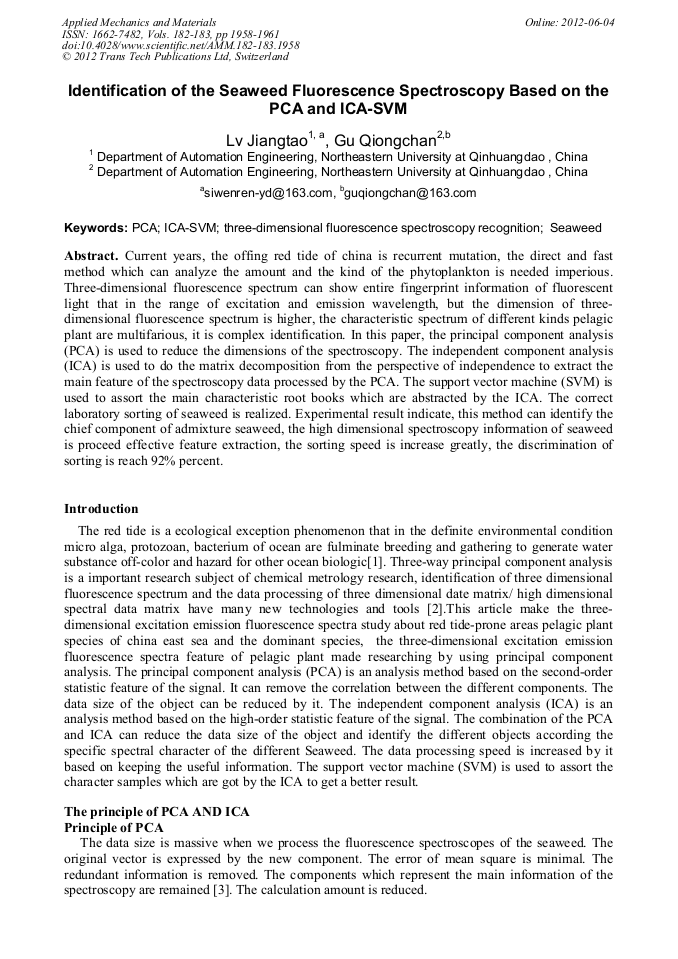
Current years, the offing red tide of china is recurrent mutation, the direct and fast method which can analyze the amount and the kind of the phytoplankton is needed imperious. Three-dimensional fluorescence spectrum can show entire fingerprint information of fluorescent light that in the range of excitation and emission wavelength, but the dimension of three-dimensional fluorescence spectrum is higher, the characteristic spectrum of different kinds pelagic plant are multifarious, it is complex identification. In this paper, the principal component analysis (PCA) is used to reduce the dimensions of the spectroscopy. The independent component analysis (ICA) is used to do the matrix decomposition from the perspective of independence to extract the main feature of the spectroscopy data processed by the PCA. The support vector machine (SVM) is used to assort the main characteristic root books which are abstracted by the ICA. The correct laboratory sorting of seaweed is realized. Experimental result indicate, this method can identify the chief component of admixture seaweed, the high dimensional spectroscopy information of seaweed is proceed effective feature extraction, the sorting speed is increase greatly, the discrimination of sorting is reach 92% percent.
Info:
Periodical:
Pages:
1958-1961
Citation:
Online since:
June 2012
Authors:
Price:
Сopyright:
© 2012 Trans Tech Publications Ltd. All Rights Reserved
Share:
Citation: