Estimating the Rebound and Reduce Effect of Low Carbon Policy in Shanghai Industrial Sectors

Article Preview

Abstract:

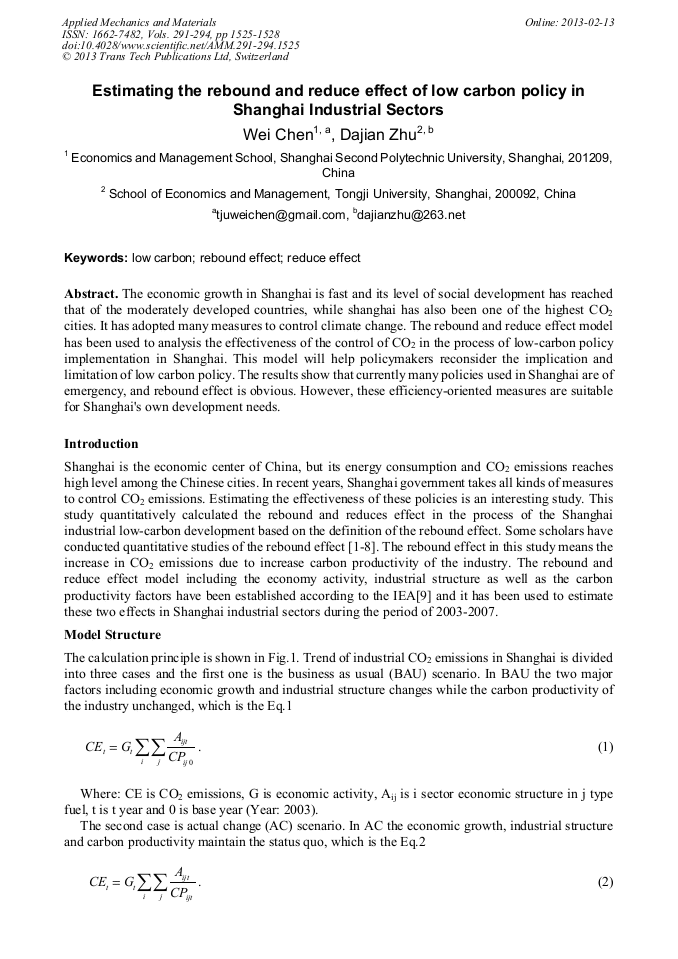
The economic growth in Shanghai is fast and its level of social development has reached that of the moderately developed countries, while shanghai has also been one of the highest CO2 cities. It has adopted many measures to control climate change. The rebound and reduce effect model has been used to analysis the effectiveness of the control of CO2 in the process of low-carbon policy implementation in Shanghai. This model will help policymakers reconsider the implication and limitation of low carbon policy. The results show that currently many policies used in Shanghai are of emergency, and rebound effect is obvious. However, these efficiency-oriented measures are suitable for Shanghai's own development needs.
You might also be interested in these eBooks

Info:

Periodical:

Pages:

1525-1528

Citation:

Online since:

February 2013

Authors:

Export:

Price:

Permissions CCC:

Permissions PLS:

Сopyright:

© 2013 Trans Tech Publications Ltd. All Rights Reserved

Share:

Citation:

[1] B. Alcott, Jevonsparadox, Ecological Economics, 2005, 54 (1): 9-21.

Google Scholar

[2] P.H.G. Berkhout, J.C. Muskens, J.W. Velthuijsen, Defining the Rebound Effect, Energy Policy, 2000, 28(6-7): 425-432.

DOI: 10.1016/s0301-4215(00)00022-7

Google Scholar

[3] Z.L. Bai, D.J. Zhu, B. Cai, The Complete Decomposition Analysis on Energy Rebound Effect in Shanghai From 1978 to 2009, East China Economic Management, 2011, 9(25): 1-7 (In Chinese).

Google Scholar

[4] B. Runar, G. Tarek, N. Jonas, Increased Energy Efficiency and Rebound Effect: Effects on Consumption and Emissions, Energy Policy, 2007, 1(29): 1-17.

Google Scholar

[5] J. Guo, Y. Ling, C.H. Guo, Estimating the Rebound Effect of Energy Consumption of Industrial Sectors in China Based on the Perspective of Technological Advancement, Resources Science, 2010, 32(10): 1839-1845 (In Chinese).

Google Scholar

[6] J. Bentzen, Estimating the reboundeffect in US manufacturing energy consumption, Energy Economics, 2004, 26 (1): 123-134.

DOI: 10.1016/s0140-9883(03)00047-1

Google Scholar

[7] T. Karen, Negative rebound and disinvestment effects in response to an improvement in energy efficiency in the UK economy, Energy Economics, 2009, 31 (5): 648-666.

DOI: 10.1016/j.eneco.2009.01.008

Google Scholar

[8] Y. Zhou., Y.Y. Lin, The estimation of technological progress on the energy consumption returns effects, Economist, 2007(2): 45-52(In Chinese).

Google Scholar

[9] P.G. Taylor, O.L. d'Ortigue, M. Francoeur, et al, Final Energy Use in IEA Countries: The Role of Energy Efficiency, Energy Policy, 2010, 11(38): 6463-6474.

DOI: 10.1016/j.enpol.2009.05.009

Google Scholar