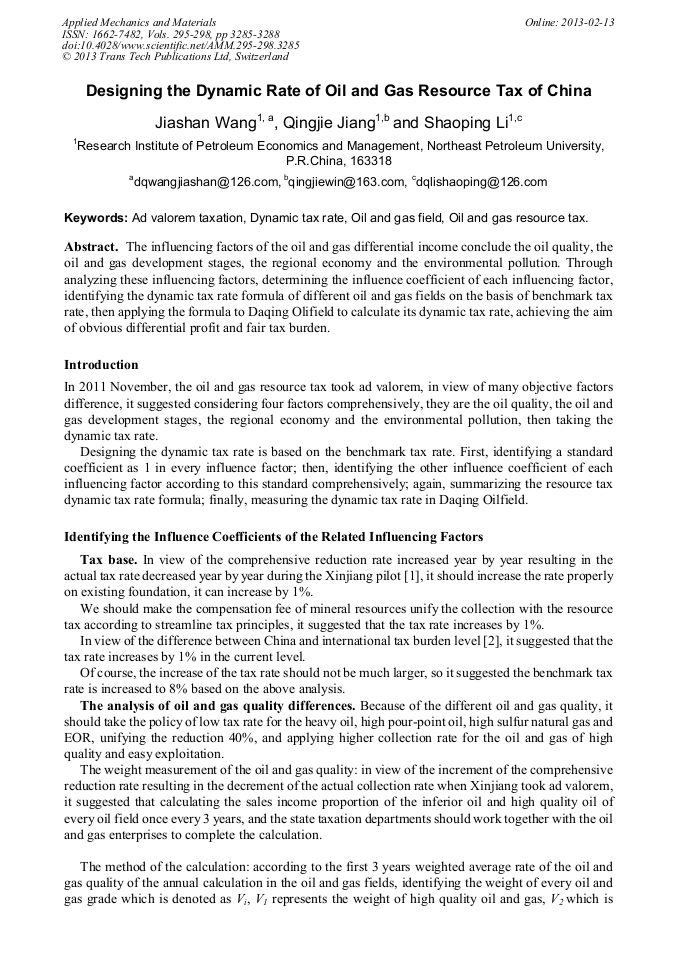
Designing the Dynamic Rate of Oil and Gas Resource Tax of China

Article Preview

Abstract:

The influencing factors of the oil and gas differential income conclude the oil quality, the oil and gas development stages, the regional economy and the environmental pollution. Through analyzing these influencing factors, determining the influence coefficient of each influencing factor, identifying the dynamic tax rate formula of different oil and gas fields on the basis of benchmark tax rate, then applying the formula to Daqing Olifield to calculate its dynamic tax rate, achieving the aim of obvious differential profit and fair tax burden.
You might also be interested in these eBooks

Info:

Periodical:

Pages:

3285-3288

Citation:

Online since:

February 2013

Export:

Price:

Permissions CCC:

Permissions PLS:

Сopyright:

© 2013 Trans Tech Publications Ltd. All Rights Reserved

Share:

Citation:

[1] F.J. Xian: Taxation Research (2010) No. 12, p.26. (In Chinese).

Google Scholar

[2] W.J. Wu and J. Hu: Journal of Xi'an Shiyou University (2007) No. 1, p.5. (In Chinese).

Google Scholar

[3] N. Cui and Y.L. Lei: Petroleum Science (2011) No. 4, p.515. (In Chinese).

Google Scholar

[4] M.W. Fan, Z.X. Li and Y.G. Liu: Economic Management (2011) No. 4, p.49. (In Chinese).

Google Scholar

[5] Mariano J and La Rovere E. Oil and gas exploration and production activities in Brazil: The consideration of environmental issues in the bidding rounds promoted by the National Petroleum Agency[J]. Energy Policy, 2007, 35(5): 2899-2911.

DOI: 10.1016/j.enpol.2006.10.005

Google Scholar

[6] Wayne Leightya, C. -Y. Cynthia Linb. Tax policy can change the production path: A model of optimal oil extraction in Alaska[J]. Energy Policy, 2012(41): 759–774.

DOI: 10.1016/j.enpol.2011.11.043

Google Scholar

[7] Z.L. Wang: Study on some issues of environmental tax in China for sustainable development (MS., Xiamen University, China 2007). (In Chinese).

Google Scholar