An Efficient Parallel Montgemery Cryptography for Multi-Core Processor

Article Preview

Abstract:

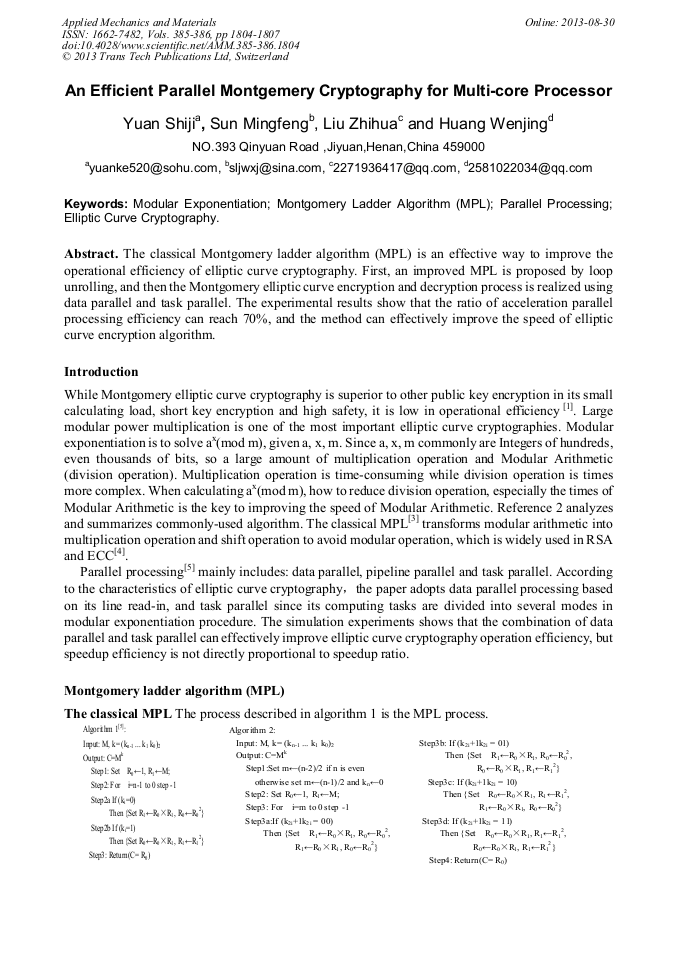
The classical Montgomery ladder algorithm (MPL) is an effective way to improve the operational efficiency of elliptic curve cryptography. First, an improved MPL is proposed by loop unrolling, and then the Montgomery elliptic curve encryption and decryption process is realized using data parallel and task parallel. The experimental results show that the ratio of acceleration parallel processing efficiency can reach 70%, and the method can effectively improve the speed of elliptic curve encryption algorithm.

You might also be interested in these eBooks

Info:

Periodical:

Pages:

1804-1807

Citation:

Online since:

August 2013

Export:

Price:

Permissions CCC:

Permissions PLS:

Сopyright:

© 2013 Trans Tech Publications Ltd. All Rights Reserved

Share:

Citation:

[1] Diffie W, Hellman M. New directions in cryptography . IEEE tans. Inform. Theory, 1976 (22): 644-654.

DOI: 10.1109/tit.1976.1055638

Google Scholar

[2] Zhu Zhaoguo, Ren Zhongbao, Gui Zuoqin. Fast algorithm of large integer modular exponentiation. High Performance Computing Technology. 2006(2) : 45-48.

Google Scholar

[3] Montgomery P L. Modular multiplication without trial division . Mathmatics of Computation, 1985, 44(170): 519-521.

DOI: 10.1090/s0025-5718-1985-0777282-x

Google Scholar

[4] Zuo Ping, Pang Shichun, Hua Hongtu. Secure and parallel Montgomery ladder algorithm of ECC. Journal of Jilin University(Science Edition) , 2011, 49(4): 690-692.

Google Scholar

[5] Li Xiaomei, Dou Yong. Parallel computation models and algorithm design. Journal of numerical methods and computer applications. 1995, 16(3): 18-22.

Google Scholar

[6] Gordon D M. A survey of fast exponentiation methods. Algorithms, 1998, 27(1): 129–146.

Google Scholar

[7] Li Wenlong, Liu Li , Tang Zhizhong. Loop unrolling optimization for software pipelining. Journal of Beijing University of Aeronautics and Astronautics. 2004, 30(11): 1111-1115.

Google Scholar

[8] Information on http: /so. 5ipatent. com/PatentDetails. aspx?patentID=4ba69c8d-aaee-44a5-9478 h-7c0411970b64&patentClass=1.

Google Scholar