Impact of Thickness on Rubber Aging Life

Article Preview

Abstract:

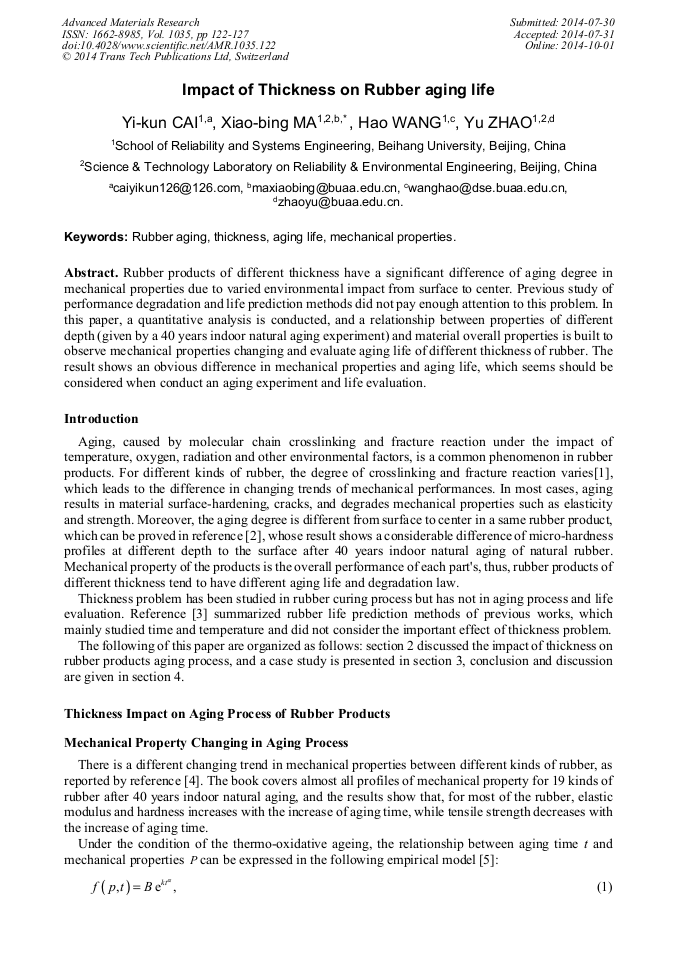
Rubber products of different thickness have a significant difference of aging degree in mechanical properties due to varied environmental impact from surface to center. Previous study of performance degradation and life prediction methods did not pay enough attention to this problem. In this paper, a quantitative analysis is conducted, and a relationship between properties of different depth (given by a 40 years indoor natural aging experiment) and material overall properties is built to observe mechanical properties changing and evaluate aging life of different thickness of rubber. The result shows an obvious difference in mechanical properties and aging life, which seems should be considered when conduct an aging experiment and life evaluation.
You might also be interested in these eBooks

Info:

Periodical:

Pages:

122-127

Citation:

Online since:

October 2014

Export:

Price:

Permissions CCC:

Permissions PLS:

Сopyright:

© 2014 Trans Tech Publications Ltd. All Rights Reserved

Share:

Citation:

* - Corresponding Author

[1] Li A. Aging phenomenon and the aging mechanism of rubber, Special Purpose Rubber Products, 2009, 05 56-67.

Google Scholar

[2] Brown R P, Soulagnet G. Microhardness profiles on aged rubber compounds, Polymer testing, 2001, 20(3) 295-303.

DOI: 10.1016/s0142-9418(00)00035-0

Google Scholar

[3] Qu M Z. Rubber life prediction methods, Technology Innovation and Application, 2012, 21 4-5.

Google Scholar

[4] Brown R P, Butler T. Natural Ageing of Rubber Changes in Physical Properties Over 40 Years, iSmithers Rapra Publishing, (2000).

Google Scholar

[5] Li Y J. Research on the laws of the physical and mechanical properties changes in vulcanized rubber hot oxygen aging process, Special Purpose Rubber Products, 1997, 0144-53.

Google Scholar

[6] Ren Q B, Cai T M, Wang R Q, Hu D Y. Research on structure parameters and failure criterion of rubber O, ring, Journal of Solid Rocket Technology, 2006, 01 9-14.

Google Scholar

[7] Hu W J, Liu Z F, Chen Y M. Rubber accelerated thermo-oxidative aging test and life prediction method, China Rubber Industry, 2004, 10 620-624.

Google Scholar

[8] Bao Y W, Wang W, Zhou Y C. Investigation of the relationship between elastic modulus and hardness based on depth-sensing indentation measurements, Acta Materialia, 2004, 52(18) 5397-5404.

DOI: 10.1016/j.actamat.2004.08.002

Google Scholar

[9] Pharr G M. Measurement of mechanical properties by ultra-low load indentation, Materials Science and Engineering A, 1998, 253(1) 151-159.

DOI: 10.1016/s0921-5093(98)00724-2

Google Scholar