p.873
p.879
p.883
p.887
p.891
p.895
p.899
p.904
p.911
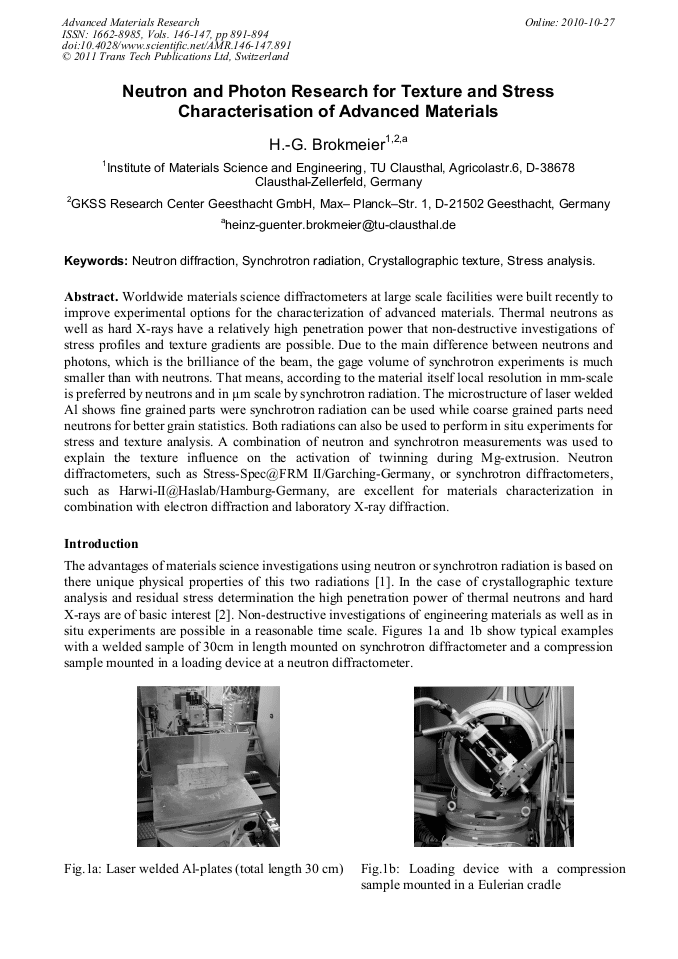
Neutron and Photon Research for Texture and Stress Characterisation of Advanced Materials

Abstract:
Worldwide materials science diffractometers at large scale facilities were built recently to improve experimental options for the characterization of advanced materials. Thermal neutrons as well as hard X-rays have a relatively high penetration power that non-destructive investigations of stress profiles and texture gradients are possible. Due to the main difference between neutrons and photons, which is the brilliance of the beam, the gage volume of synchrotron experiments is much smaller than with neutrons. That means, according to the material itself local resolution in mm-scale is preferred by neutrons and in μm scale by synchrotron radiation. The microstructure of laser welded Al shows fine grained parts were synchrotron radiation can be used while coarse grained parts need neutrons for better grain statistics. Both radiations can also be used to perform in situ experiments for stress and texture analysis. A combination of neutron and synchrotron measurements was used to explain the texture influence on the activation of twinning during Mg-extrusion. Neutron diffractometers, such as Stress-Spec@FRM II/Garching-Germany, or synchrotron diffractometers, such as Harwi-II@Haslab/Hamburg-Germany, are excellent for materials characterization in combination with electron diffraction and laboratory X-ray diffraction.
Info:
Periodical:
Pages:
891-894
Citation:
Online since:
October 2010
Authors:
Price:
Сopyright:
© 2011 Trans Tech Publications Ltd. All Rights Reserved
Share:
Citation: