Thermal Degradation of Pa 6 Film Prepared from a Phenol/Dichloroethane Mixed Solution

Article Preview

Abstract:

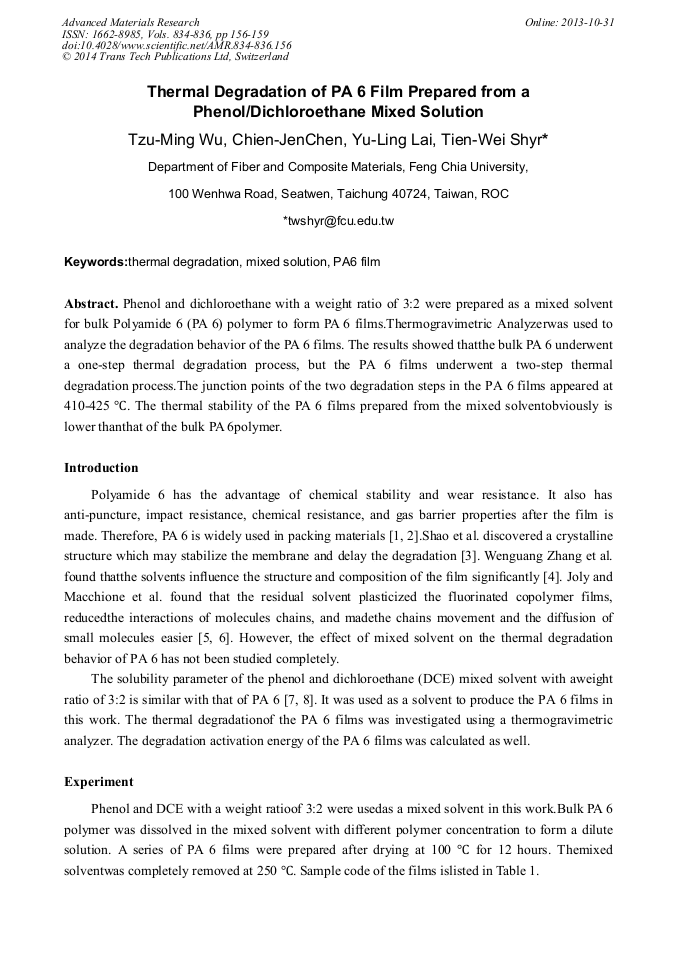
Phenol and dichloroethane with a weight ratio of 3:2 were prepared as a mixed solvent for bulk Polyamide 6 (PA 6) polymer to form PA 6 films. Thermogravimetric Analyzer was used to analyze the degradation behavior of the PA 6 films. The results showed that the bulk PA 6 underwent a one-step thermal degradation process, but the PA 6 films underwent a two-step thermal degradation process. The junction points of the two degradation steps in the PA 6 films appeared at 410-425 °C. The thermal stability of the PA 6 films prepared from the mixed solvent obviously is lower than that of the bulk PA 6 polymer.
You might also be interested in these eBooks

Info:

Periodical:

Advanced Materials Research (Volumes 834-836)

Pages:

156-159

Citation:

Online since:

October 2013

Export:

Price:

Permissions CCC:

Permissions PLS:

Сopyright:

© 2014 Trans Tech Publications Ltd. All Rights Reserved

Share:

Citation:

[1] Y. Ma, T. Zhou and C. Zhao: Carbohydrate Research Vol. 343 (2008), pp.230-237.

Google Scholar

[2] J. Narang, N. Chauhan, A. Singh and C. S. Pundir: Journal of Molecular Catalysis B: Enzymatic Vol. 72 (2011), pp.276-281.

Google Scholar

[3] L. Shao, T. S. Chung, G. Wensley, S. H. Goh, K. P. Pramoda, Casting solvent effects on morphologies, gas transport properties of a novel 6FDA/PMDA–TMMDA copolyimide membrane and its derived carbon membranes, Journal of Membrane Science, 2004, pp.85-86.

DOI: 10.1016/j.memsci.2004.07.005

Google Scholar

[4] W. Zhang, W. Liu, C. Wang, Effects of solvents on the tribological behaviour of sol–gel Al2O3 films, Ceramics International, Vol. 29(2003), pp.427-434.

DOI: 10.1016/s0272-8842(02)00155-4

Google Scholar

[5] C. Joly, D. Le Cerf, C. Chappey, D. Langevin, G. Muller, Residual solvent effect on the permeation properties of fluorinated polyimide films, Separation and Purification Technology, 1994, pp.50-51.

DOI: 10.1016/s1383-5866(98)00118-x

Google Scholar

[6] M. Macchione, J. C. Jansen, G. D. Luca, E. Tocci, M. Longeri, E. Drioli, Experimental analysis and simulation of the gas transport in dense Hyflon® AD60X membranes: Influence of residual solvent, Polymer(2007), P. 2633.

DOI: 10.1016/j.polymer.2007.02.068

Google Scholar

[7] A. Guner, The algorithmic calculations of solubility parameter for the determination of interactions in dextran/certain polar solvent systems, European Polymer Journal(2004), P. 1590.

DOI: 10.1016/j.eurpolymj.2003.10.030

Google Scholar

[8] C. Bordes, V. Fréville, E. Ruffin, P. Marote, J. Y. Gauvrit, S. Briancon and P. Lantéri: International Journal of Pharmaceutics Vol. 383 (2010), pp.236-243.

DOI: 10.1016/j.ijpharm.2009.09.023

Google Scholar

[9] T. Hatakeyama, F. X. Quinn, Thermal Analysis Fundamentals and Application to Polymer Science, 1990, p.77~80.

Google Scholar