p.745
p.751
p.757
p.763
p.769
p.775
p.780
p.786
p.792
Transshipment Modeling and Simulation of Container Port Terminals

Abstract:
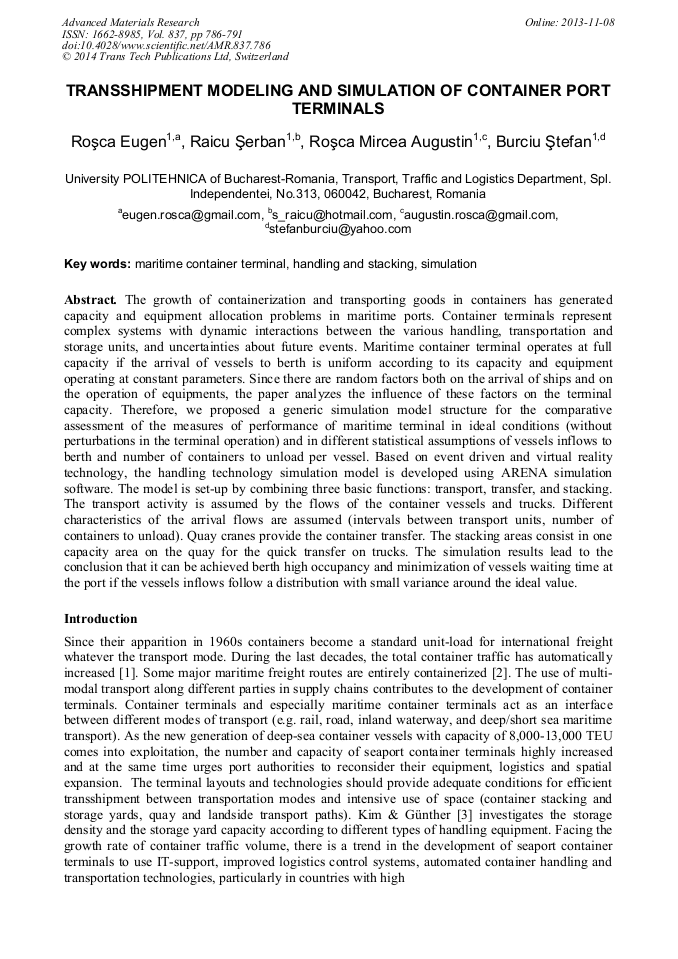
The growth of containerization and transporting goods in containers has generated capacity and equipment allocation problems in maritime ports. Container terminals represent complex systems with dynamic interactions between the various handling, transportation and storage units, and uncertainties about future events. Maritime container terminal operates at full capacity if the arrival of vessels to berth is uniform according to its capacity and equipment operating at constant parameters. Since there are random factors both on the arrival of ships and on the operation of equipments, the paper analyzes the influence of these factors on the terminal capacity. Therefore, we proposed a generic simulation model structure for the comparative assessment of the measures of performance of maritime terminal in ideal conditions (without perturbations in the terminal operation) and in different statistical assumptions of vessels inflows to berth and number of containers to unload per vessel. Based on event driven and virtual reality technology, the handling technology simulation model is developed using ARENA simulation software. The model is set-up by combining three basic functions: transport, transfer, and stacking. The transport activity is assumed by the flows of the container vessels and trucks. Different characteristics of the arrival flows are assumed (intervals between transport units, number of containers to unload). Quay cranes provide the container transfer. The stacking areas consist in one capacity area on the quay for the quick transfer on trucks. The simulation results lead to the conclusion that it can be achieved berth high occupancy and minimization of vessels waiting time at the port if the vessels inflows follow a distribution with small variance around the ideal value.
Info:
Periodical:
Pages:
786-791
DOI:
Citation:
Online since:
November 2013
Authors:
Keywords:
Price:
Сopyright:
© 2014 Trans Tech Publications Ltd. All Rights Reserved
Share:
Citation: