Investigation of PDC Cutter Interface Geometry Using 3D FEM Modelling

Article Preview

Abstract:

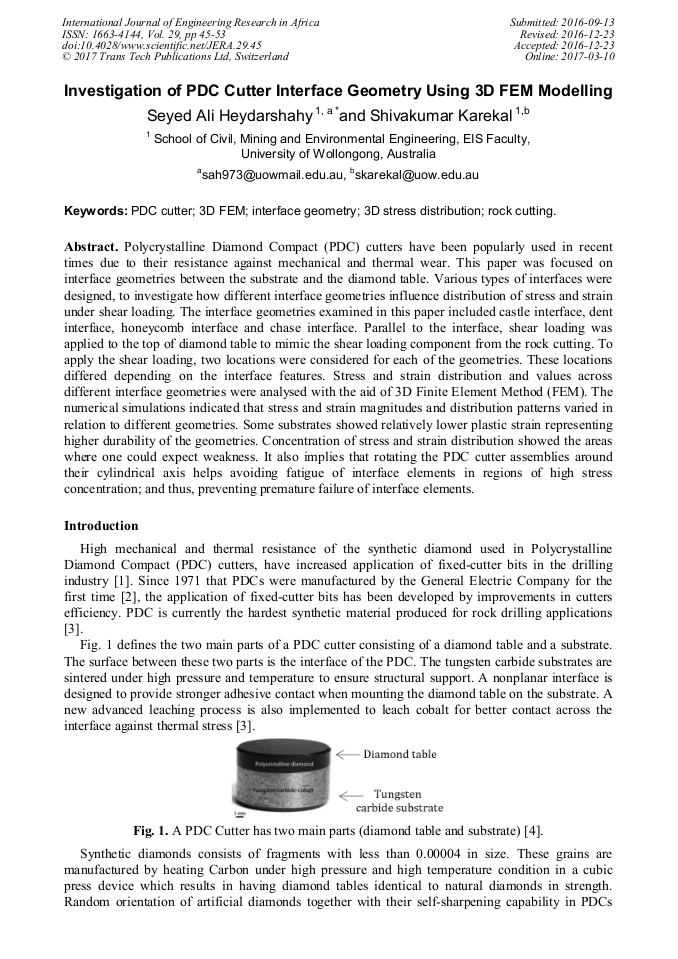
Polycrystalline Diamond Compact (PDC) cutters have been popularly used in recent times due to their resistance against mechanical and thermal wear. This paper was focused on interface geometries between the substrate and the diamond table. Various types of interfaces were designed, to investigate how different interface geometries influence distribution of stress and strain under shear loading. The interface geometries examined in this paper included castle interface, dent interface, honeycomb interface and chase interface. Parallel to the interface, shear loading was applied to the top of diamond table to mimic the shear loading component from the rock cutting. To apply the shear loading, two locations were considered for each of the geometries. These locations differed depending on the interface features. Stress and strain distribution and values across different interface geometries were analysed with the aid of 3D Finite Element Method (FEM). The numerical simulations indicated that stress and strain magnitudes and distribution patterns varied in relation to different geometries. Some substrates showed relatively lower plastic strain representing higher durability of the geometries. Concentration of stress and strain distribution showed the areas where one could expect weakness. It also implies that rotating the PDC cutter assemblies around their cylindrical axis helps avoiding fatigue of interface elements in regions of high stress concentration; and thus, preventing premature failure of interface elements.
You might also be interested in these eBooks

Info:

Pages:

45-53

Citation:

Online since:

March 2017

Export:

Price:

Permissions CCC:

Permissions PLS:

Сopyright:

© 2017 Trans Tech Publications Ltd. All Rights Reserved

Share:

Citation:

* - Corresponding Author

[1] Gerbaud, L., et al., All comes from the cutter rock interaction. SPE paper, 2006(98988).

Google Scholar

[2] Wentorf Jr, R.H. and W.A. Rocco, Diamond tools for machining. 1987, Google Patents.

Google Scholar

[3] Lake, L.W. and J.R. Fanchi, Petroleum engineering handbook. 2006: Richardson, TX : Society of Petroleum Engineers.

Google Scholar

[4] Yahiaoui, M., et al., A study on PDC drill bits quality. Wear, 2013. 298–299: pp.32-41.

DOI: 10.1016/j.wear.2012.12.026

Google Scholar

[5] Lin, T.P., et al., Residual stresses in polycrystalline diamond compacts. Journal of the American Ceramic Society, 1994. 77(6): pp.1562-1568.

DOI: 10.1111/j.1151-2916.1994.tb09757.x

Google Scholar

[6] Feng, C., X. Gen, and G. -p. Xu, Thermal residual stress of polycrystalline diamond compacts. Transactions of Nonferrous Metals Society of China, 2010. 20(2): pp.227-232.

DOI: 10.1016/s1003-6326(09)60126-6

Google Scholar

[7] Zhang, D.R., et al. The Structure Design of Special-Shaped PDC Reinforced-Cutter and its Finite Element Method Analysis. in Applied Mechanics and Materials. 2012. Trans Tech Publ.

DOI: 10.4028/www.scientific.net/amm.215-216.877

Google Scholar

[8] Abaqus Users' Manual, Version 6. 12-1. Dassault Systémes Simulia Corp., Providence, RI, (2012).

Google Scholar

[9] Guo, J., et al., Molecular dynamics study on diamond nanowires mechanical properties: Strain rate, temperature and size dependent effects. Diamond and Related Materials, 2011. 20(4): pp.551-555.

DOI: 10.1016/j.diamond.2011.02.016

Google Scholar

[10] Wise, J.L., et al., Effects of design and processing parameters on performance of PDC drag cutters for hard-rock drilling. Transactions-Geothermal Resources Council, 2002: pp.201-206.

Google Scholar

[11] Rassenfoss, S. Seeking Ways to Make Better Diamonds by Tending to the Tiniest Details. 2016 2016 15/05/2016]; Available from: http: /www. spe. org/jpt/article/6437-seeking-ways-to-make-better-diamonds-by-tending-to-the-tiniest-details.

DOI: 10.2118/0614-0038-jpt

Google Scholar

[12] Smith, R.H., Polycrystalline diamond cutting element, 10/02/1993, Editor. (1993).

Google Scholar