p.427
p.431
p.435
p.439
p.443
p.447
p.451
p.455
p.459
Fracture Behavior in a Rock Pillar Subjected to Coupled Thermo-Mechanical Loading

Abstract:
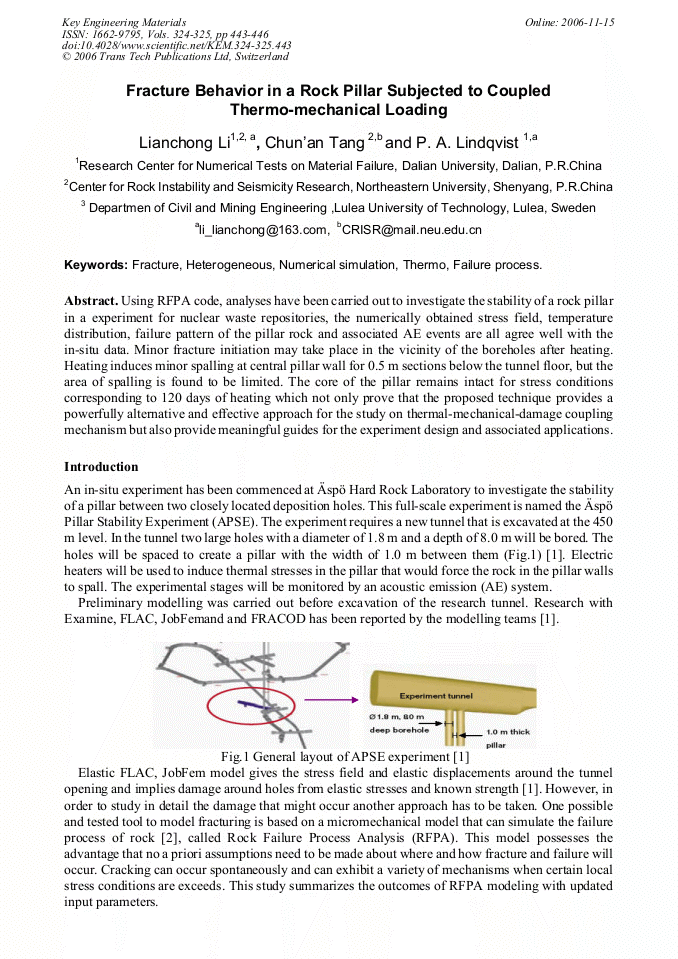
Using RFPA code, analyses have been carried out to investigate the stability of a rock pillar in a experiment for nuclear waste repositories, the numerically obtained stress field, temperature distribution, failure pattern of the pillar rock and associated AE events are all agree well with the in-situ data. Minor fracture initiation may take place in the vicinity of the boreholes after heating. Heating induces minor spalling at central pillar wall for 0.5 m sections below the tunnel floor, but the area of spalling is found to be limited. The core of the pillar remains intact for stress conditions corresponding to 120 days of heating which not only prove that the proposed technique provides a powerfully alternative and effective approach for the study on thermal-mechanical-damage coupling mechanism but also provide meaningful guides for the experiment design and associated applications.
Info:
Periodical:
Pages:
443-446
Citation:
Online since:
November 2006
Authors:
Keywords:
Price:
Сopyright:
© 2006 Trans Tech Publications Ltd. All Rights Reserved
Share:
Citation: